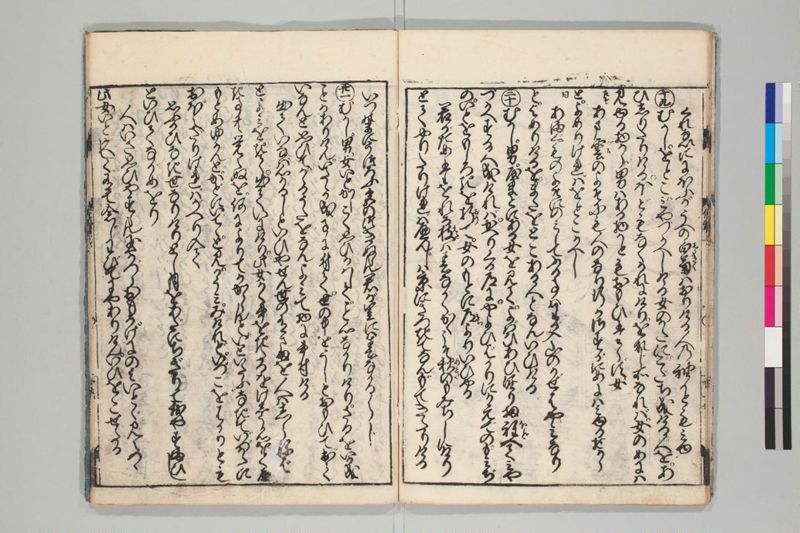
翻刻
【右丁】
くれないににほふがうへの白菊(しらきく)はおりける人の袖かともみゆ
「十九」むかし。をとこ。みやづかへしける女のかたに。ごだち成ける人を。あ
ひしりたりける。ほどもなくかれにけり。をなじ所なれば。女のめには
見ゆる物から。男はある物かともおもひたらず。女
《送り仮名:古今》あま雲(ぐも)のよそにも人のなり行かさすがにめにはみゆる物から
と。よめりければをとこかへし
《送り仮名:同》あまぐものよそにのみしてふる事はわが入山のかぜはやみなり
と。よめりけるを。またをとこある人となんいひける
「二十」むかし。男。やまとにあり女を見て。よばひあひにけり扨 程(ほど)へてみや
づかへする人成ければ。かへりくる道に。やよひばかりにかえでの。もみぢ
の。いとをもしろきを折(おり)て。女のもとに道(みち)よりいひやる
君がためたをれる枝(えた)は春なからかくこそ秋(あき)のもみちしにけり
とてやりたりければへんじは京にきつきてなん。もてきたりける
【左丁】
いつのまにうつろふ色のつきぬらん君が里にははるなかるらじ#1
「廿一」むかし。男。女いとかしこく思ひかはして。こと心なかりけり。さるをいか成
ことかありけん。いさゝか成事に付て。世の中をうしとおもひて。出て
いなんと思ひて。かゝるうたをなんよみて物に書付ける
出ていなば心かるしといひやせん世の有さまを人はしらねば
とよみをきて。出ていにけり。此女かく書をきたるをけしう心をくべ
き事共覚えぬを。何によりてかゝらんと。いといたふなきて。いづかたに
もとめゆかんと。かどにいでゝ。と見。かうみ。みけれど。いづこをはかりとも
おぼえざりければ。かへり入て
思ふかひなき世なりけりとし月をあだにちぎりて我やすまひし
といひてながめをり
人はいさ思ひやすらん玉かづらおもかげにのみいとゞ見えつゝ
此女。いと久しく有て念じわびてにやありけん。いひをこせたる
現代語訳
【右丁】
(第十八段、続き)
*紅に匂ふが上の白菊は折りける人の袖かとも見ゆ*
(紅に美しく輝く上に白菊が重なっているのは、それを折った人の(紅に染まった)袖かとも見える)
【第十九段】
昔、男が、宮仕えをしていた女の方に、親しく行き来していた人(友人)がいた。(その関係も)ほどなく途絶えてしまった。同じ場所(宮中)であるため、女の目には(その男の姿が)見えるのだけれど、男は(女のことを)いる者とも思っていないようだった。(そこで)女が(詠んだ)、
*天雲の よそにも人の なりゆくか さすがに目には 見ゆるものから*
(空の雲のように、あの人はすっかりよそよそしくなってしまったことよ――それでも(同じ宮中にいるため)さすがに目には見えるのだけれど)
と詠んだところ、男が返した(歌)、
*天雲の よそにのみして ふる事は わが入山の 風はやみなり*
(雲がよそよそしくただ遠くを漂うばかりで(あなたの元へ)降り来ないのは、私が(都を離れ)入ろうとしている山の風が激しいからだ)
と詠んだ。(この男は)また、別の女の人(妻)があると言われていた。
【第二十段】
昔、男が、大和(の国)にいる女を見初めて、求婚し合った(男女の仲になった)。さて、(男は)しばらく経って宮仕えをする身であったので、(宮仕え先から)帰ってくる道すがら、三月ごろに、(道端に)楓(かえで)の紅葉が(散らずに残っており)、たいそう趣き深いのを折って、道から女のもとに(歌を)送った。
*君がため たをれる枝は 春ながら かくこそ秋の もみぢしにけり*
(あなたのために折ったこの枝は、春であるのに、このように秋の紅葉(のように色づいて美しく)なっていることよ)
と送ったところ、返事は(男が)京に到着してから(女の使いが)持って来た。
【左丁】
*いつの間に うつろふ色の 尽きぬらん 君が里には 春なかるらじ* #1
(いつの間に(春の緑が)色あせて(秋色に)尽き果てたのでしょうか――あなたの(いらっしゃる)里には、春というものがないのでしょう)
【第二十一段】
昔、男と女がたいそう深く思い合っていて、(互いに)浮気心はなかった。それなのに、どういうわけがあったのだろうか、ちょっとしたことをきっかけに、(男は)世の中をつらく(嫌に)思って、(どこかへ)出て行こうと思って、このような歌を詠んで、(何かに)書き付けておいた。
*出ていなば 心かるしと いひやせん 世のありさまを 人は知らねば*
((私が)出て行ってしまったなら、(あの人は私のことを)心が軽い(薄情だ)と言うだろうか――世間の実情というものを(あの人は)知らないから)
と詠み置いて、出て行ってしまった。この女は、このように書き置かれたことが、さほど(男を)責め立てるべきことには思われなかったのに、何によってこのようにするのだろうと、たいそうひどく泣いて、どちらへ(男を)探しに行こうかと、門に出て、あちらを見、こちらを見したけれど、どちらの方角とも見当がつかなかったので、戻って入って(家に帰り)、
*思ふかひなき 世なりけり 年月を あだに契りて 我やすまひし*
(思っても甲斐のない世の中であったことよ――長い年月を、むなしく(空虚に)誓い合って、私はどうして暮らしてきたのだろう)
と言いながら(外を)眺めていた(すると、もう一首)、
*人はいさ 思ひやすらん 玉かづら おもかげにのみ いとど見えつつ*
(あの人はさあどのように(私のことを)思っているのだろうか――(あの人の面影は)玉かずらのように、面影の中にばかりいっそう(はっきりと)見えてきて(離れないことよ))
この女は、たいそう長い間(待ち続けて)、(もはや)思い堪えかねてのことであったのだろうか、(男へ)言い送った(歌がある)。
英語訳
【Right Page】
(Section 18, concluded)
*Kurenai ni / niou ga ue no / shiragiku wa / orikeru hito no / sode ka to mo miyu*
(Upon what glows crimson and bright, the white chrysanthemum is laid — it seems as though it might be the sleeve of the one who broke it off.)
【Section 19】
Long ago, a man had been on close terms with someone who frequented the quarters of a woman serving at court. Before long, however, that familiarity had faded away. Since it was the same place (the court), the woman could see the man with her own eyes, yet the man seemed to regard her as if she were not even there. The woman composed:
*Ama gumo no / yoso ni mo hito no / nari yuku ka / sasuga ni me ni wa / miyuru mono kara*
(Like clouds drifting in the sky, has that person grown so utterly distant? — And yet, he is still visible to my eyes, close as ever in that regard.)
Receiving this, the man replied:
*Ama gumo no / yoso ni nomi shite / furu koto wa / waga iriyama no / kaze hayami nari*
(That the clouds drift away and do not descend to you — it is because the winds blow fierce around the mountain I am about to enter.)
It was said that this man had another woman — a wife — elsewhere.
【Section 20】
Long ago, a man caught sight of a woman living in Yamato Province and they began a courtship, becoming lovers. After some time had passed, being a man of court service, he was on his way back (from the capital) when, around the third month, he noticed maple leaves of remarkable beauty still clinging to their branches along the road. He broke off a branch and, from the roadside, sent it to the woman with this poem:
*Kimi ga tame / taoreru eda wa / haru nagara / kaku koso aki no / momiji shi ni keri*
(This branch, broken off for your sake — though it is still spring, it has taken on the colours of autumn foliage, as brilliant as this.)
Having sent this, the woman's reply arrived only after the man had reached the capital, brought by her messenger.
【Left Page】
*Itsu no ma ni / utsurou iro no / tsuki nu ran / kimi ga sato ni wa / haru nakaruraji* #1
(In what moment did the shifting colours come to their end? — Surely in the place where you dwell, there is no such thing as spring.)
【Section 21】
Long ago, a man and a woman loved each other most deeply, and neither harboured any wandering heart. Yet for some reason — what it may have been, one cannot say — over some small matter the man came to find the world unbearable, and thinking to leave and go away, he composed this poem and wrote it down upon something:
*Idete inaba / kokoro karushi to / ihi ya sen / yo no arisama wo / hito wa shiraneба*
(If I go away, will she say my heart is light and fickle? — She does not know the true state of this world.)
Having set down these words, he went away. The woman, reading what he had left behind, found it not so much a thing to hold against him — and yet she could not understand why he should act so, and wept bitterly. Wishing to go and search for him in some direction, she went out to the gate and looked this way and that, but had no sense of which way he might have gone. Turning back inside, she composed:
*Omou kai naki / yo nari keri / toshi tsuki wo / ada ni chigiri te / ware ya sumaishi*
(What a world it is, in which longing avails nothing — through all these years and months, have I lived pledging vows that counted for naught?)
And so she sat gazing out, lost in thought. Then (yet another poem):
*Hito wa isa / omoi ya suran / tama kazura / omokage ni nomi / itodo mie tsutsu*
(I wonder how he thinks of me — if he thinks of me at all. His face, like trailing vine-strands, grows only clearer in my mind's eye, fading not at all.)
This woman, after a very long time had passed, perhaps no longer able to bear the longing, sent word to him (with this poem):