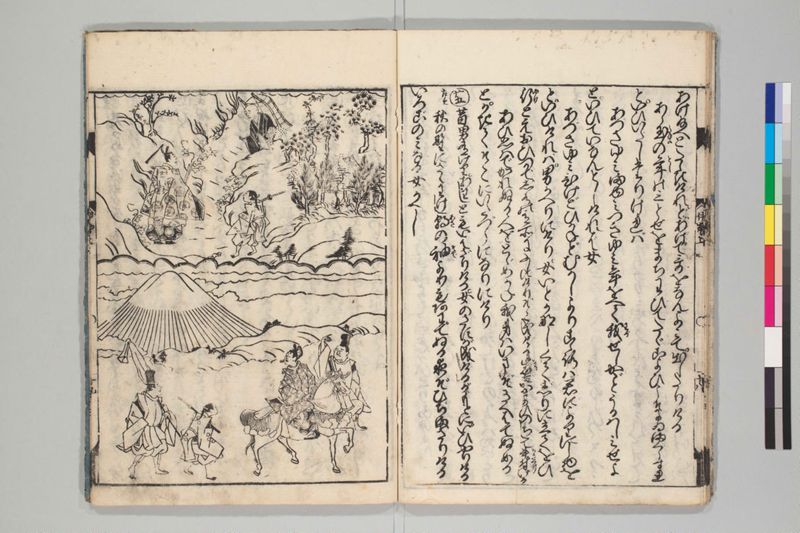
翻刻
【右丁】
あけ給へとたゝきけれどあけで哥をなんよみて。出したりける
あら玉(たま)の年(とし)のみとせをまちわびてたゞこよひこそにゐまくらすれ
と。いひいだしたりければ
あづさゆみまゆみつきゆみ年をへて我(わが)せしかごとうるはしみせよ
と。いひていなんとしければ女
あづさゆみひけどひかねどむかしよりこゝろは君によりにし物を
と。いひければ。男かへりにけり。女いとかなしくて。しりに立てをひ
行(ゆけ)とえおひつかで。し水の有所にふしにけり。そこ成ける岩(いわ)におよびのちして書付(かきつけ)ける
あひ思はでかれぬる人をとゞめかね我身はいまぞきへはてぬめる
と。かきてそこにいたづらになりにけり
「廿五」昔男有けり。あわじともいはざりける。女のさすが成けるがもとに。いひやりける
《送り仮名:古今》秋の野にさゝわけし朝(あさ)の袖(そで)よりもあわでぬる夜ぞひぢまさりける
いろごのみなる女かへし
【左丁】
【挿絵】
現代語訳
【右丁】
(第二十四段、続き)
(女は、男が)「(戸を)開けてください」と叩いたけれど、開けないで、歌を詠んで外へ出した。
*あらたまの 年の三年を 待ちわびて ただ今宵こそ 寝まくらすれ*
(長い年月——三年というものを待ちわびて、ちょうど今夜こそ(ようやく別の人と)枕を共にしようとしているのです)
と言い出したところ、(男は、)
*あづさゆみ まゆみ槻弓 年を経て わがせしごとく うるはしみせよ*
(梓弓・真弓・槻弓——(弓の名を連ねるように)長い年月をかけて私がしてきたように、(あなたも新しい男を)いとおしみ大切にしなさい)
と言って去ろうとしたので、女は、
*あづさゆみ ひけどひかねど 昔より こころは君に よりにし物を*
(梓弓を引こうと引くまいと(関係なく)、昔から私の心はあなたにこそ寄り添っていたのに)
と言ったので、男は(それでも)帰ってしまった。女はたいそう悲しくて、(男の)後ろに立って追いかけようとしたが、追いつくことができず、清水のある場所に倒れ伏してしまった。そこにあった岩に、爪で(文字を)書きつけた。
*あひ思はで かれぬる人を とどめかね わが身はいまぞ きえはてぬめる*
((私のことを)思ってくれないまま去ってしまった人を引き止めることもできず、私のこの身は今まさに消えてしまいそうだ)
と書いて、そこで(女は)はかなく(この世から)消えてしまった。
---
【第二十五段】
昔、男がいた。「淡路(には行かない)とも言わなかった」ような、(なびくに)しても惜しい女のもとへ、(男が歌を)送った。
*秋の野に さわけし朝の 袖よりも あわでぬる夜ぞ ひぢまさりける*
(秋の野を分け入った朝の袖(の露)よりも、(あなたに)逢わないで(ひとり寝した)夜(の涙)の方が、ずっとひどく(袖が)濡れることだ)
恋愛に積極的な(色好みの)女の返歌(は左丁の挿絵に続く)。
【左丁】
【挿絵】
英語訳
【Right Page】
(Section 24, continued)
The man knocked, asking her to open the door, but she would not open it, and instead sent out a poem:
*Aratama no / toshi no mitose wo / machiwabite / tada koyoi koso / nemakura sure*
(Three long years — a span of precious time — I have waited, weary with longing; and it is precisely tonight that I am at last laying down my pillow (beside another).)
To this, the man replied:
*Azusa-yumi / mayumi tsuki-yumi / toshi wo hete / waga seshi ga goto / uruwashimi seyo*
(Like the azusa bow, the mayu bow, the tsuki bow — so too have the years passed by; love and cherish (this new man) just as tenderly as I once cherished you.)
And as he made to leave, the woman called out:
*Azusa-yumi / hikedo hikanedo / mukashi yori / kokoro wa kimi ni / yori ni shi mono wo*
(Whether the azusa bow is drawn or not — from long ago, my heart has always leaned toward you, and you alone.)
So she said, but the man went home all the same. The woman was overcome with grief; she rose and ran after him, but could not catch up, and collapsed at a place where clear water flowed. On a rock that lay there, she scratched out with her fingernail:
*Ai omowade / karenuru hito wo / todome kane / waga mi wa ima zo / kie hatenu meru*
(Unable to hold back the one who left without caring for me in return — my very self seems now on the verge of vanishing altogether.)
Having written this, she faded away to nothing at that very spot.
---
【Section 25】
Long ago, there was a man. He sent a poem to a woman who, though one might hesitate to call her easy — for she was not one to be trifled with — had not refused him outright either:
*Aki no no ni / sasawakeshi asa no / sode yori mo / awade nuru yo zo / hiji masari keru*
(More than the sleeves wet with dew when I parted the grasses in the autumn fields at dawn — the sleeves I have soaked (with tears) on the nights I spend without seeing you are far more drenched.)
The reply of the woman, who was accomplished in the ways of love (continues on the left page with the illustration).
【Left Page】
【Illustration】