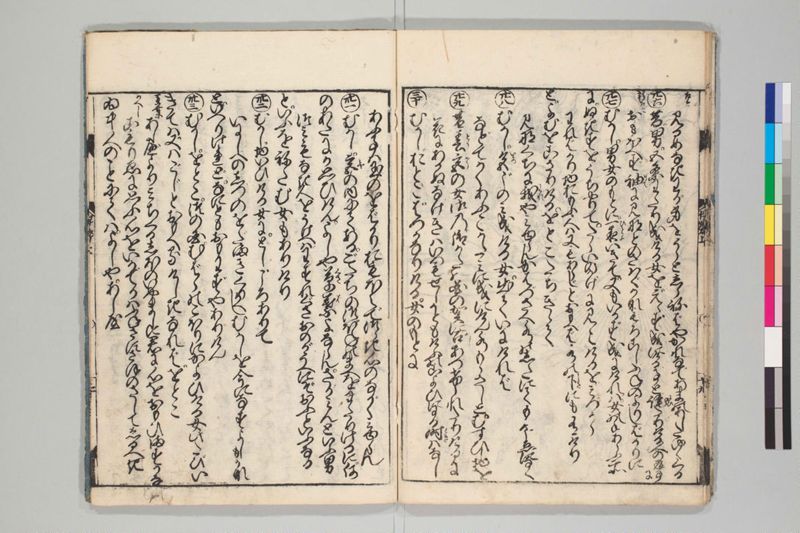
翻刻
【右丁】
《送り仮名:古今》 見るめなきわが身をうらとしらねばやかれなであまのあしたゆくくる
「廿六」昔。男。五条わたり成ける女を。えゝず成にける事と詫(わひ)たりける人の返事に
《送り仮名:新古今》おもほへず袖(そて)にみなとのさはぐかなもろこしふねのよりしばかりに
「廿七」むかし。男女のもとに。一夜(ひとよ)いきて。又もいかず成にければ。女の手あらふ所
に。ぬきすをうちやりて。たらいのかげに見えけるをみづから
わればかり物おもふ人は又もあらじとおもへば水の下(した)にも有けり
と。よむをこさりける。をとこたちきゝて
みなくちに我(われ)やみゆらんかはづさへ水の下(した)にても□【ろ】ごゑになく
「廿八」むかし。色(いろ)ごのみ成ける女。出ていにければ
などてかくあふごかたみに成にけん水もらさしと。むすひし物を
「廿九」昔 春宮(とうくう)の女御の御かたの花の賀に召(めし)あづけられたりけるに
花にあかぬなけきはいつもせしかどもけふのこよひににる時(とき)はなし
「三十」むかし。おとこ。はつかなりける。女のもとに
【左丁】
あふ事は玉のをばかりおもほえでつらき心のながくみゆらん
「卅一」むかし。宮(みや)の内にてある。ごたちのつぼねのまへをわたりけるに。何
のあたにか思ひけん。よしや草葉(くさば)よならん。さがみんといふ男
つみもなき人をうけへばわすれぐさおのがうへにぞおふといふなる
と。いふをねたむ女もありけり
「卅二」むかし。物いひける女に。としごろありて
いにしへのしつのをだまきくりかへしむかしを今になすよしもかな
と。いへりけれど。なにともおもわずやありけん
「卅三」むかし。をとこ。つの国。むばらのこほりにかよひける女此たびい
きては。又はごじ#1とおもへるけしきなれば。をとこ
《送り仮名:万葉》 あしべよりみちくるしほのいやましに君に心をおもひますかな
《送り仮名:かへし》こもりゑに思ふ心をいかでかはふねさすさほのさしてしるべき
ゐ中人のことにては。よしや。あしや
現代語訳
【右丁】
(第二十五段、続き)
*見るめなき わが身をうらと しらねばや かれなで あまの あしたゆくくる*
(海松布(みるめ)もない——つまり、逢う目もない、そんなつまらない私の身を「浦」とは知らないからでしょうか、(あなたは)離れもせずに、海人(あま)が朝な夕な行き来するように、(私のもとへ)通ってくるのですね)
---
【第二十六段】
昔、男が五条あたりに住んでいた女と疎遠になってしまったことを嘆いていた人への返事に(女が詠んだ歌)。
*おもほえず 袖にみなとの さわぐかな もろこし船の よりしばかりに*
(思いがけなく、袖の中に港が騒ぎ立っているようです——まるで唐(もろこし)の船がほんのひとときだけ寄港しただけで(大きな波風が立ったように、あなたが少し訪れただけで私の心がこれほど乱れています))
---
【第二十七段】
昔、男が女のもとへ一夜だけ行って、その後もう行かなくなってしまったので、女が手を洗う場所に(男が)抜き簾(ぬきすず)を投げ込んでおいたところ、たらいの影に(その簾が)映っているのを(女が)自分で(見て詠んだ)。
*わればかり 物おもふ人は 又もあらじ と思へば 水の下にも有けり*
(私ほど物思いに沈んでいる人は、他にはいないだろうと思っていたら、水の中(の影)にもいたのでした)
と詠んだのを(男が)来ずにいたが、男たちが(それを)聞いて(答えた)。
*みなくちに われやみゆらん かはづさへ 水の下にても □(ろ)ごゑになく*
(水の湧き出る泉(みなくち)に私の姿が映って見えるだろうか。蛙(かはづ)でさえ水の底でも(しっかりと)声をあげて鳴くのに)
---
【第二十八段】
昔、恋多き(色好みの)女が(男のもとから)出て去ってしまったので(男が詠んだ)。
*などてかく あふごかたみに 成にけん 水もらさじと むすびし物を*
(どうしてこのように、逢うことが難しくなってしまったのだろう。水も漏らすまいと(固く)結んだはずなのに)
---
【第二十九段】
昔、春宮(東宮)の女御のお部屋の花の賀に召し出されていた時に(詠んだ)。
*花にあかぬ なげきはいつも せしかども けふのこよひに にる時はなし*
(花(の美しさ)に飽きることができないという嘆きはいつもしていたけれど、今日のこの夜(の宴の美しさ)に似る時はかつてなかった)
---
【第三十段】
昔、男が、ほんのわずかな(はつかな)つながりしかなかった女のもとへ(歌を送った)。
【左丁】
*あふことは 玉のをばかり おもほえで つらき心の ながくみゆらん*
(逢うことは、珠の緒ほど(ほんの短く)しか感じられないのに、(あなたの)薄情な心(=別れの時間)の方は、なぜこんなにも長く続くように思われるのだろう)
---
【第三十一段】
昔、宮中で、ある御方の局(つぼね)の前を通りかかった時に、何かの恨みがあったのだろうか、「よしや、(相手を)草葉(くさば)に見立てて呪ってやろう、試してみよう」と言う男(が詠んだ)。
*つみもなき 人をうけへば わすれぐさ おのがうへにぞ おふといふなる*
(罪もない人を呪えば、その忘れ草(=怨みを忘れさせる草)は自分の身の上に生えるというぞ)
と言ったのを、妬む女もいた(のであった)。
---
【第三十二段】
昔、言い交わしていた女に、(別れて)年月が経った後で(男が送った)。
*いにしへの しつのをだまき くりかへし むかしを今に なすよしもかな*
(昔の賤(しつ)の苧環(をだまき)を繰り返すように、過ぎ去った昔を今に取り戻す方法があればよいものを)
と言ったけれど、(女は)何とも思わなかったようであった。
---
【第三十三段】
昔、男が摂津の国・牟婁(むばら)郡に通っていた女が、「今度(男が)行ったら、もう会うまい」と思っているようすだったので、男(が詠んだ)。
*あしべより みちくるしほの いやましに 君に心を おもひますかな*
(葦辺から満ちてくる潮がいよいよ増すように、あなたへの心(の思い)がますます増していくことです)
(女の)返し。
*こもりゑに 思ふ心を いかでかは ふねさすさほの さしてしるべき*
((水草の茂る)こもり江(入り江)に(舟をさすように)秘めたる心の思いを、どうして舟をさす竿が差して(=知って)知らせることができましょうか)
(これは)田舎の人のことなので、まあよいか悪いかは(なんとも言えない)。
英語訳
【Right Page】
(Section 25, conclusion)
*Miru me naki / waga mi wo ura to / shiraneba ya / karenaide / ama no / ashita yuku kuru*
(Perhaps because you do not know that this body of mine — where there is no "sea-grass to see," no hope of meeting — is such a desolate "shore," you neither leave nor stay away, but come and go like a fisherman passing morning after morning.)
---
【Section 26】
Long ago, in reply to a man who lamented that his relationship with a woman who lived around Gojō had grown distant:
*Omohoezu / sode ni minato no / sawagu kana / morokoshi-bune no / yorishi bakari ni*
(Unexpectedly, the harbor within my sleeve is all astir — as though a ship from China had called in for just a brief moment, yet left such turbulence behind. Even your brief visit has stirred my heart into such commotion.)
---
【Section 27】
Long ago, a man went to a woman for a single night and then stopped coming altogether. He had tossed a reed blind (*nukisu*) into the place where the woman washed her hands, and when she saw its reflection in the basin, she composed to herself:
*Ware bakari / mono omou hito wa / mata mo araji / to omoeba / mizu no shita ni mo ari keri*
(I thought there could be no one else in the world as sunk in sorrow as I — but then, here was another, in the depths of the water below.)
The man had not come, but some men who heard the poem replied:
*Minakuchi ni / ware ya miyuran / kawazu sae / mizu no shita nite / □(ro)-goe ni naku*
(Might I be seen there, reflected in the spring where the waters well up? Even the frogs cry out from beneath the water in full voice — and yet I cannot reach you.)
---
【Section 28】
Long ago, a woman of passionate nature departed and was gone, and so the man composed:
*Nado te kaku / afu go katami ni / nari ni ken / mizu morasaji to / musubishi mono wo*
(How has it come to this, that meeting has grown so difficult for both of us? I thought we had tied our bond so tightly that not even water could seep through.)
---
【Section 29】
Long ago, when the man had been summoned to the flower banquet at the chambers of the Crown Prince's consort:
*Hana ni akanu / nageki wa itsu mo / seshi kado mo / kyō no koyoi ni / niru toki wa nashi*
(I have always lamented that I could never tire of the beauty of flowers — but never before has there been a night quite like this evening.)
---
【Section 30】
Long ago, a man sent a poem to a woman with whom his connection had been ever so slight:
【Left Page】
*Au koto wa / tama no o bakari / omohoe de / tsuraki kokoro no / nagaku miyuran*
(The time we spend together feels no longer than the thread upon which jewels are strung — and yet why does your cold and indifferent heart, the time of parting, seem to stretch on so endlessly?)
---
【Section 31】
Long ago, in the imperial palace, as a man passed before the chamber of one of the ladies-in-waiting, he must have harbored some grievance against her, for he said, "Very well — I shall curse her, taking her for a blade of grass, and see what comes of it," and composed:
*Tsumi mo naki / hito wo ukere ba / wasuregusa / onoga ue ni zo / ou to iu naru*
(They say that if you curse an innocent person, the "forgetting grass" — the very plant that makes one forget one's resentments — will spring up upon yourself instead.)
There was a woman who felt pangs of jealousy at hearing this.
---
【Section 32】
Long ago, after many years had passed since he had been on speaking terms with a woman, the man sent her this:
*Inishie no / shitsu no odamaki / kurikaeshi / mukashi wo ima ni / nasu yoshi mo kana*
(Like the humble spindle of thread wound round and round from long ago — if only there were some way to wind back those past days and make yesterday into today once more.)
But it seems she thought nothing of it.
---
【Section 33】
Long ago, a man used to visit a woman in Mubara district of Tsu Province (Settsu). This time, however, her manner suggested that she was thinking: "If he comes again, I will not see him." So the man composed:
*Ashibe yori / michikuru shio no / iya mashi ni / kimi ni kokoro wo / omohi masu kana*
(Just as the tide comes flooding in from the reed-beds, rising ever higher — so too do my feelings for you swell and grow ever stronger.)
Her reply:
*Komori e ni / omou kokoro wo / ikade ka wa / fune sasu sao no / sashite shirubeki*
(The heart that longs in secret, like a boat hidden in a sheltered inlet — how could the pole that steers the boat ever point its way to it and make it known?)
As this concerns a provincial person, well — whether it is good or not is neither here nor there.