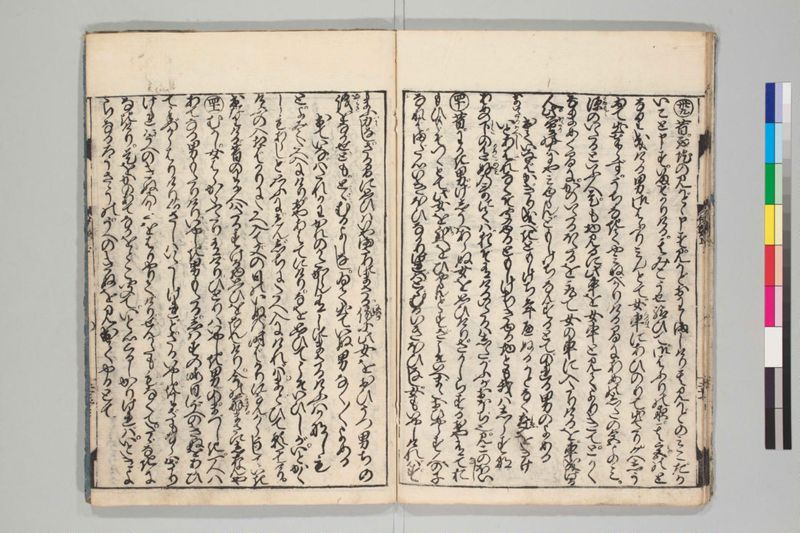
翻刻
【右丁】
「卅九」昔。西院のみかどゝ申す。みかどおわしましけり其みかどのみこ。たか
いこと申す。いまぞかり#3ける。其みこうせ給ひて。御はふりの夜。其 宮(みや)のと
なり成ける男。御はふりみんとて。女 車(くるま)にあひのりて出たり。久しう
ゐて出奉らず。うちなきてやみぬべかりける間にあめのしたの色このみ。
源(みなもと)のいたるといふ人。是も物みるに。此車を女車と見てよりきて。とかく
なまめく間に。かのいたるほたるを取て女の車に入たりけるを。車成ける
人。此 蛍(ほたる)の火にやみゆらん。ともしけちなんするとて。のれる男のよめる
出ていなばかぎり成べきともしけち年へぬるかとなく声(こゑ)をきけ
《送り仮名:かのいたるかへし》いとあはれなくぞ聞ゆるともしけちきゆる物とも我はしらずな
あめの下(した)の色好(いろこのみ)の哥にては。猶ぞ有けるいたるはしたがふがおほぢ也。みこのほいなし
「四十」昔。わかき男。げしう#4はあらぬ女を思ひけり。さかしらするおや有てお
もひもぞつくとて。此女を外(ほか)へをひやらんとす。さこそいへまたおひやらす人の子
なれば。まだ心いきほひなかりければとゞむるいきほひなし。女もいやしければ。す
【左丁】
まふ力(☐か☐)なし。さる間に思ひはいやまさりにまさる。俄(にはか)に此女をおひうつ男ちの
涙(なみた)をながせども。とゞむるよしなし。ゐて出ていぬ男なく〳〵よめる
出ていなばたれかわかれのかたからん有しにまさるけふはかなしも
とよみてたへ入にけり。おやあはてにけり。なを思ひてこそいひしが。いとかく
しもあらしど#1おもふに。しんじちにたへ入にければ。まどひて願たてけり。
けふの入相ばかりにたへ入て。又の日のいぬの時ばかりになん。からうじていき
出たりける。昔のわか人はさるすける物思ひをなんしけり。今の翁(おきな)まさにしなんや
「四十一」むかし。女はらからふたり有けり。ひとりはいやしき男の。まづしき。一人は
あてなる男もたりけり。いやしき男もたる。しはすの晦日に。うへのきぬをあらひ
て手づからはりけり。心さしはいたしけれど。さるいやしきわざもならはざり
けれは。うへのきぬのかたをはりやりてけり。せんかたもも#2なくて。たゞなきに
なきけり。是をかのあてなるをとこ聞て。いと心くるしかりければ。いときよ
らなるろうさうの。うへのきぬを見出てやるとて
現代語訳
【右丁】
---
【第三十九段】
昔、西院の帝(みかど)と申し上げる帝がいらっしゃった。その帝の御子(みこ)を、「たかいこ」と申し上げた。(その御子が)今まさに薨じられた。その御子がお亡くなりになって、ご葬送(おはふり)の夜、その宮のお隣に住んでいた男が、葬送の儀を見ようとして、女の車に相乗りして出かけた。(車は)長いことそこに止まったまま(主を)お見送り申し上げず、(中で)泣き続けてそのままになってしまいそうな間に、世に聞こえた色好みの、源の至(みなもとのいたる)という人が、これも(葬送を)見物しに来て、この車を女車と見て近づいてきて、あれこれと色めいたふるまいをしている間に、あの源の至が蛍を捕まえて女の車の中に入れた。車に乗っていた人は「この蛍の光に(暗がりが照らされて)あちらから見えてしまうかもしれない。火(蛍の光)を消してしまおう」と言ったので、相乗りしていた男が詠んだ。
*出ていなば かぎりなるべき ともしけち 年へぬるかと なく声をきけ*
((あなたが)出ていってしまえばそれで終わりになってしまうだろう(消えてしまうような)灯火を消してしまわないで——長い年月を経てきたか(老いたか)のように鳴く声を聞いてください)
あの源の至の返し。
*いとあはれ なくぞ聞ゆる ともしけち きゆるものとも 我はしらずな*
(たいそうしみじみと(哀れに)泣いているように聞こえます。蛍の火を消してしまったとしても、(私はあなたへの思いを)消えるものとは(決して)思いませんから)
世に聞こえた色好みの歌としては、やはりそれなりのものですね。源の至は(かの色好みで有名な)業平(なりひら)の従兄弟(おほぢ)にあたる。(女の車に乗った男は)御子(みこ)の本意(ほい)を(果たせず終わった)。
---
【第四十段】
昔、若い男が、身分はそれほど低くない女を思っていた。口やかましい(さかしらする)親がいて、(男が女に)思いを寄せてしまっては困ると思い、この女を他の所へ追いやろうとした。そうは言っても、まだ(他家へ)追いやっていない。(女は)他人の子であるから(強引には追い出せず)、また(男は)まだ気力・勢いがなかったので、(女を)引き留めるだけの力もない。女も(身分が)低いので、
【左丁】
(自分の意志で)踏みとどまる力もない。そうしている間に(男の女への)思いはますます募るばかりとなった。突然この女を追い移す(立ち退かせる)ことになり、男たちは涙を流したけれど、(それを)引き留めるすべもない。(女を)連れ出して去ってしまった。男は泣く泣く詠んだ。
*出ていなば たれかわかれの かたからん 有しにまさる けふはかなしも*
((あなたが)出て行ってしまえば、誰が(この)別れを辛いと思わないでいられようか——(あなたと)一緒にいた時よりも、今日はいっそう悲しい)
と詠んで、気を失ってしまった(たへ入にけり)。親はあわてふためいた。(親は)やはり(男のことを)思ってのことと(こそ)言いはしたが、まさかここまでのことになるとは思わなかったのに、本当に気を失ってしまったので、(親は)狼狽して願掛けをした。今日の入相(いりあい)の頃(夕方の鐘の時分)に気を失って、翌日の戌の刻(午後八時頃)に、ようやく息を吹き返した。昔の若い人は、そのようなひどく切ない物思いをしたものだ。今の老人(翁)が(そんな思いをして)本当に死ぬことがあるだろうか(いや、ありはしない)。
---
【第四十一段】
昔、女の姉妹(はらから)が二人いた。一人は身分の低い、貧しい男と(夫婦に)なり、一人は高貴な男(を夫)として持っていた。身分の低い男と一緒になった(姉妹の一人が)、十二月の晦日(みそか)に、(夫の)上着(うへのきぬ)を洗って自分の手でのりを張った。心尽くしではあったが、そのような(女のする)卑しい仕事には慣れていなかったので、上着の片方(の袖か肩か)をのりで張ってしまった(片方しか張れなかった)。どうしようもなくて、ただひたすら泣くばかりであった。これを(もう一方の姉妹の夫)かの高貴な男が聞いて、たいそう気の毒に思ったので、たいそう美しい(絹の)「ろうさう(嚢装か)」の上着を(取り)出して贈ろうとして、(歌を詠んだ)——
英語訳
【Right Page】
---
【Section 39】
Long ago, there was an Emperor known as the Emperor of the West Palace (Saiin no Mikado). This Emperor had a child called "Takaiko." That child had just recently passed away. On the night of the burial rites, a man who lived next door to that prince's residence rode together in a woman's carriage, intending to witness the funeral procession. The carriage remained stopped for a long time without proceeding to see the deceased off, and while it seemed as though the passengers would simply go on weeping there, a man renowned throughout the land for his amorous ways — a man named Minamoto no Itaru — came to watch the procession as well. Seeing this carriage and taking it for a ladies' carriage, he drew close and began to behave in a flirtatious, seductive manner. While doing so, that Itaru caught a firefly and tossed it into the woman's carriage. The person in the carriage said, "The light of this firefly might give us away — let us put out the light." At this, the man who had ridden along composed:
*Idete inaba / kagiri naru beki / tomoshikeshi / toshi henuru ka to / naku koe wo kike*
(Do not snuff out this light, which, if extinguished, will be gone forever — and do listen to the sound of weeping, as if one who has lived through long and weary years.)
The reply from that Minamoto no Itaru:
*Ito aware / naku zo kikoyuru / tomoshikeshi / kiyuru mono to mo / ware wa shirazu na*
(I hear the sound of your weeping, and it is deeply moving and touching. Even though you speak of snuffing out the firefly's light, know that I do not regard my feelings for you as something that can simply be extinguished.)
As poems by a man celebrated throughout the land for his amorous ways, these are, after all, rather fitting compositions. Minamoto no Itaru was a cousin (*ōji*) of Narihira, the great lover. And so the man in the carriage was left unable to fulfill the true purpose he had come for — to pay his respects to the prince.
---
【Section 40】
Long ago, a young man was in love with a woman who was not of particularly low birth. There was a meddlesome parent who, fearing that the young man might become too attached to this woman, attempted to send her away to some other place. Even so, the woman had not yet been sent away. Since she was another person's child, she could not simply be driven out by force; and furthermore, the young man did not yet have the means or influence to resist, so he could not stop what was happening. The woman, too, was of low standing,
【Left Page】
and had no power to remain of her own accord. In the meantime, the man's feelings for her grew ever stronger and more overwhelming. Suddenly, the men came to move this woman away by force; the man shed tears, but there was no way to stop them. She was taken away and gone. The man, weeping as he went, composed:
*Idete inaba / tare ka wakare no / katakaran / arishi ni masaru / kyō wa kanashi mo*
(If you go away, who could find this parting anything but unbearable? Today is sadder even than the days when we were together.)
Having composed this poem, he collapsed unconscious. The parent was thrown into a panic. The parent had indeed said it was all out of care for the young man — but had never imagined things would come to this. When the young man truly lost consciousness, the parent was thrown into such confusion that they made vows of prayer. He fell unconscious around the time of the evening bell (*iriai*), and only on the following day, around the Hour of the Dog (approximately 8 o'clock in the evening), did he barely manage to revive. In times of old, the young people suffered such intense and devastating heartache. Could an old man of today truly die of such feelings? Surely not.
---
【Section 41】
Long ago, there were two sisters. One had taken up with a man who was of low station and poor; the other had a man of noble birth as her husband. The one who was with the lowly man, on the last day of the twelfth month, washed her husband's outer robe (*uwagi*) and starched and mounted it herself by hand. Her devotion was deep, but she was not accustomed to such lowly domestic work, and she ended up starching only one side of the robe. With nothing she could do to remedy this, she simply wept and wept. When the noble man who was husband to the other sister heard of this, he felt great compassion for her, and took out a most beautiful (*kiyora*) outer robe made of fine lustrous silk (*rōsō*) to send to her, composing a poem with it to say —