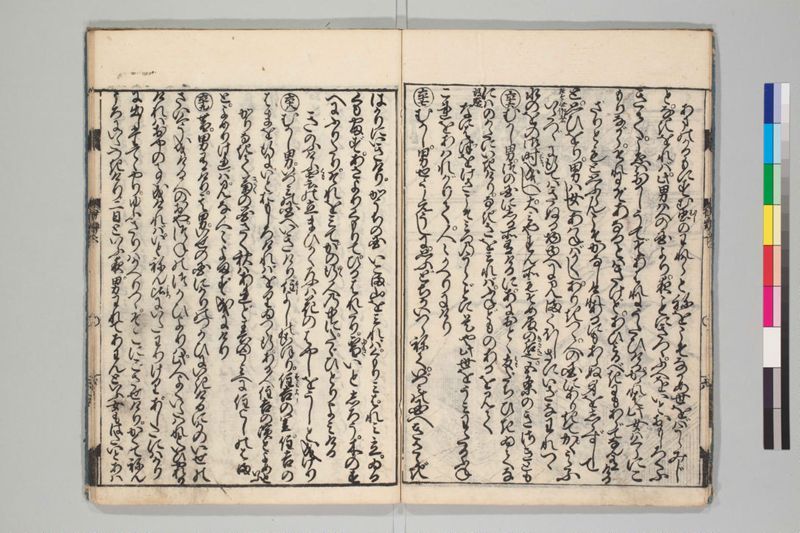
翻刻
【右丁】
あまのかるもにすむ虫(むし)のわれからとねをこそなかめ世をばうらみじ
と。なきをれば。此男は人の国より。夜ことにきつゝ。ふへをいとおもしろくふ
きて。こゑはおかしうてぞあはれにうたひける。かゝれば此女はくらにこ
もりながら。それにぞあなるとはきけど。あひみるべきにもあらでなん有ける
さりともと思ふらんこそかなしけれあるにもあらぬ身をしらずして
と。思ひをり。男は女しあはねばかくし。ありきつゝ。人の国にありきて。かくうたふ
《送り仮名:古今無作者》いたづ□#1に行てはきぬる物ゆへに見まくほしさにいざなわれつゝ
水のをの御 時(とき)成べし。大みやすん所もそめ殿の后(きさき)也。五条のきさきとも
「六十六」むかし男。つの国にしる所有けるに。あにおとゝ友(とも)だちひきゐてな
にはのかたにいきけり。なぎさをみれば。ふねどものあるをみて
《送り仮名:後撰》なには津(ツ)をけさこそみつのうらごとに是や此世をうみわたるふね
これをあはれがりて。人々かへりにけり
「六十七」むかし。男せうえうしに。思ふどちかいつらねて。いづみの国へきさらぎ
【左丁】
はかりにいきけり。かうちの国いこま山をみれば。くもりみ。はれみ立。ゐる
くもやまず。あさよりくもりて。ひるはれたり。雪(ゆき)いとしろう。木のす
へにふりたり。それをみて。かの行(ゆく)人の中に。たゞひとりよみける
きのふけふ雲(くも)の立まひかくろふは花のはやしをうしと成けり
「六十八」むかし男。いづみの国へいきけり。住(すみ)よしのこほり。住吉(すみよし)の里。住吉の
はまを行に。いとおもしろければをりゐつゝ行。ある人住吉の浜とよめといふ
かりなきて菊(きく)のはなさく秋はあれど春のうみへに住よしのはま
と。よめりければ。みな人々よまず成にけり
「六十九」昔。男有けり。其男。いせの国にかりのつかひにいきけるにかのいせの
さいくう成ける人のおや。つねのつかひよりは。此人よくいたはれといひやれり
ければ。おやの事成ければ。いとねん比(ころ)にいたわりけり。あしたにはかり
に出したてゝやり。ゆふさりはかへりつゝ。そこにご#2させけり。かくてねん
ころにいたつきけり。二日といふ夜。男われてあわんといふ女もはたいとあは
現代語訳
【右丁】
(第六十五段・続き)
海女が刈る藻に棲む虫の「われから」ではないが、自分から(招いたこと)だと、声を上げて泣くばかりで、世を恨むまいと(思っていた)。
(女が蔵に籠って)泣いていると、この男は他国から、夜ごとにやって来ては、たいそう趣深く笛を吹き、声も美しく心に染みるように歌を歌った。こうして、この女は蔵に籠ったままでも、それ(男)がここにいると耳には聞こえるが、会えるはずもなく、そのままにしているしかなかった。
それでも(いつかは会えるだろう)と思っているだろうと思うと悲しいことよ――(私は)生きているのか死んでいるのかわからないような身であることを(あなたは)知らないで
と、(女は)思っていた。男は、女と会えないので、こうして(夜ごとに)忍び歩き、他国をさまよいながら、次のように歌を歌った。
(古今・作者不明)
(あなたに会いたい)ということもなく行って帰ってきてしまうのだが、(あなたを)見たい一心に誘われながら
これは「水の尾(清和天皇)の御代」のことであろう。大御息所(おおみやすどころ)はまた「染殿の后」とも、「五条の后」とも言われる。
---
**第六十六段**
昔、男が摂津の国に知人のいる所があったので、兄弟や友人を連れて難波の方へ行った。渚を見ると、船がたくさんあるのを見て、
(後撰・)
難波津を今朝こそ見つれ、浦ごとにこれやこの世を海渡る船
と詠んだ。これを(人々は)しみじみとしたと思い、みな帰って行った。
---
**第六十七段**
昔、男が気晴らしに(旅に)出ようと、気心の知れた者たちを引き連れて、和泉の国へ二月ごろに行った。河内の国の生駒山を見ると、曇ったり晴れたり、山にたなびく雲が絶えることがない。朝から曇っていたが、昼には晴れた。雪がたいそう白く、木の梢に降り積もっている。それを見て、同行の人々の中でただ一人(男が)詠んだ。
きのう今日、雲が立ちのぼり舞い隠れているのは、(早咲きの)花の林を(もう散って)惜しく(愛惜して)なったからなのだろうか
---
**第六十八段**
昔、男が和泉の国へ行った。住吉の郡、住吉の里、住吉の浜を歩いて行くうちに、たいそう趣深かったので、足を止めては進んだ。ある人が「住吉の浜を詠め」と言う。
雁が鳴いて菊の花が咲く秋もあるけれど、春の海辺に(こそ)住吉の浜は(趣深い)
と詠んだので、他の人々はみな詠まなくなってしまった(=誰もかなわないと感じた)。
---
**第六十九段**
昔、男がいた。その男が伊勢の国へ狩りの使いとして行ったところ、伊勢の斎宮(さいぐう)であった人の親(母)が、「普段の使者よりも、この人をよくもてなしなさい」と(娘に)言い遣わしていたので、(娘は)親の命令ということもあって、たいそう丁寧にもてなした。朝には狩りに送り出し、夕方には帰って来ると、そこで(酒食などを)饗応させた。こうして心を込めてもてなしていた。二日目という夜、男が「ぜひ(あなたと)お会いしたい」と言い、女もまたたいそう(男に)会いたいと思っていた。
【左丁】
(以下、左丁に続く)
英語訳
【Right Folio】
*(Continued from previous page — Section 65)*
Like the creature called *warekarafrom* (*ware kara*: a small crustacean that lives among seaweed gathered by fisher-women), she wept aloud, thinking that this situation was one she had brought upon herself, and resolved not to blame the world for her suffering.
As she wept locked inside the storehouse, the man came every night from the distant province, playing his flute most beautifully, and singing in a charming, deeply moving voice. And so, though this woman, still confined in the storehouse, could hear that it was he outside, she could not possibly meet him face to face, and thus things remained as they were.
*How sad it is to think that he must imagine I still hold hope of seeing him — not knowing that I am a person barely between living and dying*
So she was thinking. Unable to meet the woman, the man went about in secret like this, wandering through other provinces and singing:
*(Anonymous — from the Kokinshū)*
*Going there and returning with nothing accomplished, yet I am drawn along by my longing just to see you*
This must have been during the reign of Emperor Mizunoo (Emperor Seiwa). The *Ōmiyasundokoro* is also referred to as "the Consort of Somedonō" or "the Consort of Gojō."
---
**Section 66**
Long ago, a man had an acquaintance in the province of Tsu (Settsu), and he went to the Naniwa area with his brothers and friends. Looking out at the shore, they saw many boats, and he composed:
*(From the Gosenshū)*
*Naniwa Bay — this morning I have seen it: in every inlet, there they are — the boats that cross this world of ours across the sea*
People found this deeply moving, and all turned back (home).
---
**Section 67**
Long ago, a man set out on a pleasure excursion, taking along close companions, and went to the province of Izumi around the second month. Looking at Mount Ikoma in the province of Kawachi, they could see it alternately clouding over and clearing, with clouds endlessly drifting over the mountain. It had been cloudy since morning, but by noon it had cleared. The snow lay very white upon the treetops. Gazing at this, only one person among the traveling party composed a poem:
*Yesterday and today, the clouds rose and danced and concealed — it must be that they have come to mourn the grove of early blossoms (now gone)*
---
**Section 68**
Long ago, a man traveled to the province of Izumi. Walking along the shore of Sumiyoshi — in the district of Sumiyoshi, the village of Sumiyoshi — he found the scenery so beautiful that he kept stopping and starting as he went. Someone said, "Compose a poem on Sumiyoshi no Hama."
*Though there is an autumn when the geese cry and the chrysanthemums bloom, it is the spring seashore — Sumiyoshi no Hama*
At this, all the others gave up composing — (feeling none could surpass it).
---
**Section 69**
Long ago, there was a man. This man had gone to the province of Ise as an Imperial envoy for the hunt (*kari no tsukai*). The mother of the woman who was then serving as Ise Saigū (the Imperial Priestess at Ise) sent word to her daughter: "Treat this person with more care than the ordinary messengers." Since it was her mother's instruction, the daughter attended to him with great warmth and devotion. In the mornings she would see him off to the hunt; in the evenings when he returned, she would have him entertained there (with food and drink). In this way she served him most attentively. On the night of the second day, the man said he wished to meet with her (in private), and the woman, for her part, greatly desired to meet him too—
【Left Folio】
*(Continued on the left folio)*