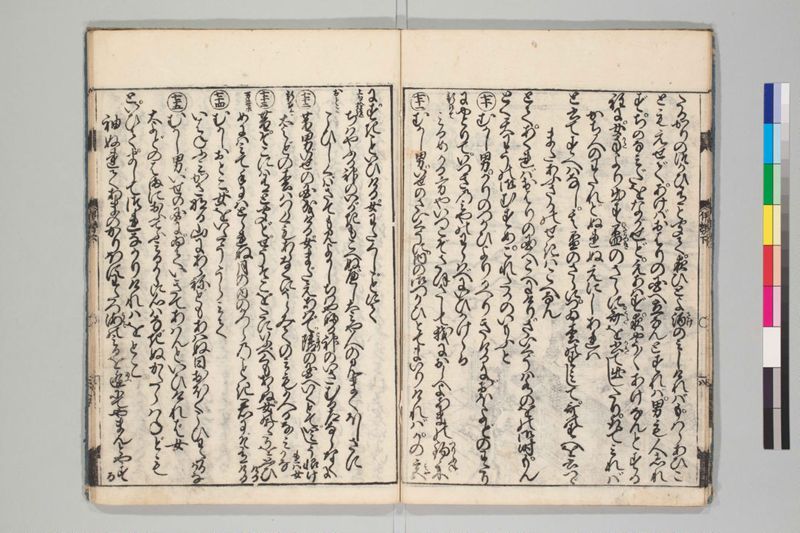
翻刻
【右丁】
たるかりのつかひ有と聞て。夜ひとよ酒(さけ)のみしければ。もはらあひこ
ともえせで。あけばおはりの国へ立なんとすれば。男も人しれ
ず。ちのなみだをながせど。えあはず。夜やう〳〵あけなんとする
程に。女 方(かた)より出す。盃(さかつき)のさらに。哥(うた)を書(かき)て出したり。取てみれば
かち人のわたれどぬれぬえにしあれは
と書てすへはなし。其盃のさらに。つゐ松のすみして。哥のすへを書つぐ
またあふさかのせきはこへなん
とて。あくればおはりの国へこへにけり。さいくうは水のをの御時。もん
とく天わうの御むすめ。これたかのいもふと
「七十」むかし男。かりのつかひよりかへりきけるに。おほよどのわたり
にやとりて。いつきのみやのわらはべにいひかけゝる
《送り仮名:新古今》みるめかる方やいつこぞさほさして我におしへよあまの釣舟(つりふね)
「七十一」むかし男。いせのさいくうに。内の御つかひとてまいりければ。かの宮(みや)
【左丁】
に。すきこといひける。女わたくしごとにて
《送り仮名:上勺拾遣》ちはやふる神のいがきもこへぬべし大みや人のみまくほしさに
《送り仮名:おとこ》こひしくばきても見よかしちはやふる神のいさむる道ならなくに
「七十二」昔男。いせの国成ける。女まだえあはで。隣(となり)の国へいくとて。いみしう恨けれは女
《送り仮名:新古今》大よどの松はつらくもあらなくにうらみてのみもかへるなみかな
「七十三」昔。そこには有と聞ど。せうそこをたにいふべくもあらぬ。女のあたりを思ひける
《送り仮名:万葉》めにはみて手にはとられぬ月の内のかつらのことき君にぞ有ける
「七十四」むかしおとこ。女をいたううらみて
いはねふみかさなる山にあらねどもあはぬ日おほくこひわたるかな
「七十五」むかし男。いせの国に。ゐていきてあはんといひければ女
大よどのはまにおふてふみるからに心はなぎぬかたらはねども
と。いひて。ましてつれなかりけれはをとこ
袖ぬれてあまのかりほすわたつ海(うみ)のみるを逢(あふ)にてやまんとやする
現代語訳
【右丁】
(第六十九段・続き)
(国守が)狩りの使いが来ていると聞いて、一晩中酒を飲ませたので、男はまったく(女と)逢うこともできなかった。夜が明けたら尾張の国へ立ち去ろうとすると、男は人知れず血の涙を流したが、逢うことができない。夜がようやく明けようとするころに、女の方から(使いが)盃の皿に歌を書いて差し出した。取って見れば、
かち人のわたれどぬれぬえにしあれば
と書いて、下の句はなかった。その盃の皿に、(男は)松の炭で歌の下の句を書き継いだ。
またあふさかの関はこえなん
と(詠んで)、夜が明けると尾張の国へ越えていった。斎宮は水尾(清和天皇)の御代に、文徳天皇の御娘で、惟喬親王の妹(恬子内親王)であった。
【第七十段】
昔、男が、狩りの使いの任を終えて帰ってくる途中、大淀のあたりに宿をとって、斎宮に仕える童女たちに言い掛けた。
みるめかる方やいづこぞ棹さして我に教へよ海人の釣り舟
(海藻を刈るところはどこですか、棹をさして私に教えてください、海人の釣り舟よ。)
※「みるめ」は「見る目(逢う機会)」と「海藻のみるめ(布海苔)」の掛詞。
【第七十一段】
昔、男が伊勢の斎宮のもとへ、宮中からの御使いとして参ったところ、その宮(斎宮)に対して艶めいたことを言った。女は(斎宮の侍女が)私的なこととして(歌を詠んだ)。
ちはやふる神の斎垣もこえぬべし大宮人の見まく欲しさに
(神聖な斎垣(神の垣根)さえも越えてしまいそうです、あなた(宮中の方)にお目にかかりたい一心で。)
男は、
恋しくば来ても見よかしちはやふる神の諌むる道ならなくに
(恋しければ、来てご覧なさい。神がお咎めになる道ではありませんから。)
【第七十二段】
昔、男が伊勢の国にいた女とまだ逢えないうちに、隣の国へ行くとして(別れを告げると)、女がたいへん恨めしがったので、(女が詠んだ)。
大淀の松はつらくもあらなくに恨みてのみも帰る波かな
(大淀の松は薄情でもないのに、ただ恨めしそうに返ってゆく波であることよ。)
※「松」は「待つ」の掛詞。
【第七十三段】
昔、そこにいると聞いていても、言伝えすらすることもできない女のあたりを思っていた(男が詠んだ)。
目には見て手にはとられぬ月の内の桂のごとき君にぞありける
(目には見えても手には取れない、月の中の桂の木のようなあなたであることよ。)
【第七十四段】
昔、男が女をひどく恨んで(詠んだ)。
岩根踏み重なる山にあらねども逢はぬ日多く恋ひわたるかな
(岩を踏み重なる山というわけでもないが、逢えない日が多くて、ずっと恋い慕い続けることだ。)
【第七十五段】
昔、男が伊勢の国に(女を)連れて行って逢おうと言ったところ、女が(詠んだ)。
大淀の浜に生ふてふみるからに心はなぎぬ語らはねども
(大淀の浜に生えるという海藻(みる)のように、あなたをひと目見ただけで心は凪いでしまいました。語り合ってもいないのに。)
※「みる」は「見る」と「海藻のみる」の掛詞。
と言って、(女は)ますけんなくふるまったので、男が(詠んだ)。
袖濡れて海人の刈り干す海の「みる」を逢ふにてやまんとやする
(袖を濡らしながら海人が刈り干す、海の「みる(海藻)」を、ただ「見る(逢う)」だけで終わってしまうのか。)
英語訳
【Right folio】
(Episode 69 — continued)
Hearing that a hunting messenger had arrived, (the provincial governor) kept him drinking wine all through the night, so that the man was completely unable to meet with the lady. As dawn broke he was about to depart for Owari Province, and the man wept tears of blood in secret, yet still could not see her. Just as the night was on the verge of turning to dawn, from the lady's side, a poem was written on a sake-cup saucer and sent out to him. He took it and saw:
*Kachihito no / wataredo nurenu / enishi areba*
(A traveller on foot crosses and is not wetted — if there is such a bond between us…)
It was written, but the lower verse (shimo no ku) was absent. On that same sake-cup saucer, using charcoal from a pine, the man wrote the completing lower verse:
*mata Ausaka no / seki wa koenan*
(…then we shall cross the Barrier of Ausaka once more.)
When dawn broke, he crossed over into Owari Province. The Saigū (Vestal Princess) was, in the reign of Emperor Seiwa (Mizunoo), the daughter of Emperor Montoku and the younger sister of Prince Koretaka — (Princess Teishi).
---
**Episode 70**
Long ago, a man, returning from his duties as a hunting messenger, took lodging near Oyodo, and called out to the young attendants of the Saigū:
*Mirume karu / kata ya izuko zo / sao sashite / ware ni oshieyo / ama no tsuribune*
(Where is the place where one cuts the seaweed? Punt your pole and show me the way, O fisherman's boat.)
*Note: "mirume" is a pivot word (kakekotoba) meaning both "seaweed (mirume)" and "a chance to meet and see (miru me)."*
---
**Episode 71**
Long ago, a man came to the Ise Saigū as an imperial messenger, and spoke words of amorous intent to the palace there. A lady of the household composed privately:
*Chihayafuru / kami no igaki mo / koenu beshi / ōmiyabito no / mimaku hoshisa ni*
(Even the sacred fence of the mighty gods I feel I could leap over, so great is my longing to see you, O noble one from the Great Palace.)
The man replied:
*Koishiku ba / kite mo miyo kashi / chihayafuru / kami no isamuru / michi naranaku ni*
(If you long for me, come and see for yourself — this is not a path that the gods forbid.)
---
**Episode 72**
Long ago, a man had a woman in Ise Province whom he had not yet been able to meet, and when he said he was going to the neighbouring province, she was very resentful. (She composed:)
*Ōyodo no / matsu wa tsuraku mo / aranaku ni / uramite nomi mo / kaeru nami kana*
(The pine of Ōyodo is not heartless — yet here are the waves, returning full of resentment alone.)
*Note: "matsu (pine)" is a pivot word for "matsu (to wait)."*
---
**Episode 73**
Long ago, though a man knew a certain woman was somewhere nearby, he could not even send a message to her vicinity, and so he composed in longing:
*Me ni wa mite / te ni wa torarenu / tsuki no uchi no / katsura no gotoki / kimi ni zo arikeru*
(You are like the laurel tree inside the moon — seen by the eye but impossible to reach by hand.)
---
**Episode 74**
Long ago, a man, deeply resentful of a woman, composed:
*Iwane fumi / kasanaru yama ni / aranedomo / awanu hi ōku / koi wataru kana*
(Though ours is no mountain of piled-up boulders, the days we do not meet are many, and still I go on longing for you.)
---
**Episode 75**
Long ago, a man said he would take a woman to Ise Province to meet her. The woman composed:
*Ōyodo no / hama ni ou to iu / miru kara ni / kokoro wa naginu / katarawa nedo mo*
(Like the "miru" seaweed said to grow on the shore of Ōyodo — the moment I saw you, my heart grew calm, even though we have not yet spoken.)
*Note: "miru" is a pivot word for both "miru (the seaweed)" and "miru (to see/meet)."*
Having said this, she was even more aloof and cold, so the man composed:
*Sode nurete / ama no karihosu / watatsu umi no / miru wo au ni te / yaman to ya suru*
(Must I end with only "seeing" — like the sea-weed the fisher-folk cut and dry, sleeves wet from the sea — is this mere glimpse to be all there is of our meeting?)