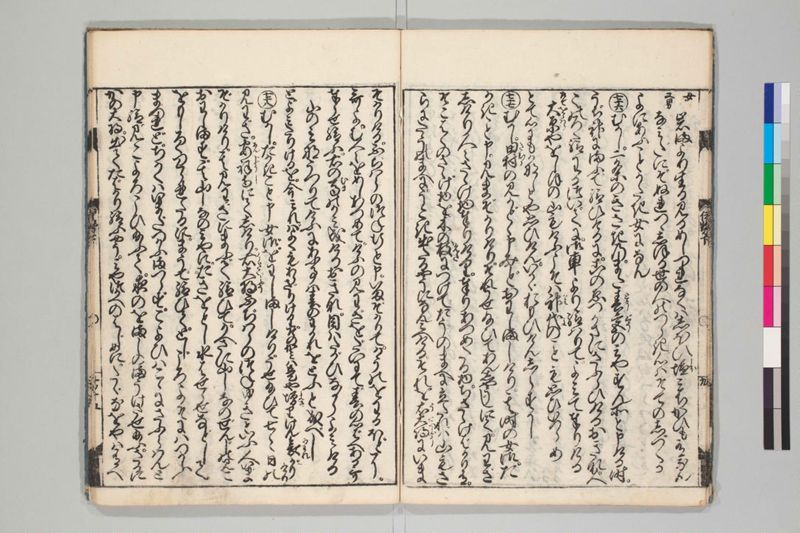
翻刻
【右丁】
《送り仮名:女》岩まより生る見るめしつれなくはしほひ塩(しほ)みちかひも有なん
《送り仮名:又男》なみだにぞぬれつゝしほる世の人のつらき心はそてのしづくか
よにあふことかたき女になん
「七十六」むかし。二条のきさきの。また春宮(とうぐう)のみやすん所と申ける時。
うぢ神にまふで給ひけるに。このゑつかさにさふらひけるおきな。人
々のろく給わるついでに。御車より給はりて。よみて奉りける
《送り仮名:古今》大原(をゝはら)やをしほの山もけふこそは神代(かみよ)のことも思ひいつらめ
とて。心にもかなしとや思ひけん。いかゞおもひけんしらすかし
「七十七」むかし。田村(たむら)のみかどゝ申みかどおわしましけり。其時の女御。た
かきこと申。みまぞかりけり。それうせ給ひてあんしやうじにて。みわざ
しけり人々さゝけ物奉りけり。奉りあつめたる物。ちさゝけばかり有。
そこはくのさゝげ物を。木の枝(えた)につけてたうのまへに立たれは山もさ
らにたうのまへに。うこき出たるやうになんみへける。それを右大将(うだいしやう)にいま
【左丁】
そかりける、ふぢはらのつね行と申。いまぞかりて。かうのをわるほどに。
哥よむ人々をめしあつめて。けふのみわざをだいにて。春の心ばへある哥
奉らせ給ふ。右の馬(むま)のかみ成けるおきな。目はたがひなからよみける
山のみなうつりてけふにあふ事は春のわかれをとふと成べし
と。よみたりけるを。今みればよくもあらざりけり。そのかみは是や増(まさ)りけん哀(あわれ)がりけり
「七十八」むかし。たかきこと申女〝 御。をわしましけり。うせ給ひて七々日の
みわざ。安祥寺(あんじやうし)にてしけり。右大将(うだいしやう)ふぢはらのつねゆきといふ人いま
ぞかりけり。其みわざにまふで給ひて。かへさに山しなのぜんじのみこ
おわします。其山しなのみやに。たきをとし水はせらせなどして。
をもしろくつくられたるに。まうで給ひて。としごろよそにはつかふ
まつれど。ちかくはいまだつかふまつらず。こよひはこゝにさふらはんと
申給。みこよろこひ給ふて。夜のをましのまうけさせ給ふ。さるに
かの大将。出てたばかり給ふやう。みやつかへのはじめに。たゞなをやは有べ
現代語訳
【右丁】
(第七十五段・続き)
(女が詠んだ)
岩間より生るみるめしつれなくは潮干潮満ちかひもあらなん
(岩の間から生えるみる(海藻)のように、もしあなたがそっけないのなら、潮が干いたり満ちたりするかいもないことでしょう。)
※「みるめ」は「見る目(逢う機会)」と「海藻のみるめ」の掛詞。「かひ」は「甲斐(かいのある価値)」と「貝」の掛詞。
(また男が詠んだ)
涙にぞ濡れつつしぼる世の人のつらき心は袖の雫か
(涙で濡れてはしぼる、その世の人のつれない心というのは、袖からしたたる雫のようなものでしょうか。)
(この女は)世に逢うことが難しい女であったのだ。
---
【第七十六段】
昔、二条の后が、まだ春宮(皇太子)の御息所と申し上げていた時に、宇治の神(宇治上神社)に参拝なさったところ、近衛の役所に仕えていた老人が、人々に禄(ろく)を賜わるついでに、御車のそばで(禄を)賜わって、(次の歌を)詠んで奉った。
大原や小塩の山も今日こそは神代のことも思ひ出づらめ
(大原の小塩の山も、今日こそは、神代のことも思い出すことでしょう。)
と(詠んで)、(后は)心から感動なさったのか、どのようにお思いになったのかはわからない。
---
【第七十七段】
昔、田村の帝(文徳天皇)と申し上げる帝がいらっしゃった。その時の女御を、多賀幾子(たかきこ)と申し上げた。(その女御が)お亡くなりになって、安祥寺にて御法要が営まれた。人々が捧げ物を奉った。奉り集めた物は、千の捧げ物ほどもあった。そのおびただしい数の捧げ物を、木の枝に付けて塔の前に立てたところ、山がそのまま塔の前に動き出てきたように見えた。それを右大将(右近衛大将)で、今(まだご存命の)藤原常行と申し上げる方が、(今は)まだご存命であって、香の折(くばること)をするにあたって、
【左丁】
(その)香の折をするほどに、歌を詠む人々をお召し集めになって、今日の御法要をお題として、春の風情ある歌を奉らせなさった。右の馬の頭であった老人が、目は(涙で)たがいながらも(次の歌を)詠んだ。
山のみな移りて今日に逢ふことは春の別れを弔ふとなるべし
(山のすべてが(塔の前に)移ってきて、今日(ここに)集うことは、春のお別れ(女御の死)を弔うためということになるのでしょう。)
と詠んだのを、今(振り返って)見れば、それほどよい歌でもなかった。しかしその当時は、これに勝るものがあったであろうか、皆が感動したのであった。
---
【第七十八段】
昔、多賀幾子(たかきこ)と申し上げる女御がいらっしゃった。お亡くなりになって、七七日(四十九日)の御法要を安祥寺で行った。右大将・藤原常行という人が、まだご存命であった。その御法要にお参りになって、帰りに山城の前司(ぜんじ)の宮(親王)がいらっしゃる(邸に立ち寄った)。その山城の宮に、(庭に)滝を落とし、水を走らせたりなどして、趣ある造りがなされているところに(常行が)参られて、「長年よそからはお仕えしてきましたが、近くには(直接お仕えしたことは)まだなく、今夜はここにお仕えしてお側にいたい」と申し上げた。宮はお喜びになって、夜の御座所(お休みの場所)のご準備をさせなさった。ところが、かの大将(常行)は外に出て(密かに)たくらんで申されるには、「宮仕えの初めには、ただの(普通の)身ではいられないものだ。
英語訳
【Right folio】
(Episode 75 — continued)
(The woman composed:)
*Iwama yori / ouru mirume shi / tsurenaku wa / shiohishi shiomichi / kai mo aranан*
(If you, like the seaweed that grows between the rocks, are truly so cold and indifferent, then there would be no point in the tides going in and out.)
*Note: "mirume" is a pivot word for both "seaweed (mirume)" and "a chance to see/meet (miru me)"; "kai" is a pivot word for both "worth/use (kai)" and "shellfish (kai)."*
(The man again composed:)
*Namida ni zo / nuretsutu shiboru / yo no hito no / tsuraki kokoro wa / sode no shizuku ka*
(Soaked and wrung out with tears — could it be that the coldness of people in this world is nothing more than drops from a sleeve?)
This was a woman whom it was exceedingly difficult to meet with in the world.
---
**Episode 76**
Long ago, when the Nijō Empress was still referred to as the Consort of the Crown Prince, she made a pilgrimage to the Uji Shrine. An elderly man who served in the Inner Palace Guards, at the occasion when people were being given gifts of reward, received his gift from beside the imperial carriage and composed this poem to offer up to her:
*Ōhara ya / Oshio no yama mo / kyō koso wa / kamiyo no koto mo / omoi izuramen*
(Even the mountain of Oshio in Ōhara — surely today of all days it too recalls the age of the gods.)
Whether her heart was truly moved, or what she thought of it, one cannot say.
---
**Episode 77**
Long ago, there was an Emperor known as the Tamura Emperor (Emperor Montoku). The Imperial Consort of that time was called Lady Takakiko. After she passed away, a memorial service was held at Anshō-ji temple, and people offered up many votive gifts. The gifts that were gathered were enough to make a thousand offerings. Those countless offerings were hung on the branches of trees and set up before the pagoda, so that the trees appeared like a mountain itself having moved and emerged before the pagoda. At that time, the Right Major Captain, a man called Fujiwara no Tsuneyuki, who was still living then, presided over the distribution of incense.
【Left folio】
While the incense was being distributed, he summoned together those who composed poetry and, taking the day's memorial service as the theme, had them offer up poems with the spirit of spring. The elderly man who was the Right Master of the Horse composed, though his eyes were clouded with tears:
*Yama no mina / utsurite kyō ni / au koto wa / haru no wakare wo / toburai to naru beshi*
(All the mountains have moved and gathered here today — this gathering must be to mourn the parting of spring, i.e. to pay respects to the one departed.)
Looking back on it now, it was not so fine a poem. Yet at the time, was there anything to surpass it? People were deeply moved.
---
**Episode 78**
Long ago, there was an Imperial Consort called Lady Takakiko. After she passed away, the memorial service for the forty-ninth day was held at Anshō-ji. A man called Fujiwara no Tsuneyuki, the Right Major Captain, was still living at the time. He attended the memorial service and on his return called upon the residence of the Prince who was the Former Governor of Yamashiro. At that Prince's residence, waterfalls had been made to cascade and streams to run, and the garden had been made most pleasingly. Tsuneyuki called upon this delightful place and said: "For many years I have served you from afar, but I have not yet served close at your side. Tonight I should like to attend upon you here." The Prince was pleased and had preparations made for the night's sleeping quarters. Then the Major Captain stepped outside and schemed, saying: "At the beginning of service at court, one cannot simply remain ordinary…"