翻刻
【右丁】
き。三条のおほみゆきせし時。きの国ちさとのはまに有ける。いと
おもしろきいし奉れりき。おほみゆきのゝち奉れりしかば。ある人のみ
ざうしのまへのみぞにすへたりしを。しまこのみこたまふ君なり。此
石を奉らんとの給ひて。みずいしんとねりして。取につかはす。いく
ばくもなくてもてきぬ。此石きゝしよりはみるはまされり。是を
たゞに奉らば。すゞろ成へじ#1とて。人々に哥よませ給ふ。右の馬のかみ成ける
人をなん。あをきこけをきざみて。まきゑの方に。此哥を付て奉りける
あかねとも岩(いわ)にぞかふるいろみへぬ心をみせんよしのなければ
となんよめりける
「七十九」むかし。うじのなかにみこ生れ給へりけり。御うぶ屋に人々うた
よみけり。御おほぢがたなりける。おきなのよめる
わが門にちひろ有かげをうへつれば夏(なつ)ふゆたれかかくれざるべき
これはさだかずのみこ。ときの人。中将の子となんいひけるあにの
【左丁】
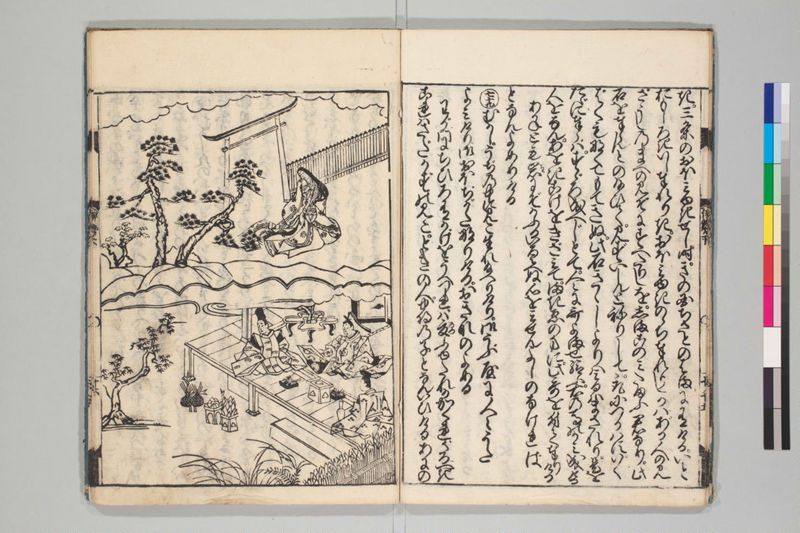
【挿絵】
現代語訳
【右丁】
(第七十八段・続き)
(常行が計略をめぐらせていうには)「(かつて)三条(の帝)の御幸があった時に、紀の国(紀伊国)の千里の浜にあったたいそう趣深い石を(誰かが帝に)献上したことがあった。御幸ののちに献上したものであったので、ある人の御曹司(部屋)の前の溝のそばに置いてあったのを、(実は)しまこのみこ(惟喬親王)が欲しいとお望みになっている方でいらっしゃる。この石を(宮に)献上しよう」とおっしゃって、水(を汲む)石を担当する舎人(とねり)をして(石を)取りに遣わせた。ほどなくして(石を)持って来た。「この石は、聞いていたよりも実際に見ると(さらに)素晴らしい。これをただ(何の趣向もなく)献上するのでは、風情がないだろう」とおっしゃって、人々に歌を詠ませなさった。右の馬の頭であった人(在原業平)を、青い苔を刻んで、蒔絵のように、この歌を(石に)添えて献上した。
あかねとも岩にぞかふる色みえぬ心をみせんよしのなければ
(あかね色に染まることもなく、ただ岩(石)の色に映えているばかりで、目には見えない(私の)心を見せるすべがないので(せめてこの石を以って心の証といたします)。)
と詠んだのであった。
---
【第七十九段】
昔、宇治の中に(ある)宮(の御子が)お生まれになった。お産屋に(集まった)人々が歌を詠んだ。御祖父方にあたる翁が詠んだ。
わが門に千尋ある陰をうへつれば夏冬誰かかくれざるべき
(わが門に千尋もある(大きな)木陰を植え付けたので、夏も冬も、誰もがその陰に隠れずにはいられないだろう。)
これは貞数(さだかず)の宮(親王)のことで、時の人(世間の人)が、中将(の子孫)の子であると言った。(その)兄の
【左丁】
【挿絵】
英語訳
【Right folio】
(Episode 78 — continued)
(Tsuneyuki laid out his plan, saying:) "At the time of the imperial progress to Sanjō, there was a most exquisite stone found on the beach at Chisato in the Province of Ki (Kii), which someone had offered up to the Emperor. It was presented after the imperial progress had concluded, and so it had been placed by the side of the drainage ditch in front of someone's private chamber. Now, the Prince of Shimako (Prince Koretaka) is a person who has long desired this very stone. Let us present this stone to the Prince" — and so saying, he dispatched a servant responsible for the water stones to go and fetch it. Before long the stone was brought back. "This stone is even more wonderful to see than what I had heard tell of it. To present it just as it is, without any artistic flourish, would be without elegance," and so he had the assembled company compose poems. The man who had served as the Right Master of the Horse (Ariwara no Narihira) finely carved green moss (around the stone) in the manner of lacquer inlay (*makie*), and attached this poem to it as an offering:
*Akane tomo / iwa ni zo kawaru / iro mie nu / kokoro wo misen / yoshi no nakereba*
(Though it cannot be stained with madder red, it shows only the colour of the rock — and since there is no way to show you my invisible heart, I offer this stone instead as its visible proof.)
And so the poem was composed and offered.
---
**Episode 79**
Long ago, within Uji, a Prince was born into (a royal) household. People gathered at the birthing-room and composed poems. The grandfather on the paternal side, an elderly man, composed:
*Waga kado ni / chihiro aru kage wo / uetsureba / natsu fuyu / tare ka / kakurezaru beki*
(Now that I have planted at my gate a shade of a thousand fathoms' depth, who, in summer or in winter, could fail to shelter beneath it?)
This was concerning Prince Sadakazu; people of the time said that he was the son of (a) Chūjō (Middle Captain). The elder brother of —
【Left folio】
【Illustration】