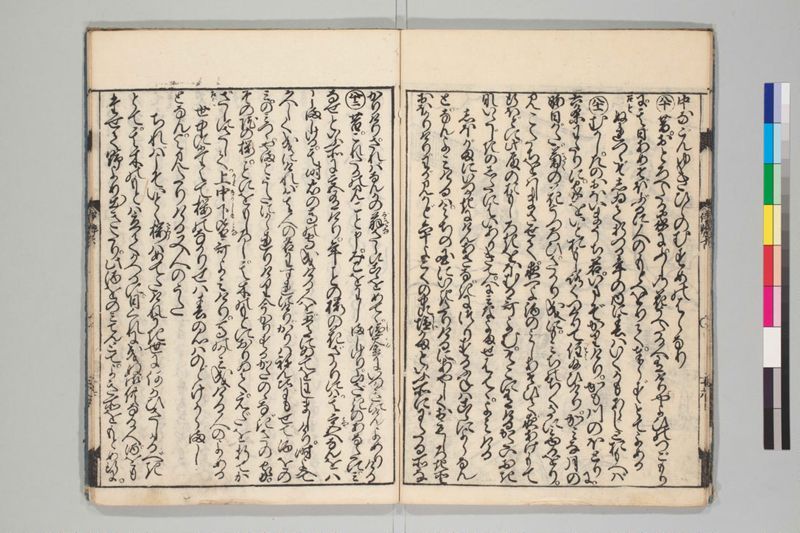
翻刻
【右丁】
中なごんゆきひらのむすめのはらなり
「八十」昔。おとろへたる家に。ふしの花うへたる人有けり。やよひのつごも り
に。其日あめそぼぶるに人のもとへをりて。奉らずとてよめる
《送り仮名:古今》ぬれつゝぞしゐて折つる年の内に春はいくかもあらじとおもへば
﹁八十一﹂むかし。左のおほいまうち君。いまぞかりけり。かも川のほとりに。
六条わたりに。家をいとおもしろくつくりて住(すみ)給ひけり。かみな月の
晦日がた。菊)(きく)の花うつろひ。さかり成に。もみぢのちくさにみゆるをり。
みこたちをはしまさせて。夜一よ酒のみしあそびて。夜あけもて
行ほどに。此殿のおもしろきをほむる哥よむ。そこに有けるかたいおき
ないたじきのしたにはいありきて。人にみなよませはてゝ。よみける
しほがまにいつかきにけんあさな#1きにつりするふねはこゝによらなん
と。なんよみけるは。みちの国にいきたりけるに。あやしくおもしろき所々
おほかりけり。わがみかど 六十よこくの中に塩(しほ)かまといふ所ににたる所な
【左丁】
かりけり。さればなんかの翁(おきな)さらにこゝをめてゝ。塩釜(しほかま)にいつかきにけんよめりける
﹁八十二﹂昔。これたかのみこと申。みこをわしましけり。山ざきのあなたに。み
なせといふ所に宮有けり。年ことの桜の花ざかりには。その宮(みや)へなんをは
しましける。其時右の馬の守成ける人を。常にゐてをわしましけり。時よへて
久しく成にければ其人の名わすれにけり。かりはねん比にもせで酒をの
み。のみつゝ。やまとうたにかゝれりけり今かりするかたのゝなぎさの家。
その院の桜。ことにをもしろし。其木のもとにをりゐて。えだを折てか
ざしにさして。上(かみ)中(なか)下(しも)皆(みな)哥よみけり。馬のかみ成ける人のよめる
《送り仮名:古今》 世中にたえて桜のなかりせは春の心はのどけからまし
となん。よみたりける又人のうた
ちればこそいとゝ桜(さくら)はめてたけれうき世に何かひさしかるべき
とて。其木のもとは立てかへるに。日くれに成ぬ。御供なる人。酒をも
たせて野より出きたり。此酒をのみ てんとて。よき所をもとめ行に。
現代語訳
【右丁】
(前段・続き)
(これは)中納言行平の娘が産んだ子(である)。
---
**【第八十段】**
昔、荒れ衰えた家に、藤の花を植えた人がいた。弥生(三月)の末日に、その日は雨がしょぼしょぼと降る中、(花を)人のもとへ折って送ろうとしたが、(自分では)届けられないとして詠んだ歌(『古今集』)。
ぬれつつぞしひて折りつる年の内に春はいくかもあらじと思へば
(雨に濡れながらも、無理にこの藤の枝を折ったのだ。この年のうちに春はあといく日もないと思えば。)
---
**【第八十一段】**
昔、左の大臣(源融)が、今(の世に)おいでになった。鴨川のほとりの、六条あたりに、家をたいそう風雅に造ってお住まいになっていた。神無月(十月)の末ごろ、菊の花が色あせて、盛りとなっている折に、紅葉がさまざまな色に見えるころ、宮中の親王方をいらっしゃらせて、一夜中酒を飲んで遊んで、夜が明けていくほどに、この邸の風趣を褒める歌を詠んだ。そこにいた片居(かたい)の翁が、畳の下を這い回って、(他の)人々に皆詠み終わらせてから、詠んだ歌は、
しほがまにいつか来にけんあさな(な)きに釣りする舟はここによらなん
(塩竈(しおがま)にいつの間に来てしまったのだろうか。朝ごとに釣りをする舟よ、ここに寄ってくれないか。)
と詠んだのは、(この翁が)陸奥の国に行ったことがあり、不思議なほど風趣のある場所が多くあった。(しかし)我が君(の治める)六十余国の中で、塩竈という所に似た所は(他に)なかった。だからこそ、あの翁は改めてここ(六条の邸)を賞賛して、「塩竈にいつか来にけん」と詠んだのであった。
---
**【第八十二段】**
昔、これたか(惟喬)のみこと申し上げる親王がいらっしゃった。山崎の向こうに、水無瀬(みなせ)という所に宮(御殿)があった。年ごとの桜の花盛りには、その宮へとおいでになるのであった。その時、右の馬の頭(うまのかみ)であった人を、常にお連れになっていた。時が経って久しくなったので、その人の名は忘れてしまった。鷹狩りはほどほどにもせずに、酒を飲み、飲みながら、和歌にかかりきりになっていた。今(一行が)鷹狩りをする方角の渚の家(水無瀬の宮)、その院の桜は、格別に趣深い。その木のもとに下りて座り、枝を折って挿頭(かざし)に挿して、上(かみ)・中(なか)・下(しも)皆が歌を詠んだ。馬の頭であった人(在原業平)が詠んだ歌(『古今集』)は、
世の中にたえて桜のなかりせば春の心はのどけからまし
(世の中にまったく桜というものがなかったならば、春の人の心はどれほどのどかであることだろうか。)
と詠んだのであった。また(別の)人の歌は、
散ればこそいとど桜はめでたけれ憂き世に何かひさしかるべき
(散るからこそ、いっそう桜は素晴らしいのだ。辛いこの世に、何がいつまでも(変わらず)あり続けることができようか。)
とて、その木のもとを立って帰る(支度をする)に、日が暮れてしまった。お供の人たちが、酒を持たせて野の方から出てきた。「この酒を飲もう」とて、よい場所を求めて行くと、
【左丁】
(続く)
英語訳
【Right folio】
(Episode 79 — continued)
— (the child in question) was born of the daughter of the Middle Counsellor (Chūnagon) Yukihira.
---
**Episode 80**
Long ago, there was a person who had planted wisteria at a house fallen into ruin and neglect. On the last day of the Third Month (Yayoi), as a light rain was falling that day, the person wished to break off a branch and send it to someone, but being unable to deliver it in person, composed this poem (from the *Kokinshū*):
*Nuretsustu zo / shiite oritsuru / toshi no uchi ni / haru wa ikuka mo / araji to omoeba*
(Even while being wetted by the rain, I have forcibly broken this branch — for I think that within this year, how few days of spring can remain.)
---
**Episode 81**
Long ago, the Minister of the Left (Minamoto no Tōru) was living (in the capital) in the present age. At the bank of the Kamo River, in the vicinity of Rokujō, he had built a house of quite remarkable elegance and lived there. Toward the end of the Tenth Month (Kannazuki), at a time when the chrysanthemums were beginning to fade yet were still at their peak, and when the maple leaves were visible in a myriad of hues, he had various Princes attend upon him, and the company drank wine and made merry through the entire night. As the night moved toward dawn, those present composed poems praising the beauty of the mansion. Among those present was an old man known as Katai-no-okina, who crept beneath the floorboards and waited until all the others had finished composing their poems, and then composed:
*Shiogama ni / itsuka ki ni ken / asana (na) ki ni / tsuri suru fune wa / koko ni yoranan*
(When did I ever come to Shiogama? — I wonder. O boats that go out fishing every morning, do come and moor here at this place.)
The reason he composed this poem is as follows: the old man had once traveled to the Province of Mutsu (Michinoku), and found that there were many places of mysterious and remarkable beauty there. Yet among all the sixty-odd provinces under our sovereign's rule, there was no place that resembled Shiogama. And so the old man, moved anew by his admiration for this very place (the Rokujō mansion), composed the poem "When did I ever come to Shiogama?"
---
**Episode 82**
Long ago, there was a Prince known as Prince Koretaka. Beyond Yamazaki, at a place called Minase, there was a palace (御殿). Every year at the height of the cherry blossoms, he would make his way to that palace. At such times he would invariably bring along the man who served as the Right Master of the Horse. As time passed and many years went by, the name of that man has been forgotten. Rather than devoting themselves seriously to falconry, they drank wine, and drinking, devoted themselves to the composition of *yamato-uta* (Japanese poetry). The cherry trees now blooming at the shore residence — the direction in which the present falconry hunt proceeds — and the cherry trees of that palace in particular were of exceptional beauty. They descended to sit beneath those trees, broke off branches to insert in their hair as *kazashi* (hair ornaments), and all — high, middle, and low — composed poems. The poem composed by the man who served as the Right Master of the Horse (Ariwara no Narihira), (recorded in the *Kokinshū*), was:
*Yononaka ni / taete sakura no / nakariseba / haru no kokoro wa / nodokekara mashi*
(If there were no such thing as cherry blossoms at all in this world, how tranquil and at ease would the heart be in springtime.)
And so he composed it. Another person's poem was:
*Chireba koso / itodo sakura wa / medetakere / ukiyo ni nani ka / hisashikaru beki*
(It is precisely because they scatter that the cherry blossoms are all the more wonderful — in this sorrowful world, what indeed could be expected to last?)
And with that, they rose from beneath those trees to return, and the day had grown dark. The attendants came out from the fields bringing wine. "Let us drink this wine," they said, and set off in search of a good spot, and —
【Left folio】
(Continued)