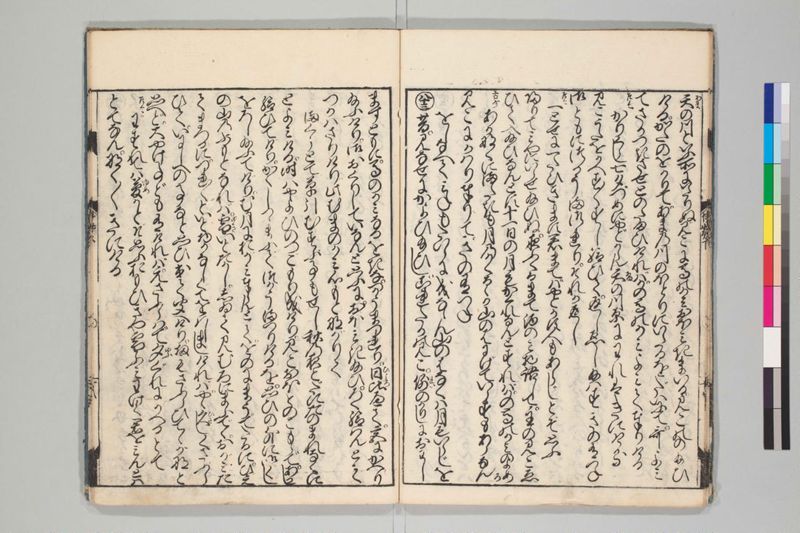
翻刻
【右丁】
天(あま)の川といふ所にいたりぬ。みこに馬のかみおほみきまいる。みこの給ひ
ける。かたのをかりて。あまの川のほとりにいたるをだいにて。哥よみ
てさかつきさせとのたまひければ。かの馬のかみよみて奉りける
《送り仮名:古今》かりくらし七夕づめにやどからん天(あま)の川原にわれはきにける
みこうたをかへす〳〵すし給ひて。返しゑし給はすきの有つね
御ともにつかうまつれり。それか返し
《送り仮名:古今》一とせに一たひきます君まてばやとかす人もあらじとぞ思ふ
帰りてみやにいらせ給ひぬ。夜ふくるまて酒のみ物語して。主のみこゑ
ひて入給ひなんとす十一日の月もかくれなんとすれば。かの馬のかみのよめる
《送り仮名:古今》あかなくにまたきも月のかくるゝか山のはにげていらすもあらなん
みこにかはり奉りて。きの有つね
をしなへてみねもたいらに成なゝん山のはなくは月もいらじを
﹁八十三﹂昔。みなせにかよひ給ひし。これたかのみこ。例(れい)のかりしにおわし
【左丁】
ますともに。馬のかみなるをきな。つかうまつれり。日比(ひころ)へて。宮にかへり
給ふけり。御おくりしていなんと思ふに。おほみき給ひ。ろく給はんとて
つかはさりけり。此むまのかみ心もとながりて
まくらとて草ひきむすぶ事もせし秋の夜とだにたのまれなくに
とよみける。時はやよひのつごもり成けり。みこおほとのこもらで。あかし
給ひてげ#1り。かくしつゝまふでつかうまつりけるを。思ひの外に御くし
をろし給ふてげ#1り。む月におがみ奉らんとて。をのにまうでたるに。ひえ
の山のふもとなれば。雪(ゆき)いとたかし。しゐてみむろにまふでゝ。おがみた
てまつるに。つれ〳〵といと物かなしくてをはしましければ。やゝ久(ひさ)しくさぶら
ひて。いにしへの事なと思ひ出て聞へけり。扨もさふらひてしがなと
思へど。大やけ事ども有ければ。えさふらはで夕(ゆふ)ぐれにかへるとて
《送り仮名:古今》わすれては夢(ゆめ)かとぞ思ふおもひきや雪ふみわけて君をみんとは
とてなん。なく〳〵きにける
現代語訳
【右丁】
(第八十二段・続き)
天の川という所に着いた。親王に、馬の頭がお酒を差し上げた。親王がおっしゃった。「交野(かたの)で鷹狩りをして、天の川のほとりに至ったことを題にして、歌を詠んで(私に)盃を勧めよ」とおっしゃったので、あの馬の頭が詠んで差し上げた歌は(『古今集』)、
狩り暮らし七夕つ女に宿借らん天の川原に我は来にける
(狩りをして日を暮らし、(気づけば)織女(たなばたつめ)に宿を借りることになるだろうか。天の川のほとりに、私はいつの間にか来ていたのだ。)
親王は歌を繰り返し繰り返しお誦(ず)じになって、返しの歌をお詠みになれなかった。紀有常(きのありつね)が御供としてお仕え申し上げていた。その(有常の)返し歌は、
一年に一たび来ます君待てばやどかす人もあらじとぞ思ふ
(一年に一度だけいらっしゃる(織姫の)君を待っているのだから、宿を貸してくれる人もいないだろう、と思う。)
(一行は)帰って宮にお入りになった。夜が更けるまで酒を飲み、語り合って、主である親王が酔ってお入りになろうとする(その時)、十一日の月もまさに隠れようとしたので、あの馬の頭が詠んだ歌は(『古今集』)、
飽かなくにまだきも月の隠るるか山の端逃げて入らずもあらなん
(まだ見飽きていないのに、早くも月が隠れてしまうのか。山の稜線よ、逃げて(どこかへ行ってしまって)月を入れないでいてほしいものだ。)
親王に代わって申し上げるとして、紀有常(の歌)、
おしなべて峰も平らになりななん山の端なくは月も入らじを
(どうか峰という峰もみな平らになってしまえ。山の稜線がなければ、月もきっと(山に)入らないだろうから。)
---
**【第八十三段】**
昔、水無瀬に通っていらっしゃったこれたか(惟喬)の親王が、例のごとく鷹狩りにおいでになる(際に)、
【左丁】
お供として、馬の頭であった翁(業平)がお仕え申し上げた。日数が経って、宮においでになろうとされた。(馬の頭が)お見送りして帰ろうと思うのに、お酒を賜り、禄(ろく)を賜ろうとして(親王が)お引き留めになってしまった。この馬の頭は(お別れが)じれったく思われて、
枕とて草引き結ぶこともせじ秋の夜とだに頼まれなくに
(枕にしようと草を引き結ぶ(野宿の)こともしますまい。秋の夜(のようにしみじみとした趣のある夜)だとさえ頼みにできないのだから。)
と詠んだ。時は弥生(三月)の末日であった。親王は(御殿に)お籠もりにならずに、夜を明かしておしまいになったようだ。このようにして(業平が)参上してお仕えしていたのに、思いがけず(親王は)ご出家なさってしまったのだった。睦月(正月)にお参り申し上げようとして、小野(おの)に参ったところ、比叡(ひえ)の山の麓であるので、雪がたいそう深い。無理をして御室(みむろ)に参って、(親王に)お目にかかり申し上げると、つれづれと(所在なげに)、とても物悲しくいらっしゃったので、(業平は)しばらく久しく(親王のそばに)お仕えして、昔のことなどを思い出して申し上げた。このままずっとお仕えしていたいと思えども、朝廷の公務があるので、(長くは)お仕えできずに、夕暮れに帰るとして(詠んだ歌)(『古今集』)、
忘れては夢かとぞ思ふ思ひきや雪踏み分けて君を見んとは
((ふと我に返ると現実を)忘れて、これは夢かと思う。まさか雪を踏み分けてあなた様にお会いしようとは(以前には)思いもしなかった。)
とて、泣く泣く帰って行ったのであった。
英語訳
【Right folio】
(Episode 82 — continued)
They arrived at a place called Amanogawa ("River of Heaven / the Milky Way"). The Right Master of the Horse presented wine to the Prince. The Prince said: "Take as your topic the fact that we have spent the day hunting at Katano and have arrived at the bank of Amanogawa, and compose a poem and offer me the cup." And so the Master of the Horse composed this verse and presented it (from the *Kokinshū*):
*Kari kurashi / Tanabata-tsume ni / yado karan / Amanogawa-hara ni / ware wa ki ni keru*
(Having spent the day in the hunt, I find I shall have to borrow lodging from the Weaving Maiden — for I have come, without quite knowing it, to the bank of the River of Heaven.)
The Prince recited the poem over and over again, and was unable to compose a reply. Ki no Aritsune had been in attendance as one of the Prince's escort. His reply poem was:
*Hitotose ni / hitotabi kimasu / kimi mateba / yado kasu hito mo / araji to zo omou*
(Because she waits for you, my lord, who come but once a year, I think there is surely no one who would offer her lodging to another.)
The company returned and the Prince entered the palace. They drank wine and conversed until deep in the night, and as the Prince, now drunk, was about to retire, the moon of the eleventh day was also on the verge of disappearing behind the mountains — whereupon the Master of the Horse composed this poem (from the *Kokinshū*):
*Akanaku ni / madaki mo tsuki no / kakururu ka / yamanoha nigete / irazu mo aranан*
(Not yet grown weary of gazing, and already the moon hides itself? O ridge of the mountains, flee away somewhere and refuse to let the moon enter behind you!)
On behalf of the Prince, Ki no Aritsune (composed):
*Oshinabete / mine mo taira ni / nari nanан / yamanoha nakuba / tsuki mo iraji wo*
(Would that every single peak were leveled flat! If there were no mountain ridge, the moon would never set behind it.)
---
**Episode 83**
Long ago, Prince Koretaka, who used to make his way to Minase, set out as usual for a hunting excursion,
【Left folio】
and the old man who served as Master of the Horse (Narihira) attended upon him. After a number of days had passed, the Prince was to return to his palace. (Narihira) was thinking to see him off and take his leave, but the Prince, wishing to bestow wine and gifts of reward upon him, kept him back and would not let him go. This Master of the Horse, growing impatient and anxious for his departure, composed:
*Makura tote / kusa hiki musubu / koto mo seji / aki no yo to dani / tanomarenanaku ni*
(I shall not even bother to gather grass and bind it for a pillow — for I cannot even take comfort in the thought that this is at least an autumn night, a night of lingering elegance and feeling.)
He composed this because the time was the last day of the Third Month (Yayoi, i.e., late spring), quite unlike the contemplative mood of an autumn night. The Prince did not retire to his chambers, and spent the night through in wakefulness. While (Narihira) had continued to attend upon the Prince in this devoted manner, quite unexpectedly the Prince took holy orders and became a monk. Wishing to pay his respects in the First Month (Mutsuki), (Narihira) made his way to Ono, but as it was at the foot of Mount Hiei, the snow lay extremely deep. Forcing his way through, he went up to the Mimuro (御室, the Prince's monastic retreat) and was granted an audience. The Prince appeared to be spending his days in solitary melancholy, in a state of deep and sorrowful detachment. (Narihira) attended upon him for quite a long while, calling to mind and speaking of things from the past. Although he wished he could remain in attendance forever, there were matters of official court business to attend to, and so he could not remain — and as he prepared to leave at dusk, he composed this poem (from the *Kokinshū*):
*Wasurete wa / yume ka to zo omou / omoiki ya / yuki fumiwakete / kimi wo min to wa*
(Forgetting for a moment where I am, I think — can this be a dream? Who could have imagined that I would come, treading through the deep snow, to look upon you, my lord?)
And with these words, he departed, weeping as he went.