翻刻
【右丁】
﹁八十四﹂むかし。男有けり。身(み)はいやしながら。母(はゝ)なん宮成ける。其母なが岡(をか)と
いふ所に住(すみ)給ひけり。子(こ)は亰にみやづかへしけれど。まふつとしけれ
ど。しば〳〵えまうでず。ひとつ子にさへ有ければ。いとかなしうしたまひけり。
さるにしはす計(ばかり)に。とみの事とて御文有を。#1ときてみればうた有
《送り仮名:古今》をひぬればさらぬわかれの有といへばいよ〳〵見まくほしき君かな
かの子いたううちなきてよめる
《送り仮名:同》世の中にさらぬわかれのなくもがな千代(ちよ)もといのる人の子のため
﹁八十五﹂昔男有けり。わらはよりつかふまつりける。君御ぐしをろし給ふてけ
り。む月にはかならずまふでけり。大やけの宮づかへしければつねにはゑ
まふです。されどもとの心うしなはでまふでけるになん有ける。昔
つかふまつりし人そく成。ぜんしなるあまた参りあつまりて。む月なれば事
たつとておほみき給ひける。雪こぼすがごとふりて。ひねもすにやます
。みなひとゑひて。雪にふりこめられたりといふを。たいにてうたありけり
【左丁】
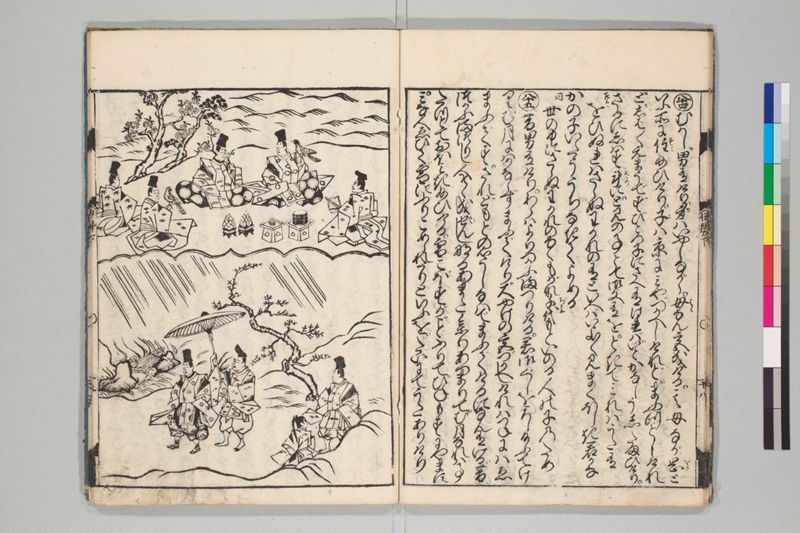
【挿絵】
現代語訳
【右丁】
**【第八十四段】**
昔、ある男がいた。(その男の)身分は低かったが、母君は宮(皇族)の出身であった。その母君は、長岡(ながおか)という所にお住まいになっていた。子(息子)は京で宮仕えをしていたが、(母君のもとへ)参上しようとは思っていても、たびたびは参ることができなかった。(その男は)一人息子でもあったので、(母君は)たいそう可愛がっていらっしゃった。
そういった折に、(ある年の)十二月ごろに、急ぎの用件があるとして御文(お手紙)があった。(息子が)取り出して見れば、(そこには)歌があった(『古今集』)。
老いぬれば さらぬ別れの あるといへば いよいよ見まく ほしき君かな
(老い先が短くなってくると、避けられない別れ(=死)というものがあると言うから、ますますあなた(息子)の顔が見たいことよ。)
あの息子は、ひどく泣きながら詠んだ歌は(『古今集』)、
世の中に さらぬ別れの なくもがな 千代もと祈る 人の子のため
(この世に、避けられない別れ(=死)というものがなければよいのに。いつまでも長生きしてほしいと千年の命を祈る、親を持つ子(自分)のために。)
---
**【第八十五段】**
昔、ある男がいた。幼い頃からある君(貴人)にお仕え申し上げていた。(その)君がご出家なさってしまった。(その男は)睦月(正月)には必ず参上していた。朝廷の宮仕えをしていたので、常には参上することができなかった。それでも昔からの志(誠意)を失わずに参上していたのであった。
(ある年の正月に参上すると)、昔(その君に)お仕えしていた人々が大勢集まって来ていた。睦月(正月)なので(めでたい)行事があるとして、お酒を賜った。雪がこぼすように(降り注ぐように)降って、一日中止まなかった。皆が酔っているところに、雪で(山中に)降り込められたと(誰かが)言ったので、それを題として歌があった(のだが、左丁の挿絵が入る)。
【左丁】
【挿絵】
英語訳
【Right folio】
**Episode 84**
Long ago, there was a man. Though his own station in life was humble, his mother was of royal (imperial) birth. This mother resided at a place called Nagaoka. Her son served at court in the capital, and though he intended to visit her, he was unable to go frequently. As he was her only child, she cherished him deeply and tenderly.
In such circumstances, around the twelfth month of a certain year, a letter arrived marked as urgent. When he opened it and looked, he found a poem (from the *Kokinshū*):
*Oinureba / saranu wakare no / aru to ieba / iyoiyo mimaku / hoshiki kimi kana*
(Now that I have grown old, they say there exists a parting that cannot be avoided — and so I find myself longing more than ever to see you, my child.)
The son wept bitterly and composed in reply (from the *Kokinshū*):
*Yo no naka ni / saranu wakare no / naku mo gana / chiyo mo to inoru / hito no ko no tame*
(Would that in this world there existed no parting that cannot be avoided! — for the sake of a child who prays for a thousand years of life for their parent.)
---
**Episode 85**
Long ago, there was a man. From his boyhood he had served a certain lord. That lord took holy orders and became a monk. (The man) always came to call upon him in the First Month (Mutsuki, i.e., January). Because he served at the imperial court, he could not come at all times; yet he came to visit without losing the devotion and loyalty he had felt since the old days.
(One year when he visited,) many people who had served the lord in former times had gathered together. As it was the First Month, there were festive ceremonies, and wine was bestowed upon them. Snow fell as if being scattered and poured down, without ceasing the whole day long. Everyone grew drunk, and (someone) remarked that they were snowed in and could not leave — and taking this as a topic, poems were composed. (The illustration on the left folio depicts this scene.)
【Left folio】
【Illustration】