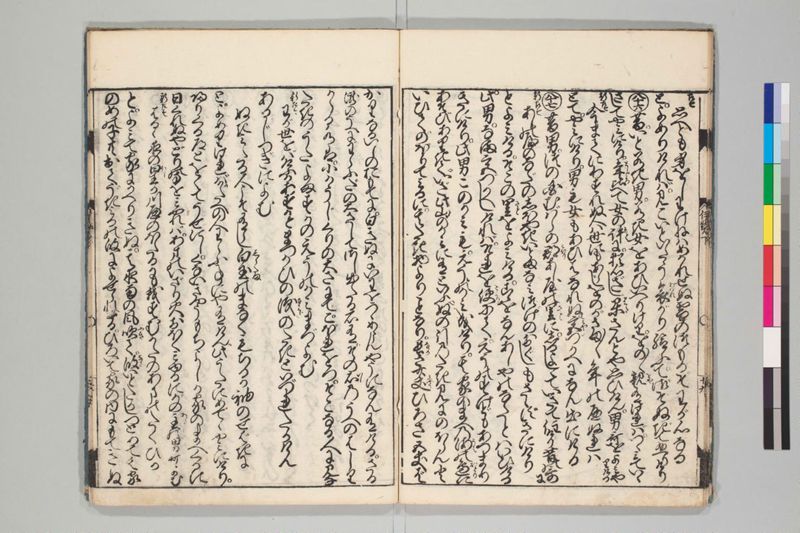
翻刻
【右丁】
《送り仮名:古今》思へども身をしわけねはめかれせぬ雪のつもるぞわが心なる
と。よめりければ。みこいといたう哀(あはれ)がり給ふて。御ぞぬぎて給へりけり
﹁八十六﹂昔。いと若き男。若き女をあひいへりけり。をの〳〵親(をや)有ければ。つゝみていゝ
さしてやみにけり。年比(としごろ)へて女の許(もと)に。猶心ざし果(はた)さんとや思ひけん。男哥をよみやりける
《送り仮名:新古今》今まてにわすれぬ人は世にもあらじをのがさま〳〵年のへぬれは
とて。やみにけり。男も女もあひはなれぬ。宮(みや)づかへになん出にける
﹁八十七﹂昔男。つの国むばらの郡(こほり)あしやの里(さと)に。しるよしゝていきて住けり昔の哥に
《送り仮名:新古今》あしのやのなだのしほやきいとまなみつげのおぐしもさゝずきにけり
とよみける。そこの里(さと)をよみける。こゝをなんあしやのなたとはいひける
。此男。なま宮づかへしければ。それを便(たより)にて。えうのすけどもあつまり
きにけり。此男このかみも。えうのかみ成けり。其家のまへの海(うみ)の辺(ほとり)に
あそびありきて。いざ此山のかみに有といふ。ぬの引のたき見にのぼらんと
いひて。のぼりてみるに。其たき物よりことなり。長(なか)さ廿 丈(しやう)ひろさ五丈ば
【左丁】
かりなるいしのおもてに。白きぬにいわをつゝめらんやうになん有ける。さる
瀧のうへに。わらふだの大さしてさし出たる石有。その石(いし)のうへのはしり
かゝる水は。小かうじくりの大さにて。こぼれをつ。そこなる人にみな
たきのうたよますかのえうのかみまづよむ
《送り仮名:新古今》わが世をばけふかあすかとまつかひの涙(なみだ)のたきといづれたかけん
あるじつぎによむ
ぬきみたる人こそ有らし白玉(したらま)のまなくもちるか袖のせばきに
と。よめりければ。かたへの人わらふ事にや有けん。此うたにめでゝやみにけり。
帰りくる道とをくてうせにし。くないきやうもちよしか家のまへくるに
日くれぬやどりの方をみやれば。あまのいざり火おほくみゆるに。かの主(あるじ)の男哥よむ
《送り仮名:新古今》はるゝ夜の星(ほし)か川辺のほたるかも我すむかたのあまのたくひか
と。よみて家にかへりきぬ。其夜南の風 吹(ふき)て。波(なみ)いとたかしつとめて其家
のめの子共出て。うきみるの波によせられ□【た】る。ひろいて家の内にもてきぬ
現代語訳
【右丁】
(前ページからの続き・第八十五段の結び)
(『古今集』)
思へども 身をし分けねば 目離れせぬ 雪の積もるぞ わが心なる
(あなたのことを思い続けているけれど、自分の身をふたつに分けることもできないので、いつも目を離さずにいる、この積もる雪こそが私の心(の深さを表すもの)です。)
と詠んだところ、(出家された)親王は、たいそう深く感動なさって、(お召しの)お召し物を脱いでお与えになった。
---
**【第八十六段】**
昔、たいそう若い男が、若い女と互いに思い合っていた。それぞれに親があったので、(人目を)はばかって(話が)中途半端なまま終わってしまった。数年が経って、男は女のもとに、やはり昔の志を遂げようと思ったのだろうか、歌を詠んで送った(『新古今集』)。
今までに 忘れぬ人は 世にもあらじ をのがさまざま 年の経ぬれば
(これほど長い間、ずっと忘れずにいた人は、世の中にもいないでしょう。それぞれが別れ別れになって、年月が経ってしまったのだから。)
とだけ言って、(そのまま関係は)終わってしまった。男も女も(互いに)離れ離れになり、宮仕えに出てしまっていたのだった。
---
**【第八十七段】**
昔、男が、摂津の国の武庫郡(むばらのこほり)の芦屋の里に、縁あってやって来て住んでいた。昔の歌に(『新古今集』)、
葦の屋の 灘の塩焼き 暇なみ 黄楊の小櫛も させず来にけり
(葦葺きの粗末な家の、灘の塩を焼くのが忙しくて、黄楊(つげ)の小さな櫛も(髪に)挿す暇もなくなってしまった。)
と詠んだ、その(歌にある)里を詠んだのであった。この場所を「芦屋の灘(なだ)」と言ったのである。
この男は、なまじ宮仕えをしていたので、そのつてを頼って、摂津権介(えうのすけ)たちが集まって来た。この男の兄もまた、摂津権守(えうのかみ)であった。その家の前の海辺を遊び歩いて、「さあ、この山の上にあるという布引の滝(ぬのひきのたき)を見に登ろう」と言って、(一同)登って見てみると、その滝は(他の)何ものとも異なるほど見事だった。長さ二十丈、幅五丈ほど
【左丁】
の岩の面に、白い布に岩を包んだかのようにかかっていた。その滝の上に、わらじ(藁沓)ほどの大きさで差し出ている岩があり、その岩の上の端を走り落ちる水は、小さな紅麹(こうじ)を繰る(=紅麹草?)ほどの細さで、(糸を繰るように)こぼれ落ちる。そこにいる人々に皆、滝の歌を詠ませると、あの摂津権守(えうのかみ)がまず詠んだ(『新古今集』)。
わが世をば 今日か明日かと 待つ貝の 涙の滝と いづれ高けん
(私のはかない命が、今日か明日かと(尽きるのを)待つ(ように流れ落ちる)、(「まつ」と「松」に)貝を掛けた、涙の滝と、どちらが(流れが)高いことだろうか。)
主人(あるじ)がそれに続いて詠んだ。
ぬきみだる 人こそあらし 白玉の まなくも散るか 袖の狭きに
((糸を)抜き乱した(ほどに、涙の玉を)乱している人(=涙を流している人)がいるに違いない。白玉(=水の雫か涙)がひっきりなしに散ることよ。袖が狭くて(受け止めきれない)ほどに。)
と詠んだところ、傍らにいた人々は笑うことになったのだろうか(=笑ったようだ)。(皆)この歌に感動して(その場は)終わった。
帰り道は遠く、(道中)亡くなってしまった宮内卿(くないきょう)持よし(もちよし)の家の前を通ると、日が暮れた。宿のある方角を眺めやると、海人(あま)の漁火(いさりび)が多く見えるので、あの主人(あるじ)の男が歌を詠んだ(『新古今集』)。
晴るる夜の 星か川辺の 蛍かも わが住む方の 天の焚く火か
(晴れた夜空の星だろうか、川辺の蛍だろうか。いや、私の住む方の、海人が焚く漁火なのだろうか。)
と詠んで、家に帰ってきた。その夜、南の風が吹いて、波がたいそう高くなった。翌朝早く、その家の女たちが出て、浮布海苔(うきみる)が波に寄せられて(打ち上げられて)いるのを拾い集めて、家の中に持って来た。
英語訳
【Right folio】
*(Continuation and conclusion of Episode 85)*
(From the *Kokinshū*):
*Omoedomо / mi wo shi wakeneba / me kare senu / yuki no tsumorizo / waga kokoro naru*
(Though I think of you constantly, I cannot divide my body in two — and so it is this ever-watching, ever-accumulating snow that embodies my heart for you.)
When he recited this, the Prince was deeply and profoundly moved, and removed his own robe and bestowed it upon him.
---
**Episode 86**
Long ago, a very young man and a young woman were in love with each other. As both had parents, they held back out of discretion, and the affair ended inconclusively. After several years had passed, the man — perhaps thinking he would still fulfill his old intentions — sent a poem to the woman (from the *Shin Kokinshū*):
*Ima made ni / wasurenu hito wa / yo ni mo araji / onoga samazama / toshi no henureba*
(There can surely be no one in this world who has gone on remembering another this long — for we have each gone our separate ways, and the years have passed.)
With that, the matter came to an end. Both the man and the woman had drifted apart from each other and had gone off to serve at court.
---
**Episode 87**
Long ago, a man went to live at Ashiya Village in Mubara District, Settsu Province, having some connection to that place. In an old poem (from the *Shin Kokinshū*):
*Ashi no ya no / Nada no shioyaki / itoma nami / tsuge no ogushi mo / sasezu ki ni keri*
(At a humble reed-thatched house, tending the salt fires of Nada keeps one so busy that there is no time even to put in a small boxwood comb.)
— this was the very village sung of in that poem. This place was called "Ashiya no Nada."
Now, this man was something of a court official, and on account of that connection, various deputy governors of Settsu (*e no suke*) gathered around him. This man's elder brother was also the governor of Settsu (*e no kami*). They strolled along the seaside before the house, and said: "Come now, let us climb up to see the Nunobiki Waterfall said to be at the top of this mountain." So they climbed up and looked — and the waterfall was utterly unlike anything else they had ever seen. It was some twenty *jō* (approx. 60 meters) in height and about five *jō* (approx. 15 meters) wide,
【Left folio】
cascading down the face of the rock like a great white cloth wrapped around a boulder. Above the falls there jutted out a rock the size of a straw sandal, and the water rushing off the edge of that rock fell in a stream no wider than a small thread of *kōji* mold being reeled, spilling and dropping away. The people assembled there were each asked to compose a poem about the waterfall, and the governor of Settsu (*e no kami*) composed first (from the *Shin Kokinshū*):
*Waga yo woba / kyō ka asu ka to / matsu kai no / namida no taki to / izure takaken*
(My life, which I wait to end like a shellfish waiting day by day — which do you suppose flows higher: that tearful waterfall, or the cascade of my own tears?)
The host then composed next:
*Nuki midaru / hito koso arashi / shiratama no / manaku mo chiruka / sode no sebaki ni*
(There must be someone here unraveling and scattering white gems — for these white droplets fall without cease, as if more than a narrow sleeve could hold.)
When this was recited, the bystanders apparently burst out laughing. Everyone was delighted with the poem, and on that note things came to a close.
The road home was long, and as they passed before the house of the late Kunakyō Mochiyoshi, night fell. Looking out toward the direction of their lodgings, they could see many fishing fires of the sea-people (*ama*) burning out on the water, and so the host composed a poem (from the *Shin Kokinshū*):
*Haruru yo no / hoshi ka kawabe no / hotaru ka mo / waga sumu kata no / ama no taku hi ka*
(Are those the stars of a clear night, or fireflies along the riverbank? Or are they the fires that the fishermen burn, there in the direction of my home?)
With this he composed, and they returned home. That night, a south wind blew and the waves grew very high. Early the next morning, the women of the house went out and gathered up the floating seaweed (*ukimiru*) that had been washed ashore by the waves, and brought it inside the house.