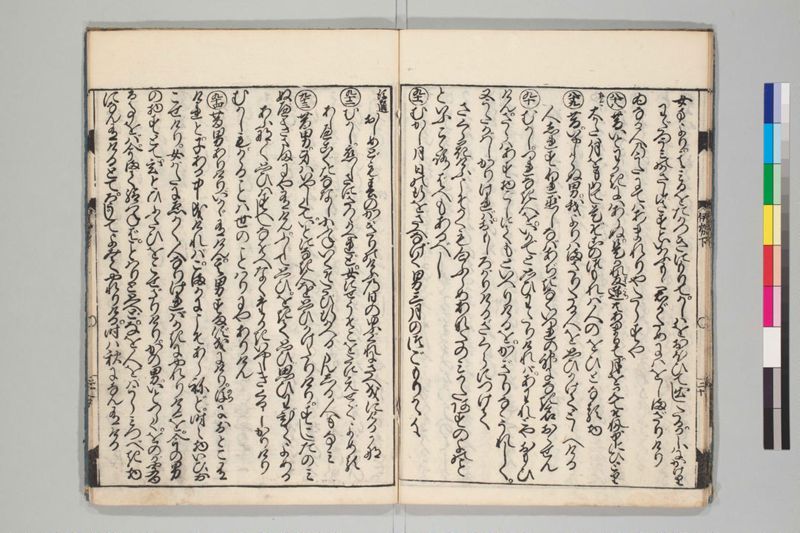
翻刻
【右丁】
女方より。其みるをたかつきにもりて。かしはをおほひて出したる。かしはにかけり
わだつうみのかさしにさすといはふもゝ君がためにはをしまざりけり
ゐなか人のうたにてはあまれりやたらすや
「八十八」昔いとわかきにはあらぬ。是かれ友達(ともたち)共あつまりて。月を見てそれが中にひとり
《送り仮名:古今》大かたは月をもめてし是ぞこのつもれば人のをひとなる物
「八十九」昔。いやしからぬ男。我よりはまさりたる人を思ひかけてとしへける
人しれすわれ恋しなばあぢきなくいつれの神になき名おゝせん
「九十」むかし。つれなき人を。いかでと思ひわたりければ。あわれとやおもひ
けん。さらはあす物ごしにてもといへりけるを。かぎりなくうれしく。
又うたがはしかりければ。おもしろがりける。さくらにつけて
さくら花けふこそかくも匂ふらめあなたのみかたあすのよのこと
といふこゝろばへもあるべし
「九十一」むかし月日の行をさへなげく男三月のつごもりかたに
【左丁】
《送り仮名:後撰》おしめども春のかぎりのけふの日のゆふくれにさへ成にけるかな
「九十二」むかし。恋しさにきつゝかへれど。女にせうそこをたにえせでよめる
あしへこぐたななし小ふねいくそたび行かへるらんしる人もなみ
「九十三」昔男。身はいやしくて。いとになき人を思ひかけたりけり。すこしたのみ
ぬべきさまにや有けん。ふして思ひ。をきて思ひ。思ひわびてよめる
あふな〳〵思ひはすへしなぞへなくたかきいやしきくるしかりけり
むかしも。かゝることは世のことはりにやありけん。
「九十四」昔男ありけり。いかゞ有けん。其男すまず成にけり。後(のち)におとこ有
けれと。子ある中成ければ。こまかにこそあらねど。時々物いひお
こせけり。女がたにゑかく人なりければかきにやれりけるを。今の男
の物すとて。ひとひふたひをこせざりけり。かの男。いとつらく。をのが聞ゆ
る事をば。今まて給はねば。ことはりと思へど。なを人をばうらみつべき物
になん有けるとて。ろうじてよみてやれりける。時は秋になん有ける
現代語訳
【右丁】
(第八十七段の続き)
女の側から、その(浮布)海苔を高坏(たかつき)に盛り、柏の葉をかぶせて出した。その柏の葉に(歌が)書き付けてあった。
わだつ海の かざしに挿すと いわふ藻も 君がためには 惜しまざりけり
(海神が髪飾りに挿すと言って神に捧げる(いわふ)藻でさえも、あなたのためなら惜しくはありません。)
田舎の人の歌としてはあまりある(=出来すぎている)と、(たたえた)のだろうか。
---
**【第八十八段】**
昔、まったく若いというわけでもない人々が、あれこれ友達同士で集まって、月を眺めていた。その中のひとりが(詠んだ)(『古今集』)。
大方は 月をもめでじ これぞこの 積もれば人の 老いとなるもの
(もう月などめでていられまい。月の巡りが積み重なれば、それが人の老いというものになるのだから。)
---
**【第八十九段】**
昔、身分のいやしくない男が、自分よりもさらに優れた(高い身分の)人を思い慕って、長年を過ごしていた。
人知れず われ恋い死なば あぢきなく いずれの神に 亡き名おわせん
(人知れず、私がこの恋のために死んでしまったなら、どうにもならない。いったいどの神に、いわれのない悪評(亡き名)をなすりつけることになるのだろうか。)
---
**【第九十段】**
昔、つれない(冷たい)人を、なんとかして(振り向かせたい)と思い続けていたところ、(相手が)気の毒に思ったのだろうか、「それなら明日、物越しにでも(会いましょう)」と言ってきた。(男は)この上もなくうれしく、またも一方で疑わしく(半信半疑で)もあったので、(気持ちを)面白く興じて、(散り際の)桜の花に結びつけて(歌を贈った)。
桜花 今日こそかくも 匂ふらめ あなたのみかた 明日の夜のこと
(桜の花よ、今日はこんなにも美しく匂うことだろう。しかし、あなた次第のこと——明日の夜のことは(どうなるかわからない)。)
という意味合いもあることだろう(=こういう心持ちもあってのことだろう)。
---
**【第九十一段】**
昔、月日の移ろいさえも嘆く男が、三月の末ごろに(詠んだ)(『後撰集』)。
【左丁】
惜しめども 春の限りの 今日の日の 夕暮れにさへ なりにけるかな
(惜しんでいても、春の最後の日である今日が、もう夕暮れにまでなってしまったことよ。)
---
**【第九十二段】**
昔、(恋しさのあまり)女のもとに行っては帰るけれど、女に(会うことも)伝言(消息)さえもできずに(男が)詠んだ。
葦辺漕ぐ たなし小舟 いくそたび 行き帰るらん 知る人もなみ
(葦辺を漕ぐ梶なし小舟のように、私は何度も行ったり来たりしていることか。それを知る人もいないまま。)
---
**【第九十三段】**
昔、男が、(自分の)身分はいやしく(低く)て、まったく届きそうにない(高貴な)人を思い慕っていた。少しは望みを持てそうな気配があったのだろうか、臥して思い、起きて思い、思い悩んで詠んだ歌。
あふな〳〵 思いはすべし なぞへなく 高きいやしき 苦しかりけり
(決して(直接)近づいてはならない相手への思いを、(それでも胸の内で)尽くしてしまうことよ。比べようもなく身分が高いのと低いのとでは、苦しいものであることよ。)
昔もこのようなことは、世の道理(ことわり)としてあったのだろうか。
---
**【第九十四段】**
昔、男(と女)がいた。(ふたりの間に)どういった事情があったのだろうか、その男(=もとの男)は(女のもとへ)通わなくなってしまった。後に(別の)男がいたが、子のある仲であったから、細やかにではないものの、時々(もとの男に)ものを言い送ってきた(=女が連絡をよこしてきた)。女の側に絵を描く人(絵師)がいたので、(女が絵を)描いて送ったのだが、今の(新しい)男が(その絵を)しまい込んで、一日も二日も(もとの男のもとへ)送ってよこさなかった。あの(もとの)男は、たいそうつらく思い、自分が(女に)お伝えしていることは、今まで(お返事を)頂かないので、(それは新しい男がいるから)当然のことと思ってはいるけれど、それでも人(相手の女)を恨めしく思わずにはいられないものである、とて、(歌を)苦心して詠んで送った。時は秋であった。
英語訳
【Right folio】
*(Continuation of Episode 87)*
From the women's side, that gathered seaweed (*ukimiru*) was heaped upon a tall footed stand (*takatsuki*) and covered with oak leaves (*kashiwa*), and presented. Upon the oak leaf a poem had been written:
*Watatsu umi no / kazashi ni sasu to / iwafu mo mo / kimi ga tame ni wa / oshimazarikeri*
(Even the sacred seaweed that the god of the sea is said to wear as a hair ornament — for your sake, I would not begrudge giving it away.)
One might wonder whether this poem was more than one might expect from a country person, and perhaps that was (the reaction it drew).
---
**Episode 88**
Long ago, people who were not exactly young anymore gathered together as friends, gazing at the moon. Among them, one person composed (from the *Kokinshū*):
*Ōkata wa / tsuki wo mo medeji / korezokono / tsumoreba hito no / oi to naru mono*
(Let us no longer admire the moon so freely — for it is precisely the accumulation of these months and their passing that becomes the aging of a person.)
---
**Episode 89**
Long ago, a man of no mean birth had spent years yearning for someone far above his station.
*Hito shirezu / ware koi shinaba / ajikina ku / izure no kami ni / naki na owase n*
(If I were to die of this love, unknown to anyone, it would be a wretched thing indeed — upon which god would such a baseless ill-reputation be laid?)
---
**Episode 90**
Long ago, a man had continued to think: how might I win over this cold-hearted one? Perhaps out of pity for him, the person sent word: "Very well then — tomorrow, even if through a screen." He was boundlessly overjoyed, and yet also doubtful and uncertain, so he expressed his feelings in playful verse, attaching it to cherry blossoms (in their scattering glory):
*Sakura hana / kyō koso kaku mo / niōrame / anata no mikata / asu no yo no koto*
(The cherry blossoms must be fragrant and glorious just like this today — but what tomorrow night brings is entirely up to you.)
Such, one supposes, was the spirit behind the poem.
---
**Episode 91**
Long ago, a man who lamented even the passage of days and months composed this poem near the end of the third month (from the *Gosenshū*):
【Left folio】
*Oshimedo mo / haru no kagiri no / kyō no hi no / yūgure ni sae / nari ni keru kana*
(Much as I would hold it back, this final day of spring — today of all days — has come to be evening already.)
---
**Episode 92**
Long ago, a man kept going to a woman out of longing, yet kept returning, unable even to send a message to her, and composed:
*Ashibe kogu / tanashi kobune / iku so tabi / yukikaeru ran / shiru hito mo nami*
(Like a little rudderless boat rowing among the reeds, how many times must I go and come back? — with no one who knows of it.)
---
**Episode 93**
Long ago, a man of lowly station had set his heart on someone utterly beyond his reach. There may have been some small indication that hope was not entirely impossible, for he lay thinking and rose thinking, and worn out with longing, composed:
*Ōna ōna / omoi wa subeshi / nazohe naku / takaki iyashiki / kurushikarikeri*
(I have poured out all my longing for one I must never approach — the gulf between the high and the low, with nothing to compare it to, is a painful thing indeed.)
Even in ancient times, surely such things were simply the way of the world.
---
**Episode 94**
Long ago, there was a man (and a woman). What circumstances there had been, one cannot say, but that man had ceased to visit (the woman). Later there was another man, but as there was a child between (the woman and the first man), though not in great detail, she would occasionally send him word. As there was a person skilled in painting on the woman's side, she had a picture painted and sent — but the current man (her new partner) hoarded it away and would not forward it for a day or two. That first man found this most painful, and thought: what I convey to her, I have not received any reply to until now — so I suppose that is to be expected — yet one cannot help but feel resentment toward the other person nonetheless. With this, he carefully composed a poem and sent it off. The season was autumn.