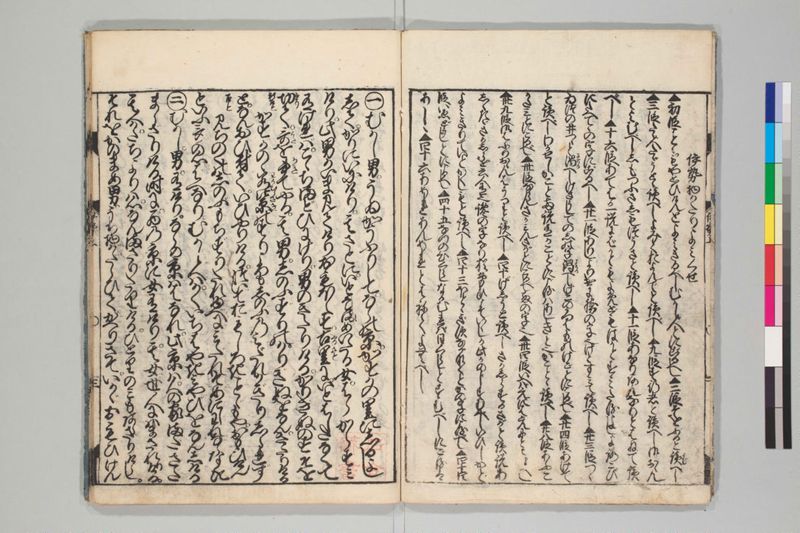
翻刻
【右丁】
伊勢物かたりよみくせ
▲初段ことゝ。もや思ひけんとよみきるべしむかし〝人とにごるへし▲二段そをふると読(よむ)へし
▲三段たゝ人たゞうとゝ読べしよみておよんでと読べし▲九段す行者と読へし御おゝん
とよむべししもつふさしもつうさと読べし▲十一段あなりあんなりとはねて読
べし▲十六段あてはか一説にばかともよめどもはかとすみたるよしよろこび
にたへてゝの字にごるへし▲廿一段ありしよりけに稀【勝では】の字也けとすみて読べし▲廿三段つゝ
ゐづの井つゝと濁(にごる)へしけさうしてのしの字 濁(にこる)へしけこのうつはものけごとにこるべし▲廿四段あけて
と読べしわかせしかこと両説有かことくにごるはあしきと也かことゝ読べし▲廿八段あふこ
かたみとにこるべし▲卅段ならんさかみんさがとにこるべし悪の字也▲卅四段いへばえにはえにと□□へし
▲卅九段御はふりおゝんはうりと読べし▲四十げしうと読べしさかしらするさがと読説あ
しくたゞさかしらを云人有也讒の字なり猶おもひこそいゝしか此かのじすむべしいひしかと
よみきりていとかくしもと読べし▲四十三ほとゝぎすながなくとかの字にこるべし▲四十四
段いゑどうじとにごるへし▲四十五なつのひくらしなかむれば日くらしとすむべしにごるは
あしゝ▲四十六あめれあんめれとはねてよむべし
【左丁】
㊀むかし男。うゐかうふりして。ならの京。かすかの里にしるよし
して。かりにいにけり。其さとに。いとなまめいたる女。はらからすみ
けり。此男かいま見てけりおもほえす。古里(ふるさと)に。いとはしたなくて
有ければ。こゝちまどひにけり。男のきたりける。かりぎぬのすそを
切(きり)て。哥(うた)を書(かき)てやる。其男。しのぶずりの。かりぎぬをなん。きたりける
《送り仮名:新古今》かすがのゝ若紫(わかむらさき)のすりころもしのぶのみだれかぎりしられず
と。なんおひ付て。いひやりける。ついでおもしろきことゞもや。おもひけん。
《送り仮名:古今》みちのくのしのぶもぢずりたれゆへにみだれそめにしわれならなくに
といふ哥の心ばへなり。むかし人は。かくいちはやきみやびをなんしける
㊁むかし。男。有けり。ならの京ははなれ。此京は。人の家まださだ
まらざりける時に。西の京に女有けり。其女。世人にはまされりける。
其人。かたちよりは。心なんまさりたりける。ひとりのみもあらざりけらし。
それをかのまめ男。うち物がたらひて。かへりきて。いかゞおもひけん
現代語訳
【右丁:伊勢物語の読み癖(読み方の注意事項)】
▲第一段:「ことゝ」——「もや思ひけん」と読み切るべし。「むかし〝人」は濁って読むべし。
▲第二段:「そをふると」と読むべし。
▲第三段:「たゞ人」——「たゞうと」と読むべし。「よみて」は「およんで」と読むべし。
▲第九段:「す行者」と読むべし。「御」は「おゝん」と読むべし。「しもつふさ」・「しもつうさ」と読むべし。
▲第十一段:「あなり」は「あんなり」と撥ねて読むべし。
▲第十六段:「あてはか」——一説には「ばか」とも読めるが、「はか」と澄んで読むが正しい。「よろこび」の「にたへて」の「ゝ」の字は濁るべし。
▲第二十一段:「ありしよりけに」——「稀」(「勝では」)の字である。「け」と澄んで読むべし。
▲第二十三段:「つゝゐづの井つゝ」は濁るべし。「けさうして」の「し」の字は濁るべし。「けこのうつはもの」——「けご」と濁るべし。
▲第二十四段:「あけて」と読むべし。「わかせしかこと」については両説あり。「かことく」と濁るのは悪い。「かこと」と読むべし。
▲第二十八段:「あふこかたみ」と濁るべし。
▲第三十段:「ならん」——「さかみん」——「さが」と濁るべし。「悪」の字である。
▲第三十四段:「いへばえにはえに」と□□(読み方)すべし。
▲第三十九段:「御はふり」は「おゝんはうり」と読むべし。
▲第四十段:「げしう」と読むべし。「さかしらする」——「さが」と読む説はよくない。ただ「さかしら」を言う人がいる。「讒」の字である。「猶おもひこそいひしか」——この「か」の字は澄むべし。「いひしかと」読み切って、「いとかくしも」と読むべし。
▲第四十三段:「ほとゝぎすながなくとか」——「か」の字は濁るべし。
▲第四十四段:「いゑどうじ」と濁るべし。
▲第四十五段:「なつのひくらしながむれば」——「日くらし」と澄んで読むべし。濁るのはよくない。
▲第四十六段:「あめれ」は「あんめれ」と撥ねて読むべし。
---
【左丁:伊勢物語 本文】
**㊀(第一段)**
昔、男が、初めての元服(成人式)を済ませて、奈良の京・春日の里に、縁故のある人を頼って、狩りに行った。その里に、たいそう優美な女が、姉妹で住んでいた。この男がふと垣間見てしまった。思いがけなくも、(奈良の)旧都にして、たいそう不似合いな(艶やかな美しさに)、心が乱れてしまった。男が着てきた狩衣の裾を切って、和歌を書いて贈った。その男は、しのぶずりの狩衣を着ていた。
《送り仮名:新古今》
春日野の 若紫の すり衣
しのぶの乱れ かぎり知られず
と、追いかけるようにして言い送った。「ついで(折々の機会)を面白く(情趣深く)扱うものよ」と思ったのだろうか。
《送り仮名:古今》
みちのくの しのぶもぢずり
たれゆえに みだれそめにし
われならなくに
という歌の趣意(心ばえ)に倣ったものである。昔の人は、かくも激しい(熱烈な)風雅の振る舞いをしたのであった。
---
**㊁(第二段)**
昔、男がいた。奈良の京からは離れて、この(新しい)京(平安京)に人々の家がまだ定まっていない頃に、西の京に女がいた。その女は、世間の人よりも優れていた。その人は、容姿よりも心のほうが一層優れていた。(その女は)一人だけではなかったらしい。それを、かの誠実な男が、話し合いを交わして、帰ってきて、どのように思ったのだろうか——
英語訳
**[Right page: Reading Notes for the Tales of Ise]**
These are pronunciation and reading guides for various episodes of the Ise Monogatari, indicating where to pause, where to voice (dakuten/voiced consonants), where to nasalize, and how to render certain words:
▲ **Episode 1:** "Kototo" — read through to "moya omoiken." "Mukashi〝hito" should be read with voicing (dakuten).
▲ **Episode 2:** Should be read as "so wo furu to."
▲ **Episode 3:** "Tadabito" should be read as "tada uto." "Yomite" should be read as "oyonde."
▲ **Episode 9:** Read as "su-gyōja." "On" (御) should be read as "oohn." Read "Shimotsu-fusa" and "Shimotsu-usa."
▲ **Episode 11:** "Anari" should be read with nasalization as "annari."
▲ **Episode 16:** "Atehaka" — one theory reads it as "baka," but the clear (unvoiced) reading of "haka" is correct. In "ni taete," the reduplication mark (ゝ) should be voiced.
▲ **Episode 21:** "Arishi yori keni" — the character is 稀 ("rare/seldom," *not* 勝). Read "ke" clearly (unvoiced).
▲ **Episode 23:** "Tsutsu-idu no i-tsutsu" should be voiced (dakuten). The "shi" in "kesō shite" should be voiced. In "ke ko no utsuwa mono," "ke-go" should be voiced.
▲ **Episode 24:** Should be read as "akete." Regarding "waga seshi kakoto," there are two theories. Reading it voiced as "kakotoku" is incorrect; it should be read as "kakoto."
▲ **Episode 28:** "Afu ko katami" should be voiced.
▲ **Episode 30:** "Naran" — "sakamin" — "saga" should be voiced. It is the character for "evil/wrong" (悪).
▲ **Episode 34:** "Ieba e ni wa e ni" should be read □□ (manner of reading unclear/damaged in manuscript).
▲ **Episode 39:** "Mihōri" should be read as "oohn-hōri."
▲ **Episode 40:** Should be read as "geshū." Reading "sakashira suru" as "saga" is incorrect — there are those who simply say "sakashira." The character is 讒 (slander/defamation). For "nao omoi koso iishika," the final "ka" should be read clearly (unvoiced). Read through "iishika to," then read on as "ito kaku shimo."
▲ **Episode 43:** "Hototogisu naga naku to ka" — the "ka" should be voiced.
▲ **Episode 44:** "Ie-dōji" should be voiced.
▲ **Episode 45:** "Natsu no hi-kurashi nagamureba" — "hi-kurashi" should be read clearly (unvoiced). Voicing it is incorrect.
▲ **Episode 46:** "Amere" should be read with nasalization as "anmere."
---
**[Left page: Text of the Tales of Ise]**
**㊀ Episode One**
Long ago, a man, having just celebrated his coming-of-age ceremony for the first time, went to the old capital of Nara — to the village of Kasuga — to visit someone he had connections with, going out on a hunt. In that village lived two sisters of remarkably graceful and refined beauty. The man happened to catch a glimpse of them. Unexpectedly, in this old capital, he found himself utterly bewildered — overwhelmed by the sight of such incongruous, dazzling beauty — and his heart fell into confusion. He cut off the hem of the hunting robe he was wearing, and wrote a poem upon it, sending it to them. The man had been wearing a hunting robe dyed in the shinobu-zuri pattern.
*(Headnote: New Kokinshū)*
*On the fields of Kasuga—*
*a robe rubbed with young purple,*
*the "shinobu" pattern's disorder:*
*my longing knows no end.*
This is what he sent after them in pursuit. Perhaps he thought this a fitting and elegant occasion.
*(Headnote: Kokinshū)*
*The dyed patterns of shinobu*
*in far Michinoku—*
*on whose account have I begun*
*to fall into disorder?*
*Surely it is not my own doing.*
The poem was composed in the spirit of that older verse. People of the ancient past performed such bold and ardent acts of elegance.
---
**㊁ Episode Two**
Long ago, there was a man. Removed from the old capital of Nara, at a time when people's residences in this new capital (Heian-kyō) had not yet been settled, there lived a woman in the western district of the capital. This woman surpassed the people of the world. In this person, the heart surpassed even the appearance in excellence. It seems she was not alone. The earnest man exchanged conversation with her, returned home, and — what thoughts must have crossed his mind...