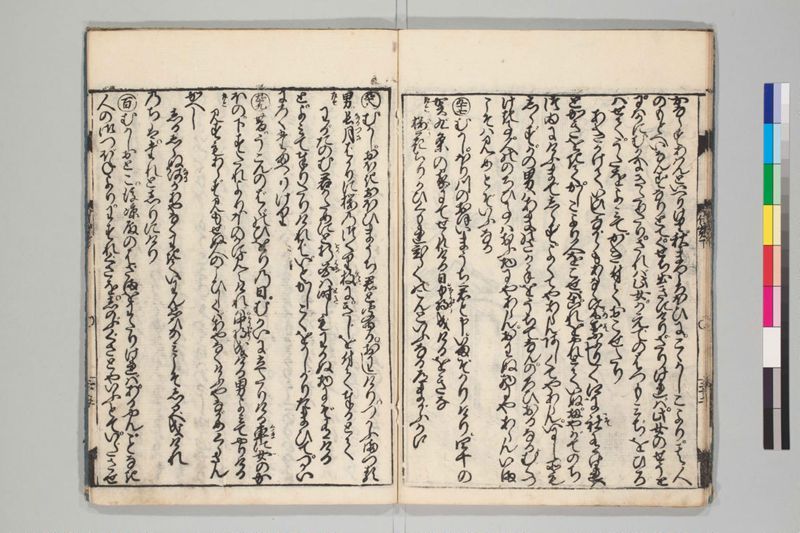
翻刻
【右丁】
かならすあはんといへりけり。秋まつころほひに。こゝかしこより。其人
のもとへいなんずなりとて。くせち出きにけり。さりければ。此の女のせうと
。にはかにむかへにきたりたり。されば此女。かえでのはつもみぢをひろ
はせて。うたをよみて。かき付ておこせたり
あきかけていひしながらもあらなくに木葉(このは)ふりしくえに社(こそ)有けれは
とかきをきて。かしこより人をこせば。これをやれとていぬ。扨やがてのち
つゐにけふまでしらず。よくてやあらんあしくてやあらん。いにし所も
しらず。かの男はあまのさか手をうちてなん。のろひおるなる。むくつ
けき事。人ののろひ事はおふ物にやあらん。おわぬ物にやあらんいま
こそは見めとぞいふなる
﹁九十七﹂むかし。ほり川のおほいまうち君と申。いまぞかりけり。四十の
賀。九条の家にてせられける日。中将(ちうじやう)成けるをきな
《送り仮名:古今》桜(さくら)花ちりかひくもれ老らくのこんといふなる道まがふかに
【左丁】
﹁九十八﹂むかし。おほきおほひまうち君と聞ゆる。おわしけり。つかふまつる
男。長月(なかつき)ばかりに。桜のつくり枝(えた)に。きじを付て奉るとて
《送り仮名:古今》わがたのむ君かためにと折(をる)花(はな)は時(とき)しもわかぬ物にぞ有ける
と。よみて奉りたりければ。いとかしこくをかしがりたまひて。つかい
にろくたまへりけり
﹁九十九﹂昔。うこんのばゞのひをりの日。むかいに立たりける車(くるま)に女のか
ほの。下すたれよりほのかに見えければ。中将(ちうじやう)成ける男よみてやりける
《送り仮名:古今》見すもあらず見もせぬ人のこひしくばあやなくけふやながめくらさん
かへし
しるしらぬ何(なに)かあやなくわきていわん思ひのみこそしるべ成けれ
のちは。たれとしりにけり
﹁百﹂むかしおとこ。後涼殿のはざまをわたりければ。あるやんごとなき
人の御つぼねより。わすれぐさを。しのぶぐさとやいふとて。いださせ
現代語訳
【右丁】
(第九十六段・続き)
きっと逢いましょう、と言い送ってきたのであった。秋を待つ頃になって、あちこちから、その人(男)のもとへ(女が)行ってしまうことになるという噂が立ってきたのであった。そういうわけで、この女の兄が、にわかに(女を)迎えに来たのであった。そこでこの女は、楓の初紅葉を拾わせて、歌を詠んで書きつけて(男のもとへ)送り届けたのであった。
秋かけて 言ひしながらも あらなくに 木の葉降りしく 江にこそありけれ
(秋になったら逢おうと言っておきながら、(その約束も果たせないまま)木の葉が降り積もる川の入り江のようなありさまになってしまいましたよ。)
と書き置いて、「あちらから人が来たら、これを渡してくれ」と言い残して(家を)出て行った。さて、その後ついに今日まで(男は女の消息を)知らない。無事でいるのか、よくないことになっているのか。去って行った所も知らない。あの男は手の甲をたたいて、(女を)呪い続けているという。不気味なことである。人の呪いというのは(相手に)及ぶものなのだろうか、及ばないものなのだろうか。今こそ(その結果が)見られるであろう、と(人々は)言っているという。
---
**【第九十七段】**
昔、堀河の大臣(おおいもうちぎみ)と申し上げる方が、今(当時)いらっしゃった。その四十の賀(お祝い)を、九条の邸にてなされた日に、中将(ちゅうじょう)であった翁(おきな)が(詠んだ)。
桜花 散りかひ曇れ 老らくの 来んといふなる 道まがふかに
(桜の花よ、散り乱れて空を曇らせておくれ。老いがやって来るという道を、まぎれて迷わせてしまうほどに。)
---
【左丁】
**【第九十八段】**
昔、大きな大臣(おおいもうちぎみ)と聞こえる方がいらっしゃった。お仕えする男が、長月(九月)の頃に、桜の造り枝(造花の枝)に雉(きじ)をつけて(その大臣に)差し上げるとして(詠んだ)。
わが頼む 君がためにと 折る花は 時しもわかぬ 物にぞありける
(私がお頼り申し上げるあなたのためにと折る花は、(造花ゆえ)季節を選ばないものなのでございます。)
と詠んで差し上げたところ、たいそう賢く(趣深く)おもしろがりなさって、使いの者に禄(ほうび)をお与えになったのであった。
---
**【第九十九段】**
昔、右近の馬場の火取りの日に、向かいに立っていた車に乗った女の顔が、下簾(さげすだれ)の下からほのかに見えたので、中将であった男が詠んで送った。
見ずもあらず 見もせぬ人の 恋しくば あやなく今日や 眺め暮らさん
(全く見知らぬわけでもなく、かといってよく知っているわけでもない人が恋しくなれば、わけもなく今日一日を物思いにふけって過ごすことになるのだろうか。)
返歌(かえし)
知る知らぬ 何かあやなく わきていわん 思ひのみこそ しるべなりけれ
(知っている人も知らない人も、どうして区別して言えましょうか。(互いへの)思いこそがただ一つの道しるべなのでございます。)
後には、(互いに)誰であるかわかったのであった。
---
**【第百段】**
昔、男が後涼殿(こうろうでん)の廊下を通ったところ、ある高貴な方のお局(つぼね)から、忘れ草を「しのぶ草とも言うのでしょうか」とおっしゃって、差し出させ(た。)
英語訳
【Right folio】
*(Episode 96, conclusion)*
— (the woman had sent word that) she would surely meet him in autumn. But around the time they were awaiting autumn, rumors began to arise from various quarters that the woman was to be taken away to some man's household. And so the woman's elder brother suddenly came to take her away. The woman therefore had someone gather the first red leaves of the maple, composed a poem, wrote it down, and sent it to the man:
*Aki kakete / iishi nagara mo / ara naku ni* / *konoha furishiku / e ni koso ari kere*
(Though I spoke of meeting you in autumn, it has not come to be — and now it is as if fallen leaves pile up and drift into the inlet, swept away before the promise could be kept.)
Having written this and left it behind, she said, "If someone comes from that direction, give them this," and departed. After that, to this very day he does not know what became of her — whether she fares well or ill. He does not even know where she went. That man, they say, strikes the back of his hand and continues to curse her. A most unsettling thing. Whether a person's curse actually reaches its mark or passes it by — that, people say, remains to be seen.
---
**Episode 97**
Long ago, there was a man known as the Minister of Horikawa (*Horikawa no Ōimōchigimi*). On the day his fortieth-year celebration (*shijū no ga*) was held at the Kujō mansion, an elderly man who was then of the rank of Middle Captain (*Chūjō*) composed:
*Sakurabana / chiri kai kumorevu / oiraku no* / *kon to iu naru / michi magau ka ni*
(O cherry blossoms, scatter and fill the sky with clouds of petals — enough to confuse and lose the way by which old age is said to come.)
---
【Left folio】
**Episode 98**
Long ago, there was a man known as the Great Minister (*Ōki Ōimōchigimi*). A man in his service, around the ninth month (*Nagatsuki*), attached a pheasant to a branch of artificial cherry blossoms, and presented it to the Minister with this poem:
*Waga tanomu / kimi ga tame ni to / oru hana wa* / *toki shimo wakanu / mono ni zo ari keru*
(The flower I pick for you, my lord, upon whom all my trust depends — being an artificial bloom, it is a thing that knows no distinction of season.)
He presented it with this verse, and the Minister found it most clever and charming, and gave a reward (*roku*) to the messenger.
---
**Episode 99**
Long ago, on the day of the fire-taking (*hitori*) ceremony at the Right Cavalry Ground (*Ukon no Baba*), the face of a woman in a carriage that was standing opposite was faintly visible from beneath the hanging blind. A man who was then a Middle Captain (*Chūjō*) composed and sent:
*Mizu mo arazu / mi mo senu hito no / koishiku ba* / *ayanaku kyō ya / nagame kurasan*
(If I have come to long for a person I have neither entirely seen nor left entirely unseen, will I spend this day in idle, purposeless reverie?)
Reply:
*Shiru shiranu / nani ka ayanaku / wake te iwan* / *omoi nomi koso / shirube nari kere*
(What need is there to sensibly distinguish those one knows from those one does not? It is feeling alone that serves as one's guide.)
Afterward, they came to know who each other was.
---
**Episode 100**
Long ago, as a man was passing through the corridor of the Kōrōden (the Rear-Cooling Hall), from the private chamber (*tsubone*) of a certain person of high standing, some *wasuregusa* (daylily / "forget-me herb") was held out, with the words, "Is this not perhaps what they call *shinobu-gusa* (grass of longing/remembrance)?" — and so it was presented to him —