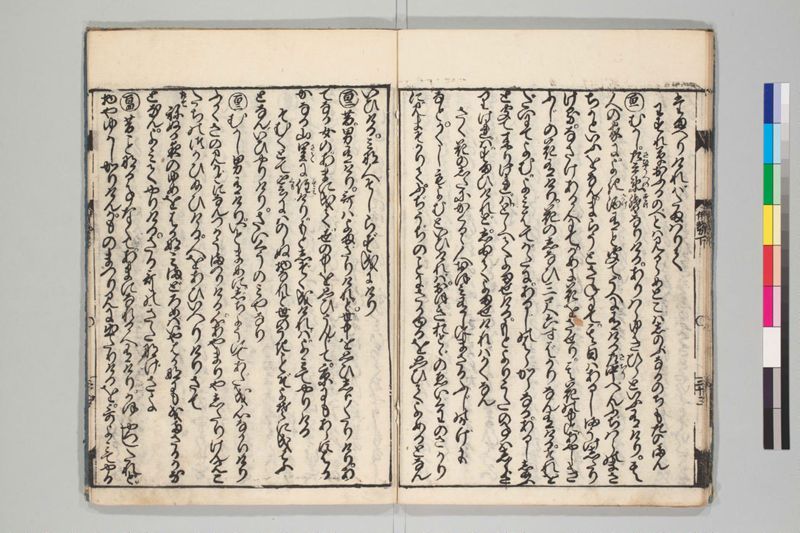
翻刻
【右丁】
たまへりければたまはりて
わすれ草おふるのべとは見るらめとこはしのぶなるのちもたのまん
﹁百一﹂むかし。左兵衛督(さひやうへのすけ)なりける。ありはらゆきひらといふ有けり。其
の人の家に。よき酒(さけ)有と聞て。うへに有ける左中(さちう)べんふぢはらのまさ
ちかといふをなん。まらうとさねにて。其日はあるしまうけしたり
ける。なさけある人にて。かめに花をさせり。其花の中に。あやしき
ふじの花有けり。花のしない三尺六寸ばかりなん有ける。それを
だいにてよむ。よみはてがたに。あるじのはらからなる。あるしし給ふ
と聞て来りければ。とらへてよませける。もとよりうたの事はしらざ
りければ。すまひけれど。しゐてよませければかくなん
さく花のしたにかくるゝ人おほみ有しにまさるふじのかげかも
なと。かくしもよむといひければ。おほきおとゞのゑいぐわのさかり
に。みまそかりて。ふぢうぢのことにさかゆるを思ひてよめるとなん
【左丁】
いひける。みな人そしらず成にけり
︻百二︼昔。男有けり。哥はよまざりけれど。世中を思ひしりたりけり。あ
てなる女の。あまに成て。世の中を思ひうんじて。亰にもあらすはる
かなる山 里(さと)に住(すみ)けり。もとしぞく成ければ。よみてやりける
そむくとて雲(くも)にはのらぬ物なれと世のうきことぞよそに成てふ
となん。いひやりけり。さいくうのみやなり
︻百三︼むかし男有けり。いとまめに。じちようにてあだ成心なかりけり
ふかくさのみかどになんつかうまつりける。心あやまりやしたりけんみこ
たちのつかひ給ひける。人をあひいへりけりさて
《送り仮名:古今》ねぬる夜のゆめをはかなみまどろめばいやはかなにも成まさるかな
となん。よみてやりける。さる哥のきたなげさよ
︻百四︼昔ことなる事なくて。あまになれる人有けり。かほやつしたれど。
物やゆかしかりけん。かものまつり見に出たりけるを。哥よみてやる
現代語訳
【右丁】
(第百段・続き)
(忘れ草を)いただいたので、受け取って(詠んだ)。
忘れ草 生ふる野辺とは 見るらめど これはしのぶなる 後も頼まん
(あなたは(私のことを)忘れ草が生える野辺のようにお思いでしょうが、これはしのぶ草(=忍ぶ草)というものですから、後々も(あなたのことを忍び続けることを)頼みにしましょう。)
---
**【第百一段】**
昔、左兵衛督(さひょうえのかみ)であった在原行平(ありわらのゆきひら)という人がいた。その人の家に良い酒があると聞いて、(帝の)御前に仕えていた左中弁(さちゅうべん)の藤原政近(ふじわらのまさちか)という人を、主客として招いて、その日は宴のもてなしをしたのであった。風流な心のある人で、甕(かめ)に花を挿していた。その花の中に、珍しい藤の花があった。花の垂れ下がった長さが三尺六寸ほどもあるのであった。それを題として(歌を)詠む。詠み終わらぬうちに、主人(行平)の兄弟で、主人(政近)が宴を催していると聞いてやって来たので、(その兄弟を)引き留めて歌を詠ませたのであった。もともと歌のことは知らなかったので(詠むことを)辞退したのだが、強いて詠ませたところ、このように(詠んだ)。
咲く花の 下に隠るる 人多み 有りしにまさる 藤の陰かも
(咲く花の下に隠れるほど多くの人がいるので、かつてよりもいっそう(栄えある)藤の陰のようですなあ。)
などと、このように詠んだと言ったので、大きな大臣(おとど)が栄華の盛りにいらっしゃって、藤氏(藤原氏)のこととして栄えていることを思って詠んだのだ、と(人々は)言ったのであった。
【左丁】
みなが(その歌を)そしらない(批判しない)ようになったのであった。
---
**【第百二段】**
昔、男があった。歌は詠まなかったけれど、世の中の道理をよく知っていた。高貴な女が尼になって、世の中を嫌気がさして、京でもなく、はるか遠い山里に住んでいた。もともと(その女とは)縁続きであったので、(男は)詠んで送ったのであった。
背くとて 雲には乗らぬ 物なれど 世の憂きことぞ よそになりてふ
((俗世を)背いたからといって、雲に乗って(天上へ)行くわけではないけれど、世の中の辛いことがよそのこととなるのだよ、(尼になることは)。)
と、このように言い送ったのであった。(この女は)斎宮(さいぐう)の御方であった。
---
**【第百三段】**
昔、男があった。たいそう誠実で、慎み深く、浮気な心がなかった。深草の帝(みかど)にお仕え申し上げていた。心の過ちをしてしまったのだろうか、親王たちがお使いになっていた女性と言い交わしていたのであった。そして(詠んだ)。
寝ぬる夜の 夢をはかなみ まどろめば いやはかなにも なりまさるかな
(眠れない夜の夢をはかないものと思いながら、うとうとすると、ますますいっそうはかないものになってしまいますよ。)
と、このように詠んで送ったのであった。なんとも(その)歌の汚らしいことよ(拙いことよ)。
---
**【第百四段】**
昔、特別なことがあったわけでもないのに尼になった人がいた。顔かたちは(尼姿に)やつしていたけれど、(世俗のものが)見たく思う気持ちがあったのだろうか、賀茂の祭りを見に出ていたのを、(男が)歌を詠んで送った——
英語訳
【Right folio】
*(Episode 100, conclusion)*
Having received (the *wasuregusa*), he accepted it and composed:
*Wasuregusa / ouru no be to wa / miru rame do* / *kore wa shinobu naru / nochi mo tanoman*
(You may perhaps look upon me as a field where forget-me-herbs grow — but since this is in fact *shinobu-gusa*, the grass of longing, I shall take heart that even hereafter you will pine for me.)
---
**Episode 101**
Long ago, there was a man called Ariwara no Yukihira (*Ariwara Yukihira*), who held the office of Left Military Guards Superintendent (*Sa-hyōe no Kami*). Hearing that this man's home held fine wine, a Left Middle Controller of the Ministry (*Sa-chūben*) named Fujiwara no Masachika, who was in attendance at the imperial court, was invited as the guest of honor, and on that day a banquet was prepared for his welcome. Being a man of refined sensibility, (Yukihira) had arranged flowers in a jar. Among these flowers was a remarkable wisteria bloom, whose trailing branch measured some three shaku and six sun in length. Taking this as his theme, he composed a poem. Before he had finished composing, the host's younger sibling, having heard that the host was holding a banquet and having come to join, was caught and made to compose a verse as well. Since (the sibling) had no knowledge of poetry, he declined, but being strongly pressed to compose, he produced the following:
*Saku hana no / shita ni kakururu / hito ōmi* / *arishi ni masaru / fuji no kage kamo*
(So many people shelter beneath the flowering blossoms — the shade of the wisteria surpasses even what it once was!)
Saying that it was composed thus, people said that it expressed the thought of the great Minister (*Ōtodo*) flourishing at the height of his glory, reflecting on the prosperity of the Fujiwara clan.
【Left folio】
And so no one came to criticize the poem at all.
---
**Episode 102**
Long ago, there was a man. He did not compose poems himself, yet he understood the ways of the world well. A highborn woman had become a nun, weary of the world, and had come to live not in the capital but in a distant mountain village. Since she had been of his family connection, he composed and sent this:
*Somuku tote / kumo ni wa noranu / mono nare do* / *yo no uki koto zo / yoso ni narite fu*
(Although in turning one's back (on the world) one does not ride up upon the clouds, it is said that the sorrows of this world do become as something distant and apart.)
Thus he sent these words. (The woman) was the Saigū no Miya — a former High Priestess of Ise.
---
**Episode 103**
Long ago, there was a man. He was exceedingly sincere and self-possessed, with not a trace of fickleness in his heart. He served at the court of the Emperor of Fukakusa (*Fukakusa no Mikado*). Perhaps his heart led him astray — he had become intimate with a woman who was in the service of the Imperial Princes. And so he composed and sent:
*Nenu ru yo no / yume wo hakanami / madoromeba* / *iya hakanani mo / nari masaru kana*
(Finding the dreams of my sleepless nights so fleeting, when I do drift into a doze, they become all the more fleeting still.)
Thus he composed and sent it. What a graceless poem that is!
---
**Episode 104**
Long ago, there was a woman who had become a nun without any particular reason. Though her appearance was transformed (into that of a nun), perhaps she still longed for the things of this world — for she had gone out to view the Kamo Festival. A man composed a poem and sent it to her —