翻刻
【右丁】
世をうみのあまとし人をみるからにめくばせよともたのまるゝかな
これは。さいくうの物見給ひける。くるまにかくきこへたりければ。みさ
してかへりたまひにけりとなん
「百五」むかし男。かくてはしぬべしといひやりたりければ。女
しらつやはけなばけなゝんきへずとて玉にぬくべき人もあらじを
といへりければいとなめしと思ひけれど心ざしはいやまさりけり
「百六」昔男。みこたちのせうえうし給ふ所に。詣(もふて)てたつた川の辺(ほとり)にて
《送り仮名:古今》ちわやふる神代(かみよ)もきかずたつた川からくれなゐに水くゞるとは
「百七」昔。あてなる男有けり。其男のもとなりける人を。内記(ないき)にあり
ける。ふぢはらのとしゆきといふ人よばひけり。されどまたわかければ
。文もをさ〳〵しからす。詞(ことは)もいひしらず。いはんや哥はよまさりければ。かの
あるじ成人案を書(かき)て。かゝせやりけり。めてまどひにける。扨男のよめる
《送り仮名:古今》つれ〳〵のながめにまさる涙(なみた)川 袖(そて)のみひちてあふよしもなし
【左丁】
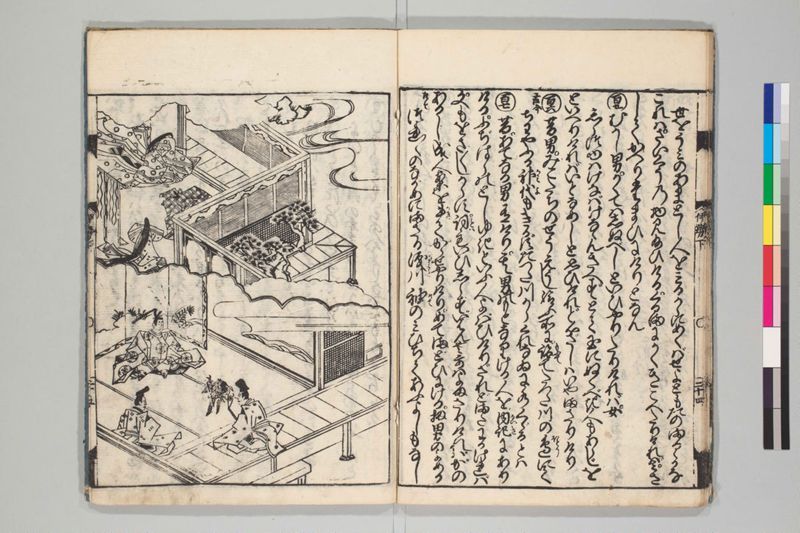
【挿絵】
現代語訳
【右丁】
(第百四段・続き)
世をうみの 海人(あま)とし人を 見るからに 目くばせよとも 頼まるるかな
(世の中を海として、その海人(あま)=尼として暮らしているあなたを見るにつけ、目くばせをしてほしいとも、自然と頼みたくなることですよ。)
これは、斎宮(さいぐう)が物見をなさっていた(見物をされていた)車に、このように(歌を)申し上げたところ、(車の簾を)さし(て顔を見せることなく)、そのままお帰りになってしまったのだということだ。
---
**【第百五段】**
昔、男が「このままでは死んでしまいそうだ」と(女に)言い送ったところ、女(は次のように詠んだ)。
白露は 消えなば消えな む 消えずとて 玉に貫くべき 人もあらじを
(白露よ、消えるなら消えてしまいなさい。消えずにいたとして、あなたを玉として貫いて(大切に持ち続けて)くれる人もいないのだから。)
と言ってきたので、(男は)たいそう無礼だと思ったけれど、(女への)思いはいっそう深まるばかりであった。
---
**【第百六段】**
昔、男が、親王たちが逍遥(しょうよう)なさる所へ参上して、龍田川(たつたがわ)のほとりで(詠んだ)。
ちはやぶる 神代(かみよ)も聞かず 龍田川 唐紅(からくれない)に 水くぐるとは
(神々の世の昔にも聞いたことがない、龍田川が唐紅色(鮮やかな紅色)に(紅葉が川面に映じて)水をくぐっているとは。)
---
**【第百七段】**
昔、高貴な男があった。その男のもとに仕えていた人を、内記(ないき)にいた藤原敏行(ふじわらのとしゆき)という人が求婚した。しかし(その人は)まだ若かったので、手紙も大人らしくなく、言葉も(口の利き方も)わきまえず、まして歌は詠めなかったので、その主人である男が(代わりに歌の)案を書いて、書き送らせたのであった。(女は)感心して(心が)乱れてしまった。さて、男(=敏行に代わって主人の男)が詠んだ(歌)。
つれづれの 眺めにまさる 涙川 袖のみ濡ちて 逢ふよしもなし
(物思いにふける物寂しい眺めよりもいっそう(涙が流れて)、涙の川のようになり、袖ばかりが濡れて、あなたに逢う方法もありません。)
【左丁】
【挿絵】
(挿絵のみ、文字なし)
英語訳
【Right folio】
*(Episode 104, conclusion)*
*Yo wo umi no / ama toshi hito wo / miru kara ni* / *mekubase yo to mo / tanomaru ru kana*
(Seeing you, who live as a sea-woman — a nun (*ama*) upon the sea of this world — I cannot help but long to ask even a glance from you.)
This (poem) was sent to the carriage in which the Saigū was viewing the festival procession. Upon hearing it, she lowered her blind (without showing her face) and departed straightaway, it is said.
---
**Episode 105**
Long ago, a man sent word saying, "If things continue thus, I shall surely die." The woman replied:
*Shira tsuyu wa / kenaba kenan / kiezu tote* / *tama ni nukubeki / hito mo araji wo*
(White dew, if you must vanish, then vanish indeed — for even if you do not, there is no one who would string you as a jewel and keep you dear.)
Upon receiving this, (the man) felt it exceedingly rude and insolent, yet his feelings (for her) only deepened all the more.
---
**Episode 106**
Long ago, a man went to attend upon the Imperial Princes at a place where they were taking a leisurely excursion, and there at the bank of the Tatsuta River he composed:
*Chihayaburu / kamivo mo kikazu / Tatsuta-gawa* / *kara kurenai ni / mizu kuguru to wa*
(Even in the age of the mighty gods, such a thing was never heard of — that the Tatsuta River should run beneath a deep Chinese crimson, as the fallen leaves drift upon its surface.)
---
**Episode 107**
Long ago, there was a man of noble birth. A person in service to this man was being courted by someone named Fujiwara no Toshiyuki (*Fujiwara Toshiyuki*), who held the post of Inner Recorder (*Naiki*). However, (Toshiyuki) was still young, and his letters were far from mature; he did not know how to express himself in words; and above all he could not compose poetry. And so his lord — the noble man — drafted a poem on his behalf and had it sent (in Toshiyuki's name). (The woman) was so moved that she was utterly captivated and bewildered. The poem that the man (the lord, on Toshiyuki's behalf) composed was:
*Tsure-zure no / nagame ni masaru / namida-gawa* / *sode nomi hichite / au yoshi mo nashi*
(Surpassing even the desolate gaze of idle melancholy, my tears fall like a river — my sleeves alone are soaked through, and yet there is no way for me to meet you.)
【Left folio】
【Illustration】
*(Full-page illustration; no text.)*