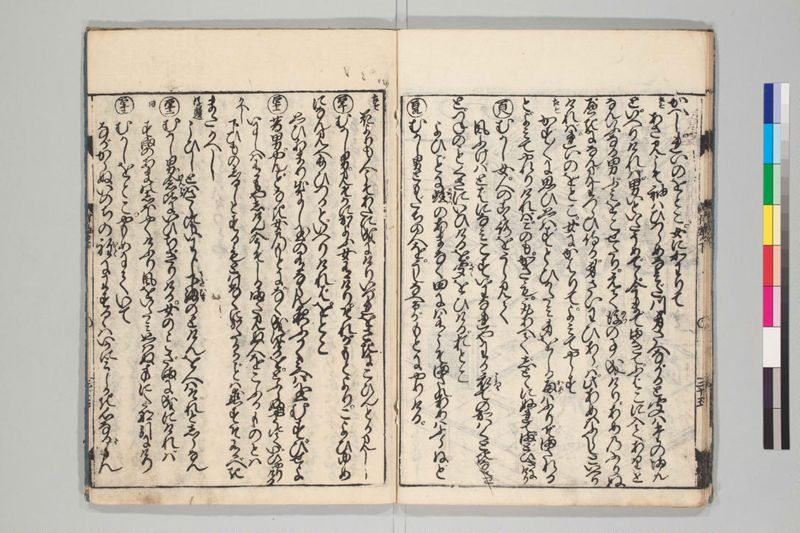
翻刻
【右丁】
かへし。れいのをとこ。女にかわりて
《送り仮名:古今》あさみこそ袖はひつらめなみだ川身さへながると聞はたのまん
と。いへりければ。男いといたうめでゝ。今までまきて。ふばこに入て。ありと
なんいふなる男。ふみをこせたり。えて後(のち)の事成けり。あめのふりぬ
べきになん。みわづらひ侍る。身さいわひあらば。此あめはふらしといへり
ければ。れいのをとこ。女にかはりて。よみてやらす
《送り仮名:古今》かず〳〵に思ひ思はずとひかたみ身をしる雨(あめ)はふりぞまされる
と。よみてやれりければ。みのも。かさも。取あへで。しとゝにぬれて。まどひきにけり
﹁百八﹂むかし女。人のこゝろをうらみて
風ふけばとばになみこすいわなれやわか衣(ころも)でのかはくときなき
と。つねのことくさにいひけるを。聞(きゝ)をひける。おとこ
よひごとに蛙(かわつ)のあまなく田には水こそまされあめはふらねど
﹁百九﹂むかし男ともだちの人を。うしなへるがもとにやりける。
【左丁】
《送り仮名:古今》花よりも人こそあたに成にけりいづれをさきにこひんとかみし
﹁百十﹂むかし男。みそかにかよふ女有けり。それがもとより。こよひゆめ
になん見へ給ひつると。いへりければ。をとこ
思ひあまり出にし玉の有ならん夜ふかくみへば玉むすびせよ
﹁百十一﹂昔男。やんごとなき女のもとに。なく成にけるを。とふらふやうにて。いひやりける
いにしへは有もやしけん今ぞしるまた見ぬひとをこふるものとは
《送り仮名:かへし》下ひものしるしとするもとけなくにかたるかごとは恋すそ有べき
またかへし
《送り仮名:後撰》こひしとはさらにもいわじ下紐(したひも)のとけんを人はそれとしらなん
﹁百十二﹂むかし男。念比(ねんごろ)にいひちぎりける。女のことざまに成にければ
《送り仮名:同》すまのあまのしほやくけふり風をいたみ思はぬ方にたな引にけり
﹁百十三﹂むかしをとこ。やもめにていて
ながからぬいのちの程(ほと)にわするゝはいかにみじかき心なるらん
現代語訳
【右丁】
**(第百七段・続き)**
返し。例の男、女に代わって(詠んだ)。
浅みこそ 袖はひつらめ 涙川 身さへながると 聞かばたのまん
(浅いからこそ袖だけが濡れるのでしょう。あの涙川に、体ごと流れているとお聞きしたなら、きっとあなたへの思いを頼みにできるのですが。)
と詠んでやったところ、男(=敏行)はたいそう感激して、今日までそれを巻いて、文箱に入れて大切にしているということだ。
(その後)男が手紙を送ってきた。(女と)契りを結んだ後のことである。「雨が降りそうな気配で、(外出すべきか)悩んでおります。もし(私に)幸いがあるなら、この雨は降らせないでください」と言ってきたので、例の男が、女に代わって詠んで送った。
数々に 思ひ思はずと ひかたみ 身をしる雨は ふりぞまされる
(あなたが私を思っているかどうか、互いに問い交わしながら、(自分の身の程を知らせるかのように)身を知る雨はますます降り続けることですよ。)
と詠んで送ったところ、(敏行は)蓑も笠も手にするいとまもなく、びしょびしょに濡れながら(女のもとへ)やって来てしまったのであった。
---
**【第百八段】**
昔、女が、人の心を恨んで、
風ふけば とばに波こす 岩なれや 我が衣手の 乾く時なき
(風が吹けばすぐに波が越えてくる岩のようなものでしょうか、私の袖が乾く時がないのは。)
と、常の言葉のように言っていたのを、聞いて(女に)通っていた男(が詠んだ)。
宵ごとに 蛙(かわず)のあまた 鳴く田には 水こそまされ 雨はふらねど
(毎晩、蛙がたくさん鳴いている田には、水がますます増えているよ。雨は降らないけれど。)
---
**【第百九段】**
昔、男が、友人が(大切な)人を亡くした(そのもとへ)送った(歌)。
【左丁】
花よりも 人こそあだに なりにけり いづれをさきに 恋ひんとかみし
(花よりも人こそ、はかなく(先に)なってしまったことよ。どちらを先に惜しみ恋うるものかと(花と人とを)見較べていたのに。)
---
**【第百十段】**
昔、男が、ひそかに通っている女があった。その女のもとから、「今夜、夢にあなた様がお見えになりました」と言ってきたので、男(が詠んだ)。
思ひあまり 出にし魂の あるならん 夜深く見えば 魂むすびせよ
(思いが溢れて抜け出た私の魂が(夢に現れた)のでしょう。夜深くにお見えになったなら、魂結びをしてください。)
---
**【第百十一段】**
昔、男が、高貴な女のもとに(通っていた人が)亡くなったのを、弔うようにして言い送った(歌)。
いにしへは ありもやしけん 今ぞしる また見ぬ人を 恋ふるものとは
(昔はそのようなことがあったのかもしれないと思っていたけれど、今こそ知りました。まだ(再び)見ぬ人を恋い慕うものだということを。)
返し(として女が詠んだ)。
下紐の 標(しるし)とするも とけなくに 語るかごとは 恋すぞあるべき
(下紐を(あなたへの思いの)しるしとしているのに、それがまだ解けないうちに、語り伝えるようなことは、恋をしているからこそのことでしょうか。)
またさらに返し(として男が詠んだ)。
恋しとは さらにも言はじ 下紐の 解けんを人は それとしらなん
(恋しいとは、もうあえて言いますまい。下紐が解けるのを、あの人がそれと察してくれればよいのだが。)
---
**【第百十二段】**
昔、男が、懇ろに(深く)約束を交わしていた女が(他の)方向へ(心が)向いてしまったので(詠んだ)。
須磨の海人の 塩焼く煙 風をいたみ 思はぬ方に たな引きにけり
(須磨の海人が塩を焼く煙が、風が激しいために、思いがけない方向へ、たなびいてしまったことよ。)
---
**【第百十三段】**
昔、男が、独り身(やもめ)になって(詠んだ)。
長からぬ 命の程に 忘るるは いかに短き 心なるらん
(長くもないこの命の間に(あなたを)忘れるとは、なんと短い(薄情な)心であることよ。)
英語訳
【Right folio】
*(Episode 107, conclusion)*
In reply, the usual man (the lord) composed on the woman's behalf:
*Asami koso / sode wa hitsura me / namida-gawa* / *mi sae nagaru to / kikaba tanoman*
(It must be because the river is shallow that only your sleeves are soaked. But if I were to hear that even your very body is swept away by that river of tears, then I could truly place my trust in your love for me.)
Upon receiving this, the man (Toshiyuki) was so deeply moved that he rolled it up and placed it in his letter-box, and keeps it there to this day, it is said.
After that, the man sent a letter. It was after they had become intimate. In it he wrote: "It looks very much as though rain will fall, and I am at a loss as to what to do. If fortune smiles upon me, please hold back this rain." Upon receiving this, the usual man composed a poem on the woman's behalf and sent it:
*Kazukazu ni / omohi omohazu to / hikagami* / *mi wo shiru ame wa / furi zo masareru*
(As we ask each other back and forth whether our feelings are returned, the "knowing rain" — the rain that reveals our true selves — falls ever more heavily.)
Upon receiving this, (Toshiyuki), without even time to take up his raincoat or hat, came rushing over completely drenched.
---
**Episode 108**
Long ago, a woman, lamenting and resenting someone's fickle heart, would often say as a common lament:
*Kaze fukeba / toba ni nami kosu / iwa nare ya* / *waga koromode no / kawaku toki naki*
(Am I like a rock over which waves wash whenever the wind blows? For there is never a moment when my sleeves dry.)
A man who had heard this and was secretly visiting her composed:
*Yoigoto ni / kawazu no amata / naku ta ni wa* / *mizu koso masare / ame wa furanu do*
(In the rice fields where frogs cry out in great numbers every night, the water rises ever higher — even though no rain has fallen.)
---
**Episode 109**
Long ago, a man sent (a poem) to a friend who had lost someone dear to him:
【Left folio】
*Hana yori mo / hito koso ada ni / nari ni keri* / *izure wo saki ni / kohin to ka mishi*
(More fleeting even than the blossoms, it is the person who has become transient and gone. When I gazed upon them both, I had wondered which I would mourn first.)
---
**Episode 110**
Long ago, a man had a woman to whom he was making secret visits. From her came a message: "Tonight you appeared to me in a dream." The man replied:
*Omohi amari / ide ni shi tama no / aru naran* / *yofukaku mieba / tama musubi se yo*
(It must be my soul, which overflowing with longing, has slipped out of me (and gone to you in your dream). If it appeared to you deep in the night, please bind it fast with a soul-knot so it does not return.)
---
**Episode 111**
Long ago, a man, sending word as if in condolence to a noble woman whose (lover) had passed away:
*Inishie wa / ari mo ya shiken / ima zo shiru* / *mata minu hito wo / kōru mono to wa*
(Perhaps such a thing existed in times long past — but now I know it for myself: what it is to yearn for one whom I shall not see again.)
The woman's reply:
*Shitahimo no / shirushi to suru mo / toke naku ni* / *kataru kagoto wa / koisu zo aru beki*
(Though my inner sash — which I keep as a token of you — has not yet come undone, surely the very act of speaking of it can only be because I am in love.)
A further reply (from the man):
*Koishi to wa / sara ni mo iwaji / shitahimo no* / *token wo hito wa / sore to shira nan*
(I shall say no more that I am longing for you — I can only hope that she will know, by the loosening of my inner sash, that it is so.)
---
**Episode 112**
Long ago, a man, when the woman with whom he had made heartfelt vows turned her heart in another direction:
*Suma no ama no / shioyaku keburi / kaze wo itami* / *omowanu kata ni / tanabiki ni keri*
(The smoke from the fires of the salt-burners of Suma — because the wind blows so fiercely — has drifted away in a direction no one would have wished.)
---
**Episode 113**
Long ago, a man, having become a widower, composed:
*Nagarakanu / inochi no hodo ni / wasururu wa* / *ikani mijikaki / kokoro naru ran*
(Within the span of this short life, to be forgotten — what a brief and shallow heart that must be.)