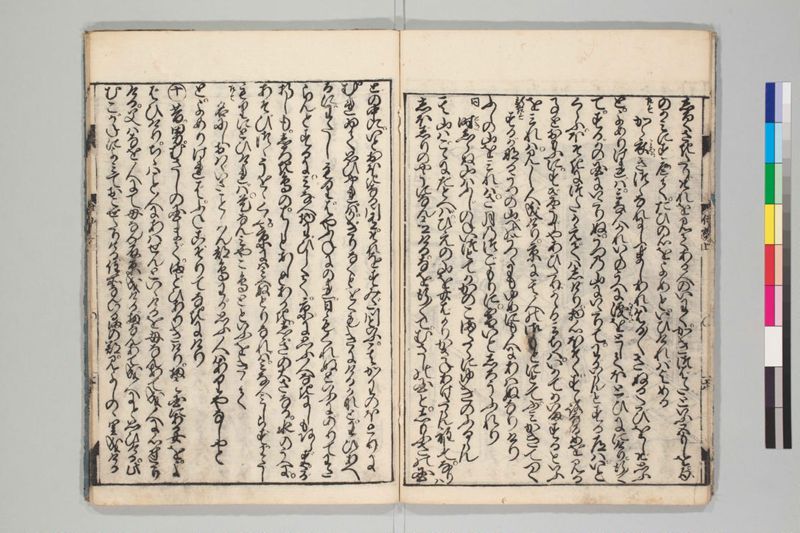
翻刻
【右丁】
しろくさきたり。それを見てある人のいわく。かきつばたといふ五もしを。句(く)
のかみにすへて。たひの心をよめと。いひければよめる
《送り仮名:古今》から衣(ころも)きつゝなれにしつましあれははる〳〵きぬるたびをしぞ思ふ
と。よめりければ。みな人かれいゝのうへに涙(なみた)をとしてほとびにけり。行々
て。するがの国にいたりぬ。うつの山にいたりて。わがいらんとする道は。いと
くらふ。ほそきにつたかえではしげり。物心ほそく。すゝろなるめを見る
事とおもふに。すぎやうじやあひたりかゝるみちは。いかでかいまするといふ
をみれは。見し人成けり。京に其人の御もとにとて。ふみかきてつく
《送り仮名:新古今》するがなるうつの山べのうつゝにもゆめにも人にあはぬなりけり
ふしの山をみれば。さ月のつごもりに。雪いとしろうふれり
《送り仮名:同》時(とき)しらぬ山はふじのねいつとてかのこまたらにゆきのふるらん
其山は。こゝにたとへば。ひえの山を廿ばかりかさねあけたらん程して。なりは
しほじりのやうになん有ける。なを行々て。むさしの国と。しもふさの国
【左丁】
との中に。いとおほきなる川有。それをすみだ川といふ。其かわのほとりに
。むれゐて思ひやれば。かぎりなくとをくもきにけるかなと。わひあへ
るに。わたしもり。はやふねにのれ。日もくれぬといふに。のりてわた
らんとするに。みな人物わびしくて。京に思ふ人なきにしもあらず。さる
折しも。しろき鳥の。はしとあしとあかき。しぎの大さなる。水のうへに。
あそびつゝうをゝく□。京にはみへぬとりなれば。みな人みしらず。わたし
もりにとひければ。是なんみやこ鳥とといふをきゝて
《送り仮名:古今》名にしおはゞいさことゝはん都鳥わが思ふ人はありやなしやと
と。よめりければ。ふねこぞりてなきにけり
㊉昔。男。むさしの国まで。まどひありきけり。扨□国にある女を。よ
ばひけり。ちゝはこと人にあはせんといゝけるを。母なんあて成人に心付たり
ける。父はなを人にて。母なん藤原成ける。扨なんあて成人にと思ひける。此
むこがねによみておこせたりける。住所なんいるまの郡。みよしのゝ里成ける
現代語訳
【右丁】
白く咲いていた。それを見て、ある人が言うには、「かきつばた」という五文字を、句の頭に置いて、旅の心を詠め」と言ったので、詠んだ歌、
*唐衣 着つつ馴れにし 妻しあれば はるばる来ぬる 旅をしぞ思ふ*
(長年着慣れた唐衣のように、慣れ親しんだ妻が都にいるので、はるばるやって来てしまったこの旅のことをしみじみ思う)
と詠んだので、皆、乾飯(かれいい)の上に涙を落として、乾飯がふやけてしまった。
さらに行き行いて、駿河の国に着いた。宇津の山に差し掛かり、自分たちが進もうとする道はたいそう暗く、細い道につたやかえでが茂り、心細く、思いもかけない目に遭うものだと思っていると、修行者と行き会った。「このような道を、どうして行かれるのですか」と言う者を見ると、以前に知っていた人であった。京に、ある人のもとへと手紙を書いて託した。
*駿河なる 宇津の山べの うつゝにも 夢にも人に あはぬなりけり*
(駿河にある宇津の山のほとりでは、現実にも夢の中でも、あの人に逢えないことだなあ)
富士の山を見れば、五月の末なのに、雪がたいそう白く降っていた。
*時知らぬ 山はふじのね いつとてか 鹿の子まだらに 雪のふるらん*
(季節を知らない山は富士の峰よ。いったいいつだと思って、鹿の子まだら模様に雪が降るのだろう)
その山は、ここ(京都)に例えるならば、比叡山を二十ほど重ね上げたほどの高さで、形は塩尻のようであった。
さらに行き行いて、武蔵の国と下総の国との間に、たいそう大きな川がある。それを隅田川という。その川のほとりに座り込んで、「はるばる遠くまで来てしまったなあ」と嘆き合っていると、渡し守が「早く船に乗れ。日も暮れてしまう」と言うので、船に乗って渡ろうとするが、皆、何となくもの悲しく、京に思う人がいないわけでもない。
【左丁】
ちょうどそのとき、白い鳥で、くちばしと脚が赤い、鴫ほどの大きさの鳥が、水の上で遊びながら魚を食べていた。京では見たことのない鳥なので、皆、知らない。渡し守に尋ねたところ、「これがみやこ鳥(都鳥)というものだ」と言うのを聞いて、
*名にし負はば いざ言問はん 都鳥 わが思ふ人は ありやなしやと*
(「都」という名を持つ鳥よ、さあ尋ねよう。私が思い慕う人は、都で元気でいるかどうかと)
と詠んだので、船の人は皆、声を上げて泣いた。
【第十段】
昔、ある男が、武蔵の国まで迷い歩いていた。さてその国にいる女に求婚した。父親は別の男と結婚させようと言っていたが、母親がこの高貴な人(男)に心を寄せていた。父は平凡な身分の人で、母は藤原氏の出であった。それゆえ母は高貴な人と娶せたいと思っていた。この婿候補の男に詠んで贈った歌。住んでいる所は入間の郡、三芳野の里であった。
英語訳
【Right Page】
...were blooming beautifully in white. Seeing this, one of the party said: "Take the five syllables of the word 'kakitsubata' (iris) and place them at the beginning of each line to compose a poem expressing the feeling of travel." Thus was composed:
*Karagoromo / kitsutsu narenishi / tsuma shi areba / harubaru kinuru / tabi wo shi zo omou*
(Just as I have long worn and grown accustomed to my Chinese robe, I have a beloved wife in the capital — and thinking of her, I feel all the more keenly the longing of this journey to distant lands.)
When this poem was recited, everyone wept tears onto their dried rice, until it became soft and swollen.
Traveling further, they arrived in the province of Suruga. Coming to Mount Utsu, they found the road they must take was very dark and narrow, overgrown with ivy and maple, and as they were feeling lonely and disheartened at encountering such unexpected hardship, they came across a wandering Buddhist monk. "How do you come to be on such a road as this?" he asked. Looking at him, they recognized him as someone they had known. They wrote a letter to entrust to him, addressed to a certain person in the capital:
*Suruga naru / Utsu no yamabe no / utsutsu ni mo / yume ni mo hito ni / awanu nari keri*
(Here at Utsu Mountain in Suruga, neither in waking reality nor in my dreams am I able to meet the one I long for.)
Looking at Mount Fuji, though it was the end of the fifth month, snow lay brilliantly white upon it:
*Toki shiranu / yama wa Fuji no ne / itsu tote ka / kanoko madara ni / yuki no furu ran*
(Oh, peak of Fuji — a mountain that knows no seasons — when does it think it is, that snow should fall upon it in dappled, fawn-spotted patterns?)
That mountain, if compared to things here, would be like stacking twenty Mount Hieis upon one another, and its shape was like a salt cone (*shiojiri*).
Continuing ever onward, between the provinces of Musashi and Shimōsa, there was an exceedingly large river called the Sumida River. Gathering at its bank, they lamented amongst themselves, "We have come so very far from the capital," when the ferryman called out, "Get on the boat quickly — it will soon be dark." As they boarded and prepared to cross, everyone felt a nameless, forlorn sadness, for there was not one among them who had no one dear to them left behind in the capital.
【Left Page】
Just at that moment, there were white birds with red beaks and red legs, about the size of a snipe, playing on the water and eating fish. As these were birds never seen in the capital, no one recognized them. When they asked the ferryman, he said, "Why, those are *miyakodori* — 'capital birds.'" Hearing this:
*Na ni shi owaba / iza koto towamu / miyakodori / waga omou hito wa / ariya nashi ya to*
(If you truly bear the name "capital bird," then let me ask you this: does the one I love still live and fare well in the capital?)
At this poem, everyone on the boat burst into tears.
【Section 10】
Long ago, there was a man who had wandered as far as the province of Musashi. There he courted a woman who lived in that province. Her father intended to give her to another man, but her mother had become attached to this man of noble birth. The father was of ordinary birth, while the mother was of the Fujiwara clan. It was for this reason that the mother wished to give her daughter to this nobleman. A poem was sent to this prospective son-in-law. Their home was in the district of Iruma, in the village of Miyoshino.