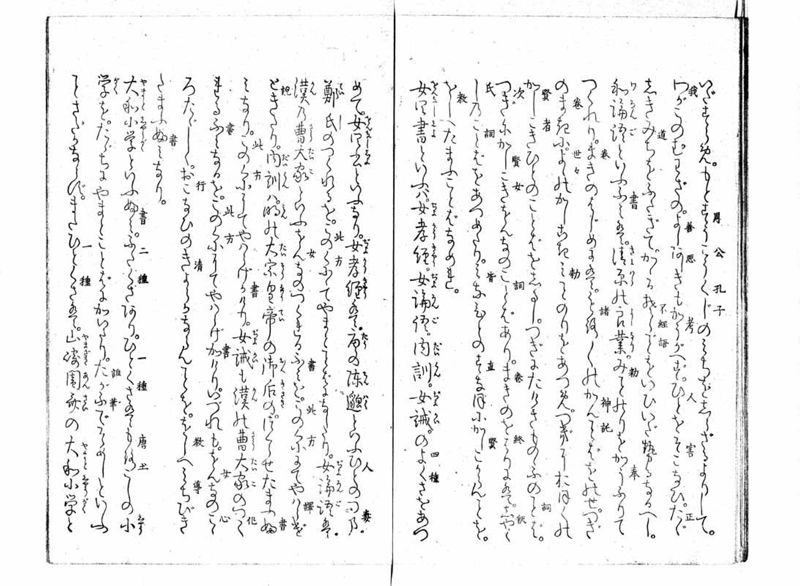
翻刻
【右丁】
いだすらめ。もと すう(周)こう(公)くじ(孔子)のみちをしらざるよりして。
わが(我)このむわざの。よし(善)あしき(悪)もかうがへず(考)。ひと(人)をそこなひ(害)。たゞ(正)
しき みち(道)をふたぎて。かヽる そらごと(不経語)をいひいざせるなるへし。
和論語(わろんご)といふ ふみ(書)は。清原(きよはら)の良業(よしなり)。みことのり(勅)をかうふり(奉)て
つくれり。まき(巻)のはじめには。もろ(諸)〳〵の かんことば(神託)をのせ。つぎ
の まき(巻)に。よゝ(世々)のかしこき みことのり(勅)をあつめ。つぎにおほくの
かしこきひと(賢者)のことばをしるし。つぎにたけきものゝふの ことば(詞)。
つぎ(次)に かしこきおんな(賢女)の ことば(詞)あり。まき(巻)のをはり(終)には。しやく(釈)
し(氏)の ことば(詞)をあつめたり。みな(皆)ひとのすなほ(直)にかしこ(賢)からんことを。
をしへ(教)たまふことばなめれ。
女四書(をんなししょ)といふは。女考経(ぢよかうきやう)。女論語(ぢよろんご)。内訓(だいくん)。女誡(ぢよかい)。の よくさ(四種)をあつ
【左丁】
めて。女四書(をんなししよ)といふなり。女考経(ぢよかうきやう)は。唐(たう)の陳邈(ちんはく)といふ ひと(人)のつま(妻)。
鄭氏(ていし)のつくれるを。このくに(此方)ゝてやまとことばになしたり。女論語(ぢよろんご)は。
漢(かん)の曹大家(さうたいこ)といふ をんな(女)のつくれる ふみ(書)を。このくに(此方)にてやはらげ(譯)
とき(説)たり。内訓(だいくん)は。明(みん)の大宗(たいそう)皇帝(くわうてい)の御后(おんきさき)の。つくらせたまふ ふ(書)
みなり。このくに(此方)にてやはらげ か(書)けり。女誡(ぢよかい)も漢(かん)の曹大家(さうたいこ)の つく(作)
れる ふみ(書)なるを。このくに(此方)にてやはらげ か(書)けり。いづれも。をんな(女)のこゝ(心)
ろたヾしく。おこなひ(行)のきよらか(清)ならんことを。をしへ(教)みちびき(導)
たまふ ふみ(書)なり。
大和小学(やまとしやうがく)といふ ふみ(書)。ふたくさ(二種)あり。ひとくさ(一種)は もろこし(唐土)の小(しやう)
学(がく)を。たヾちにやまとことばにかいたり。たが(誰)ふで(筆)そめしといふ
ことさだかならず。また ひとくさ(一種)は。山崎闇斎(やまざきあんさい)の大和小学(やまとしやうがく)と
現代語訳
【右丁】
言い出すのであろう。もとより周公・孔子の道を知らないことから、自分の好む業の善悪も考えず、人を害し、正しい道を塞いで、このような嘘を言い出すのであろう。
『和論語』という書物は、清原良業が勅命を受けて作ったものである。巻の初めには、さまざまな神託を載せ、次の巻に、代々の賢い勅をまとめ、次に多くの賢者の言葉を記し、次に武勇な武士の言葉、次に賢女の言葉がある。巻の終わりには、釈氏の言葉をまとめてある。みな人が素直で賢くあることを教えてくださる言葉であるようだ。
『女四書』というのは、『女孝経』『女論語』『内訓』『女誡』の四種をまと
【左丁】
めて、『女四書』というのである。『女孝経』は、唐の陳邈という人の妻、鄭氏が作ったものを、この国で大和言葉に翻訳したものである。『女論語』は、漢の曹大家という女性が作った書物を、この国で翻訳解説したものである。『内訓』は、明の太宗皇帝の皇后がお作りになった書物である。この国で翻訳して書かれた。『女誡』も漢の曹大家が作った書物を、この国で翻訳して書いたものである。いずれも、女性の心が正しく、行いが清らかであることを教え導いてくださる書物である。
『大和小学』という書物には二種類ある。一種は中国の『小学』を、そのまま大和言葉に書いたものである。誰が筆を染めたかということは定かではない。またもう一種は、山崎闇斎の『大和小学』と
英語訳
【Right page】
they would say such things. Originally, from not knowing the Way of the Duke of Zhou and Confucius, they do not consider the good or evil of their preferred pursuits, harm people, block the righteous path, and thus come to speak such falsehoods.
The book called "Wa Rongo" (Japanese Analects) was created by Kiyohara no Yoshinari upon receiving an imperial edict. At the beginning of the volumes, various divine oracles are recorded; in the next volume, wise imperial edicts from successive generations are compiled; next, words of many wise men are recorded; next, words of brave warriors; and next, words of wise women. At the end of the volumes, words of Buddhist monks are compiled. All seem to be words that teach people to be honest and wise.
"Onna Shisho" (Four Books for Women) refers to the compilation of four types: "Jokōkyō" (Classic of Filial Piety for Women), "Jo Rongo" (Analects for Women), "Daikun" (Inner Teachings), and "Jokai" (Admonitions for Women).
【Left page】
These are collectively called "Onna Shisho" (Four Books for Women). "Jokōkyō" (Classic of Filial Piety for Women) was created by the wife of Chen Miao of Tang, Lady Zheng, and was translated into Japanese in this country. "Jo Rongo" (Analects for Women) is a book created by a woman named Cao Dajia of Han, which was translated and explained in this country. "Daikun" (Inner Teachings) is a book created by the empress of Emperor Taizong of Ming. It was translated and written in this country. "Jokai" (Admonitions for Women) is also a book created by Cao Dajia of Han, which was translated and written in this country. All of these are books that teach and guide women to have righteous hearts and pure conduct.
There are two types of books called "Yamato Shōgaku" (Japanese Elementary Learning). One type directly translates the Chinese "Xiaoxue" (Elementary Learning) into Japanese. It is not clear who first wrote it. The other type is Yamazaki Ansai's "Yamato Shōgaku" and