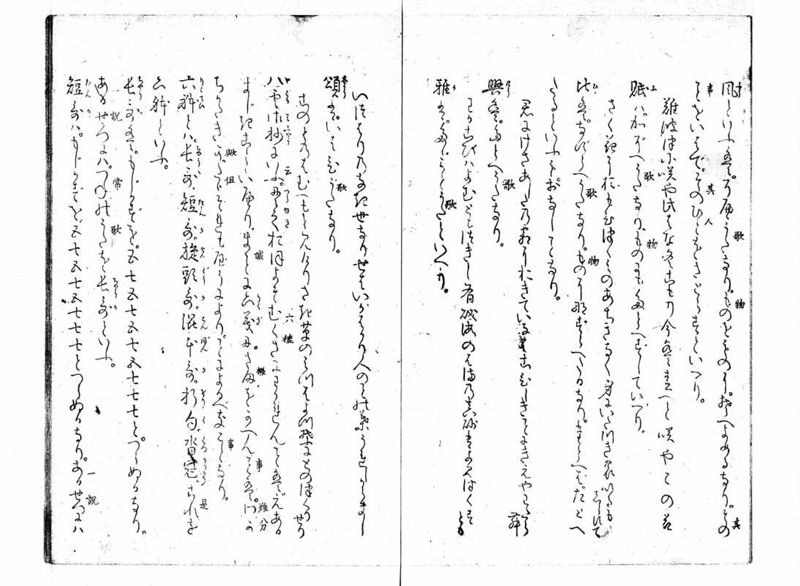
翻刻
【右丁】
風(ふう)といふは。そへ うた(歌)なり。もの(物)をものに。そへよめるなり。その(其)
こと(事)をいはで。その(其)ひと(人)をさとらすといへり。
難波津に咲や此はな冬こもり今は春へと咲やこの花
賦(ふ)は。かぞへ うた(歌)なり。もの(物)にもたとへずしていへり。
さく花におもひつくみのあちきなく身にいたつき の いるもしらすて
比(ひ)は。なずらへ うた(歌)なり。もの(物)になずらへたるなり。たとへば。たとへ
たるといふも。おなしことなり。
君にけさあしたの霜におきていなばこひしきことにきえやわたらむ
興(けう)は。たとへ うた(歌)なり。
わかこひはよむともつきし有磯海のはまの真砂はよみつくすとも
雅(か)は。たゞこと うた(歌)といへり。
【左丁】
いつはりのなき世なりせはいかはかり人のことの葉うれしからまし
頌(しやう)は。いはひ うた(歌)なり。
このとのはむへもとみけりさき草のみつはよつ葉にとのつくりせり
八雲御抄に いふ(云)。貫之(つらゆき)おほよそ むくさ(六種)にわかれんことは。えある
まじきことゝいへり。まこと(誠)に六義(りくぎ)に。さま(様)をかへん こと(事)は。わか(難分)
ちかたき か(歟)。たゞ(但)それもやうにより。ことによるべき こと(事)なり。
六体(りくてい)とは。長哥(ちやうか)。短哥(たんか)。旋頭哥(せんどうか)。混本哥(こんぽんか)。折句(をりく)。沓冠(くつかうふり)。これ(是)を
六体といふ。
長(ちやう)哥は。もじかずを。五七五七五七五七七七と。つらぬるなり。
ある(一) せつ(説)には。つね(常)の うた(歌)を 長歌(ちやうか)といふ。
短哥(たんか)は。もじかずを。五七五七五七七七とつらぬるなり。ある(一)せつ(説)には
現代語訳
【右丁】
風(ふう)というのは、添え歌である。物を物に添えて詠んだものである。そのことを言わずに、その人を悟らせるというものである。
難波津に咲くやこの花冬籠り今は春べと咲くやこの花
賦(ふ)は、数え歌である。物にも例えずして言ったものである。
咲く花に思いつく身のあちきなく身にいたつきの入るも知らずて
比(ひ)は、なぞらえ歌である。物になぞらえたものである。例えば、例えたるというのも、同じことである。
君にけさ朝の霜に置きていなば恋しきことに消えやわたらん
興(きょう)は、例え歌である。
我が恋は読むとも尽きじ有磯海の浜の真砂は読み尽くすとも
雅(が)は、ただ事歌といったものである。
【左丁】
偽りのなき世なりせばいかばかり人の言の葉嬉しからまし
頌(しょう)は、祝い歌である。
この殿はむべも富みけり咲き草の三つ葉四つ葉に殿作りせり
八雲御抄に言う。貫之がおおよそ六種に分けることは、できないことだと言った。まことに六義に様を変えることは、分かち難いのであろうか。ただしそれも様により、事によるべきことである。
六体(ろくたい)とは、長歌・短歌・旋頭歌・混本歌・折句・沓冠である。これを六体という。
長歌は、文字数を五七五七五七五七七七と連ねるものである。
ある説には、普通の歌を長歌という。
短歌は、文字数を五七五七五七七七と連ねるものである。ある説には
英語訳
【Right page】
Fū (wind) refers to supplementary verse. It is when one thing is added to another thing in verse. It is said to enlighten that person without directly stating the matter.
At Naniwa bay, do these flowers bloom? After winter's seclusion, now that spring has come, do these flowers bloom?
Fu (exposition) is enumerative verse. It is expressed without comparing to anything.
My heart drawn to blooming flowers, restlessly unaware of the weariness entering my being
Hi (comparison) is likening verse. It likens to something. For example, "comparing" means the same thing.
If I were to leave you this morning like frost at dawn, would I fade away with longing?
Kyō (evocative image) is metaphorical verse.
Though one may count my love, it will never be exhausted, even if one could count all the grains of sand on Ariso beach
Ga (elegance) is called straightforward verse.
【Left page】
If this were a world without falsehood, how delightful people's words would be
Shō (hymn) is celebratory verse.
This mansion has indeed prospered, built with three-leaf and four-leaf flourishing grass
The Yakumo Goshō states that Tsurayuki said it would be impossible to divide poetry broadly into six types. Indeed, would it be difficult to distinguish the variations within the six principles? However, this should depend on the style and circumstances.
The six forms (rokutai) are: long poem (chōka), short poem (tanka), sedōka, konpon'uta, acrostic (oriku), and crown and base (kutsukaburi). These are called the six forms.
Long poems (chōka) string together syllable counts of 5-7-5-7-5-7-5-7-7-7.
According to one theory, regular poems are called long poems.
Short poems (tanka) string together syllable counts of 5-7-5-7-5-7-7-7. According to one theory...