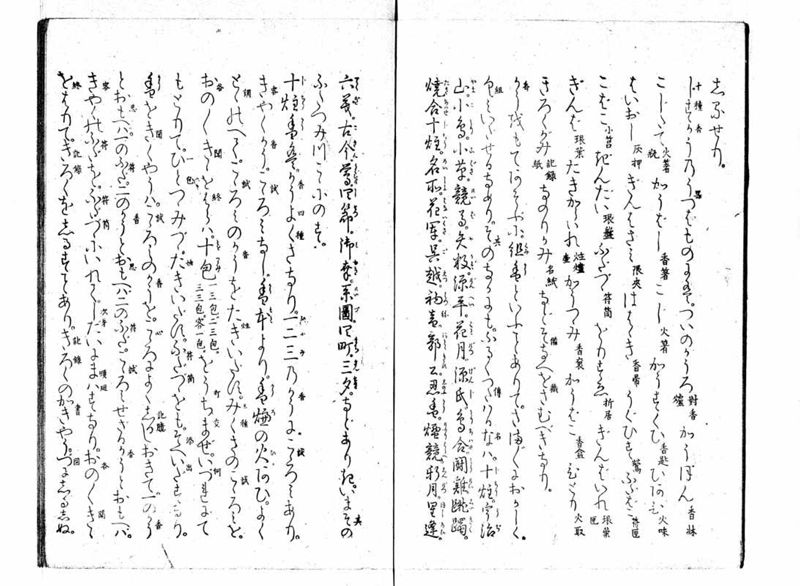
翻刻
【右丁】
しるせり。
じすかう(十種香)の うつは(器)ものには。ついのかうろ《割書:対香|炉【爐】》かうぼん《割書:香牀》
こじたて《割書:火箸|瓶》かうばし《割書:香箸》こじ《割書:火箸》かうすくひ《割書:香匙》ひあひ《割書:火味》
はいおし《割書:灰押》ぎんはさみ《割書:銀夾》ははゝき《割書:香帚》うぐひす《割書:鴬》ふだばこ《割書:符匣》
こばこ《割書:小筥》ぎんだい《割書:銀盤》ふだづゝ《割書:符筒》をりすゑ《割書:折居》ぎんばいれ《割書:銀葉|匣》
ぎんば《割書:銀葉》たきからいれ《割書:炷炉|台》かうつゝみ《割書:香嚢》かうばこ《割書:香盒》ひとり《割書:火取》
きろくがみ《割書:記録|紙》なのりかみ《割書:名紙》など そなへ(備)をさむ(蔵)べきなり。
かう(香)をもてあそぶに。組香(くみかう)といふことありて。さま〴〵におかしく。
くみ(組)いだせるなめり。その(其)なかにも。ふるく つたは(伝)る な(名)は。十炷(じちう)。宇治(うぢ)
山(やま)。小鳥(ことり)。小草(こぐさ)。競馬(けいば)。矢数(やかず)。源平(げんへい)。花月(くわげつ)。源氏(げんじ)。鳥合(とりあはせ)。闘雞(とうけい)蹴踘(しうきく)。
焼合(たきあはせ)十炷(じちう)。名所(めいしよ)。花軍(はないくさ)。呉越(ごえつ)。初音(はつね)。郭公(ほとゝきす)。忍香(しのふかう)。煙競(けふりくらへ)。新月(しんげつ)。星逢(ほしあひ)。
【左丁】
六義(りくぎ)。古今(こきん)。鴬(うぐひす)。四節(しせつ)。御幸(みゆき)。系図(けいづ)。四 町(まち)。三夕(さんせき)。などありき。いま その(其)
ふたつみつこゝにのす。
十炷香(じちうかう)は。かう(香)よくさ(四種)なり。一二三(ひふみ)のかう(香)に。こゝろ(試)み
あり。
きやくかう(客香)。こゝろみ(試)なし。香(かう)本(もと)より。香炉(かうろ)の火(ひ)あひ。よく
とゝのへ(調)て。こゝろみ(試)の かう(香)を たき(炷)いだす。みくさ(三種)のこゝろみ(試)を。
おの(各)〳〵きゝ(聞)をはら(終)は。十包(とをつゝみ)《割書:一三包。二三包。|三三包。客一包》を うち(打)まぜ(交)。いづれ(何)にて
もとりて。ひと(一)つゝみ(包)づゝ。たき(炷)いだす。ふだ(符)づゝ(筒)をも。そへ(添)いだす(出)なり。
香(かう)を きく(聞)やうは。こゝろみ(試)の かう(香)を。こゝろ(心)によく しるしおき(記憶)【臆は誤】て。一の かう(香)
と おもへ(思)ば。一の ふだ(符)。二の かう(香)と おも(思)へば二の ふだ(符)。こゝろみ(試)せざる かう(香)とおもへば。
きやく(客)の ふだ(符)を。ふだづゝ(符筒)にいれて。しだい(次第)に まは(順廻)すなり。おの(各)〳〵きゝ(聞)
をはり(終)て。きろく(記録)をしるすことあり。きろく(記録)のかき(書)やう。つ(▢)にしるしぬ。
現代語訳
【右丁】
記されています。
十種香の器物には、対香炉、香台、火取瓶、香箸、火箸、香匙、火味、灰押、銀挟、香帚、鶯、符匣、小箱、銀盤、符筒、折据、銀葉匣、銀葉、炷炉台、香嚢、香合、火取、記録紙、名紙などを備え蔵すべきです。
香を楽しむのに、組香ということがあって、さまざまに面白く組み立てられているようです。その中でも、古くから伝わる名前は、十炷、宇治山、小鳥、小草、競馬、矢数、源平、花月、源氏、鳥合、闘鶏、蹴鞠、焼合、十炷、名所、花軍、呉越、初音、郭公、忍香、煙競、新月、星逢、
【左丁】
六義、古今、鶯、四節、御幸、系図、四町、三夕などがありました。今、そのうち二つ三つここに載せます。
十炷香は、香が四種類です。一、二、三の香に試みがあります。
客香には試みがありません。香元から、香炉の火加減をよく調えて、試みの香を焚き出します。三種の試みを各々聞き終わったら、十包(一が三包、二が三包、三が三包、客が一包)を打ち交ぜ、どれでも取って、一包ずつ焚き出します。符筒も添え出すのです。
香を聞く方法は、試みの香を心によく記憶しておいて、一の香と思えば一の符、二の香と思えば二の符、試みしていない香と思えば客の符を符筒に入れて、順次回すのです。各々聞き終わって、記録を記すことがあります。記録の書き方は次に記します。
英語訳
【Right page】
are recorded.
For the implements of Ten Varieties Incense, one should prepare and store: paired incense burners, incense stands, fire-tending bottles, incense chopsticks, fire chopsticks, incense spoons, fire seasoning, ash pressers, silver tongs, incense brooms, nightingales, tally boxes, small boxes, silver trays, tally tubes, folding seats, silver leaf boxes, silver leaves, burner stands, incense pouches, incense containers, fire carriers, record paper, name paper, and so forth.
In enjoying incense, there is something called "kumikō" (composed incense), which appears to be arranged in various interesting ways. Among these, the names that have been transmitted from ancient times are: Ten Burnings, Mount Uji, Small Birds, Small Grass, Horse Racing, Arrow Count, Genji-Heike, Flower and Moon, Genji, Bird Matching, Cockfighting, Kemari, Burning Competition, Ten Burnings, Famous Places, Flower Battles, Go-Etsu, First Sound, Cuckoo, Hidden Incense, Smoke Competition, New Moon, Star Meeting,
【Left page】
Six Principles, Kokin, Nightingale, Four Seasons, Imperial Excursion, Genealogy, Four Districts, Three Evenings, and others existed. Now I will present two or three of these here.
Ten Burnings Incense uses four types of incense. The first, second, and third incenses serve as trials.
The guest incense has no trial. The incense master properly adjusts the fire in the incense burner and burns the trial incenses. After everyone has listened to the three types of trials, ten packets (three packets each of types one, two, and three, and one packet of the guest incense) are mixed together. Any may be selected and burned one packet at a time. Tally tubes are also provided.
The method of listening to incense is: remember the trial incenses well in your mind, and if you think it is the first incense, place the first tally; if you think it is the second incense, place the second tally; if you think it is an untried incense, place the guest tally into the tally tube, passing it around in order. After everyone has finished listening, records are sometimes written. The method of writing records is marked as follows.