翻刻
【右丁】
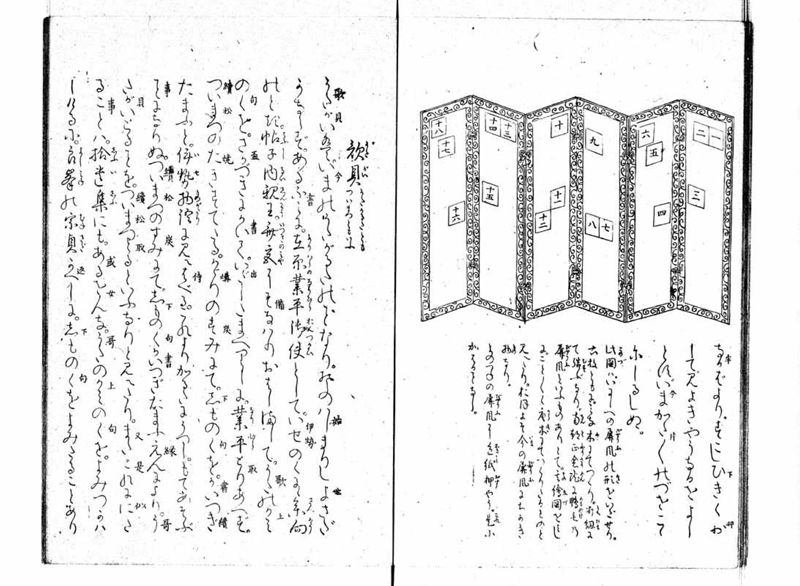
【六曲の屏風の各面に数字あり】
一 なか(半)ばより。すこし ひき(下)く お(押)
二 して。見よきやうなるをよし
三 とす。いま(今)かた(片)〳〵のづをこゝ
四 にしるしぬ。
五 此図(このづ)は。いにしへの屏風(びやうふ)の形(かた)をいだせり。
六 六枚ともに。木(き)にてつくり。打紐(うちひも)に
て結(むす)ぶなり。南都(なんと)正倉院(しやうさうゐん)に鴨毛(かものけ)の
七 屏風(びやうふ)といふものありとて。其(その)絵図(ゑづ)をみし
九 八 に。こと〳〵く唐木(からき)にてつくりたるものと
十 見えたり。おほよそ今(いま)の屏風(びやうふ)にちかき
十一 物(もの)なり。
十二 よのつねの屏風(びやうふ)に色紙(しきし)押(おす)やう。是(これ)に
十三 かはることなし。
十四
十五
十六
十七
十八
【左丁】
歌貝(うたがい)《割書:うたかるたとも|ついまつともいふ》
うたが(歌貝)いは。いま(今)のうたがるたのことなり。その はじま(始)りし よ(世)さだ
かならず。ある ふみ(書)に在原業平(ありはらのなりひら)御使(おんつかひ)として。いせ(伊勢)のくにゝ参向(さんかう)
のとき。帖子内親王(てふしないしんわう)。斎宮(いつきのみや)に そな(備)はりおはしまして。うた(歌)の かみ(上)
の く(句)を。さか(盃)づきに かい(書)て。いだ(出)したまへりしに。業平(なりひら)とり(取)あへず。
ついまつ(続松)の たき(焼)すてたる。かがり(煹)の すみ(炭)にて。しも(下)の く(句)を。かいつぎ(書続)
たまふと。伊勢物語(いせものがたり)に見え はべ(侍)る。これよりかるたにうつし。もてあそぶ
こと(事)になりぬ。ついまつ(続松)の すみ(炭)にて。しも(下)の く(句)かい(書)つぎたまふ えん(縁)により。う(哥)
た がい(貝)とることを。ついまつ(続松)とる(取)といふなりと見えたり。また(又)これ(是)に に(似)た
る こと(事)は。拾遺集(しふいしふ)にも。ある(或)をんな(女)。うた(哥)の かみ(上)の く(句)を。よみつかは
しけるに。良峯(よしみね)の宗貞(むねさだ)かへ(返)しに。しも(下)の く(句)をよみたることあり
現代語訳
【右丁】
【六曲の屏風の各面に数字あり】
一 中央より少し下に押し
二 て、見た目が良いようにするのが良い
三 とする。今、片方ずつの図をここ
四 に記す。
五 この図は、古い屏風の形を表している。
六 六枚とも、木で作り、打紐で
結ぶのである。南都正倉院に鴨毛の
七 屏風というものがあるといって、その絵図を見た
九 八 ところ、ことごとく唐木で作られたものと
十 見えた。おおよそ今の屏風に近い
十一 物である。
十二 一般的な屏風に色紙を押す方法は、これと
十三 変わることはない。
十四
十五
十六
十七
十八
【左丁】
歌貝《割書:歌かるたとも、続松取りともいう》
歌貝は、今の歌かるたのことである。その始まった時代は定かではない。ある書物に、在原業平が御使いとして伊勢国に参向した時、帖子内親王が斎宮に仕えていらして、歌の上の句を盃に書いて出されたところ、業平がとっさに、続松を焼き捨てた篝火の炭で下の句を書き続けたと、伊勢物語に見える。これよりかるたに移し、遊ぶことになった。続松の炭で下の句を書き続けた縁により、歌貝を取ることを続松取りというのだと見える。また、これに似たことは、拾遺集にも、ある女性が歌の上の句を詠み送ったところ、良峯宗貞が返事に下の句を詠んだことがある。
英語訳
【Right page】
【Numbers on each panel of the six-fold screen】
One Mount slightly below
Two the center so that it
Three looks pleasing to the eye.
Four Now I will record the diagram
Five of each side here.
Six This diagram represents the form of ancient screens.
All six panels are made of wood and
Seven bound with braided cords. It is said that at
Nine Eight Shōsōin in Nanto there is something called a
Ten duck feather screen, and when I saw its diagram,
Eleven it appeared to be made entirely of Chinese wood.
Twelve It is generally similar to today's screens.
Thirteen The method of mounting shikishi on ordinary
Fourteen screens is no different from this.
Fifteen
Sixteen
Seventeen
Eighteen
【Left page】
Uta-gai (Poetry Shells) 《Also called uta-karuta or tsukimatsu-tori》
Uta-gai refers to what is now called uta-karuta (poetry cards). The era when it began is not certain. In a certain book, when Ariwara no Narihira went to Ise Province as an imperial messenger, Princess Teishi was serving at the Itsuki-no-miya shrine, and she wrote the upper verse of a poem on a sake cup and presented it. Narihira immediately took charcoal from a torch fire where pine torches had been burned and wrote the lower verse in continuation, as seen in the Ise Monogatari (Tales of Ise). From this, it was transferred to karuta and became a form of entertainment. Due to the connection of writing the lower verse with charcoal from pine torches, taking uta-gai came to be called tsukimatsu-tori (taking pine torches). Also, something similar to this appears in the Shūi-shū, where a certain woman sent the upper verse of a poem, and Yoshimine no Munesada replied with the lower verse.