翻刻
【右丁】
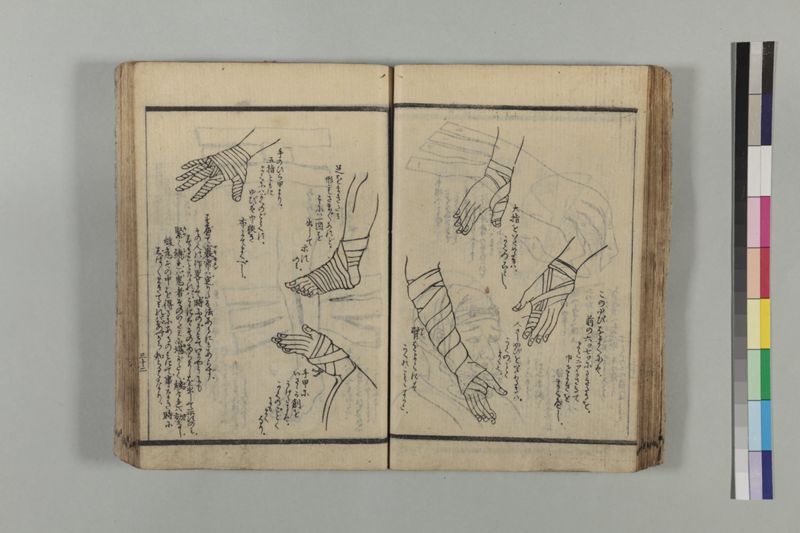
大指をいためたるは、
かくのことし、
このゆびをまくには、
前の六ッ七ッにさきたるを、
また二ッにさきて
巾せまきをまくべし、
人さしゆびをいためたるは、
かくのごとく
まく也、
臂(ヒヂ)をまくには
かくのことくすること、
【左丁】
足をまきたる
形もさま〴〵あれど、
こゝには一図を
出して
示す 手甲に
のみ、 いさゝか創を
うけたるは、
手のひら甲より、 かくのごとく
五指ともに にも
まくには、かくのごとくす、 まく
ゆびは巾狭き なり、
布にてまくべし、
すべて裹帘(マキモメン)は、定りたる法あるにもあらず、
その人の作略にて、時にのぞみていかやうにも
することなれば、こゝにはそのあらましを出して示すのみ、
緊(キツ)く縛(シバ)れば、患者そのいたみに堪(タヘ)がたく、緩(ユル)けれは効(カヒ)なし、
緩急その中を得るにあるのみにて、事なき時に
しば〳〵まきてみればおのづから知らるゝなり、
現代語訳
【右丁】
親指を負傷したときは、
このようにする。
この指を巻くには、
前の六つ七つに裂いたものを、
さらに二つに裂いて
幅の狭いものを巻くべきである。
人差し指を負傷したときは、
このようにして
巻くのである。
腕を巻くには
このようにすること。
【左丁】
足を巻いた
形も様々あるが、
ここには一つの図を
出して
示す 手の甲に
だけ。 少し傷を
負ったときは、
手のひら・手の甲から、 このようにして
五本指全てを 巻く
巻くには、このようにする。 のである。
指は幅の狭い
布で巻くべきである。
すべて包帯は、決まった方法があるわけではなく、
その人の工夫によって、その時に応じてどのようにでも
することなので、ここではその概略を出して示すだけである。
きつく縛れば、患者がその痛みに耐えがたく、緩ければ効果がない。
緩急の程度を適切に保つことが重要であり、何もないときに
しばしば巻いて練習すれば自然に分かるようになるのである。
英語訳
【Right page】
When the thumb is injured,
do it like this.
To bandage this finger,
take what was previously torn into six or seven pieces,
tear it further into two pieces
and use narrow strips to bandage.
When the index finger is injured,
bandage it
like this.
To bandage the arm,
do it like this.
【Left page】
There are various ways
to bandage the foot,
but here I show
only one diagram
as an example. When there is
a slight wound
on the back of the hand,
From the palm and back of the hand, bandage it
to bandage all like this.
five fingers, do it like this.
Fingers should be bandaged
with narrow cloth strips.
In general, bandaging has no fixed rules,
but depends on each person's ingenuity, adapting to the situation
as needed, so here I only show the general principles.
If bound too tightly, the patient cannot bear the pain; if too loose, it has no effect.
The key is to find the right balance between tight and loose, and
by practicing bandaging frequently when there are no emergencies,
one will naturally learn the proper technique.