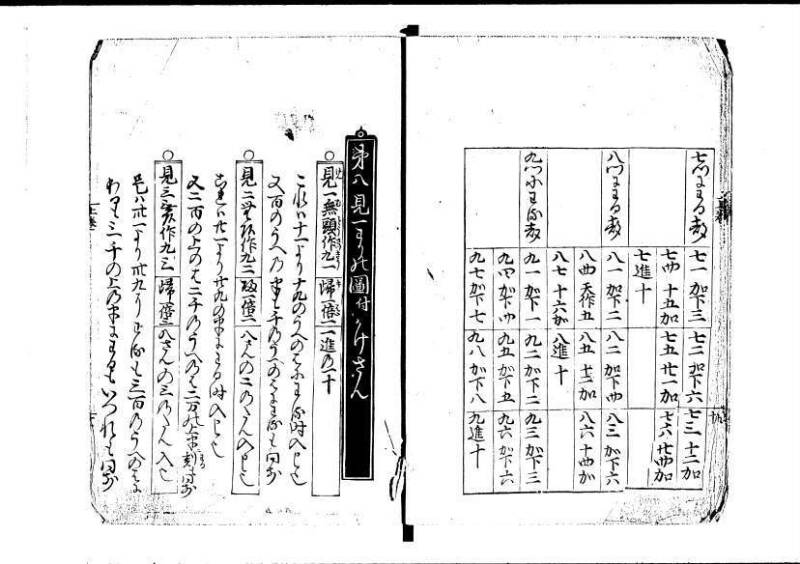
翻刻
【上巻十丁裏】
七つにわる声 七一 加下三 七二 加下六 七三 十二加
七四 十五加 七五 廾一加 七六 廾四加
七進十
八つにわる声 八一 加下二 八二 加下四 八三 加下六
八四 天作五 八五 十二加 八六 十四加
八七 十六加 八進 十
九つにわる声 九一 加下一 九二 加下二 九三 加下三
九四 加下四 九五 加下五 九六 加下六
九七 加下七 九八 加下八 九進 十
【上巻十一丁表】
《題:第八 見一わりの図《割書:付》かけさん》
○見(けん)一無/頭(むとう)作(さつ)九(きう)一 帰(き)一/倍(はい)一 一進の一十
これは十一より十九のうへのはにわる時入申す也
又百のうへのはも千のうへのはにわるも同前
○見二無頭作九二 帰一倍二 八さんの二のたん入申す也
これは廿一より廿九のはにわる時入申す也
又二百の上のは二千のうへのは二万の上は ̄ニ刻(わる)も同前
○見三無頭作九三 帰一倍三 八さんの三のたん入也
是は卅一より卅九にわるも三百のうへのはに
わるも三千の上のはにわるもいつれも同前
現代語訳
【上巻十丁裏】
七つに割る声 七一 加下三 七二 加下六 七三 十二加
七四 十五加 七五 二十一加 七六 二十四加
七進十
八つに割る声 八一 加下二 八二 加下四 八三 加下六
八四 天作五 八五 十二加 八六 十四加
八七 十六加 八進 十
九つに割る声 九一 加下一 九二 加下二 九三 加下三
九四 加下四 九五 加下五 九六 加下六
九七 加下七 九八 加下八 九進 十
【上巻十一丁表】
第八 見一割りの図(付:掛け算)
○見一無頭作九一 帰一倍一 一進の一十
これは十一より十九の上の桁に割る時に入れ申す也。
また百の上の桁も、千の上の桁に割るも同前。
○見二無頭作九二 帰一倍二 八算の二の段を入れ申す也。
これは二十一より二十九の桁に割る時に入れ申す也。
また二百の上の桁、二千の上の桁、二万の上の桁に割るも同前。
○見三無頭作九三 帰一倍三 八算の三の段を入れ申す也。
これは三十一より三十九に割るも、三百の上の桁に
割るも、三千の上の桁に割るも、いずれも同前。
英語訳
**Volume 1, Folio 10 (Verso)**
**Chants for dividing by seven:**
Seven-one: add below three Seven-two: add below six Seven-three: twelve add
Seven-four: fifteen add Seven-five: twenty-one add Seven-six: twenty-four add
Seven advances ten
**Chants for dividing by eight:**
Eight-one: add below two Eight-two: add below four Eight-three: add below six
Eight-four: heaven creates five Eight-five: twelve add Eight-six: fourteen add
Eight-seven: sixteen add Eight advances ten
**Chants for dividing by nine:**
Nine-one: add below one Nine-two: add below two Nine-three: add below three
Nine-four: add below four Nine-five: add below five Nine-six: add below six
Nine-seven: add below seven Nine-eight: add below eight Nine advances ten
---
**Volume 1, Folio 11 (Recto)**
**Section Eight: Diagram of the "Seeing-One Division" Method** *(with multiplication)*
○ "See one, no leading digit — form nine-one; return one, double one; one advances ten."
This is applied when dividing by a divisor from 11 through 19 in the upper digit position.
The same applies when the upper digit is in the hundreds place or the thousands place.
○ "See two, no leading digit — form nine-two; return one, double two." — Apply the "two" column of the eight-chants table.
This is applied when dividing by a divisor from 21 through 29 in the digit position.
The same likewise applies when dividing in the hundreds of twos, thousands of twos, or ten-thousands of twos.
○ "See three, no leading digit — form nine-three; return one, double three." — Apply the "three" column of the eight-chants table.
Whether dividing by 31 through 39, or dividing in the hundreds of threes,
or dividing in the thousands of threes — all are the same.