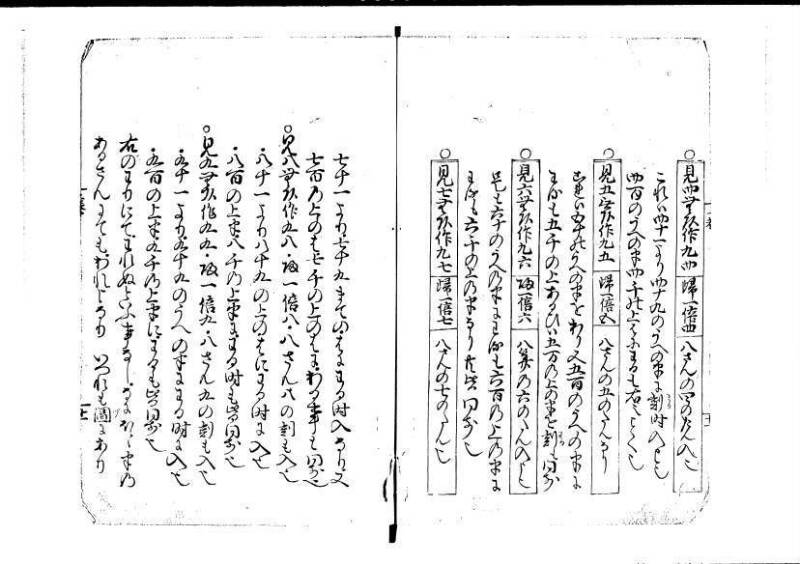
翻刻
【上巻十一丁裏】
○見四無頭作九四 帰一倍四 八さんの四のたん入也
これは四十一より四十九のうへのはに刻(わる)時入申す也
四百のうへのは四千の上のはわるも右のことく也
○見五無頭作九五 帰一倍五 八さんの五のたんなり
これは五十のうへのはをわり又五百のうえへのはに
わるも五千の上あるひは五万の上のはを刻(わる)も同前
○見六無頭作九六 帰一倍六 八算の六のたん入る也
是も六十のうへのはにわるも六百の上へのはに
わるも六千の上のはなり共皆同前也
○見七無頭作九七 帰一倍七 八算の七のたん也
#1【上巻十二丁表】
七十一より・七十九まての・はにわる時入るなり・又
七百の上のは・七千の上のはに・わる事も同前也
○見八無頭作九八 ・帰一倍八 ・八算の八の/刻(わり)も入也
・八十一より八十九の上の・はにわる時に入也。
・八百の上半・八千の上半に・わる時も皆同前也
○見九無頭作九九 ・帰一倍九 ・八算の九の/刻(わり)も入也
・九十一より・九十九のうへのはにわる時に入也
・九百の上半・九千の上半に・わるも皆同前也
右のわりにて・われぬといふ事なし・なにほと半の
あるさんにても・われ申すなり いつれも図(ヅ)にあり
現代語訳
【上巻十一丁裏】
○見四無頭作九四 帰一倍四 八算の四の段を入れ申す也。
これは四十一より四十九の上の桁に割る時に入れ申す也。
四百の上の桁、四千の上の桁に割るも右の如く也。
○見五無頭作九五 帰一倍五 八算の五の段なり。
これは五十の上の桁を割り、また五百の上の桁に
割るも、五千の上、あるいは五万の上の桁を割るも同前。
○見六無頭作九六 帰一倍六 八算の六の段を入れ申す也。
これも六十の上の桁に割るも、六百の上の桁に
割るも、六千の上の桁なりとも、皆同前也。
○見七無頭作九七 帰一倍七 八算の七の段也。
【上巻十二丁表】
七十一より七十九までの桁に割る時に入れるなり。また
七百の上の桁、七千の上の桁に割ることも同前也。
○見八無頭作九八 帰一倍八 八算の八の割りも入れ申す也。
八十一より八十九の上の桁に割る時に入れ申す也。
八百の上の桁、八千の上の桁に割る時も皆同前也。
○見九無頭作九九 帰一倍九 八算の九の割りも入れ申す也。
九十一より九十九の上の桁に割る時に入れ申す也。
九百の上の桁、九千の上の桁に割るも皆同前也。
右の割り方にて、割れぬということなし。いかほど桁の
あるような計算にても、割ることができ申すなり。いずれも図にあり。
英語訳
**Volume 1, Folio 11 (Verso)**
○ "See four, no leading digit — form nine-four; return one, double four." — Apply the "four" column of the eight-chants table.
This is applied when dividing in the upper digit position for numbers from 41 through 49.
Dividing in the hundreds of fours or the thousands of fours is likewise the same.
○ "See five, no leading digit — form nine-five; return one, double five." — This is the "five" column of the eight-chants table.
This applies when dividing in the upper digit position of fifty, and also when dividing in the hundreds of fives, the thousands of fives, or even the ten-thousands of fives — all are the same.
○ "See six, no leading digit — form nine-six; return one, double six." — Apply the "six" column of the eight-chants table.
Whether dividing in the upper digit position of sixty, or in the hundreds of sixes,
or in the thousands of sixes — all are likewise the same.
○ "See seven, no leading digit — form nine-seven; return one, double seven." — This is the "seven" column of the eight-chants table.
---
**Volume 1, Folio 12 (Recto)**
This is applied when dividing in the digit positions from 71 through 79. Likewise,
dividing in the hundreds of sevens or the thousands of sevens is the same.
○ "See eight, no leading digit — form nine-eight; return one, double eight." — Apply the "eight" division of the eight-chants table as well.
This is applied when dividing in the upper digit positions from 81 through 89.
Dividing in the hundreds of eights or the thousands of eights is likewise all the same.
○ "See nine, no leading digit — form nine-nine; return one, double nine." — Apply the "nine" division of the eight-chants table as well.
This is applied when dividing in the upper digit positions from 91 through 99.
Dividing in the hundreds of nines or the thousands of nines is likewise all the same.
With this method of division, there is nothing that cannot be divided. No matter how many digits a calculation may have, division can always be performed. All cases are shown in the diagrams.