翻刻
【上巻序一丁裏】
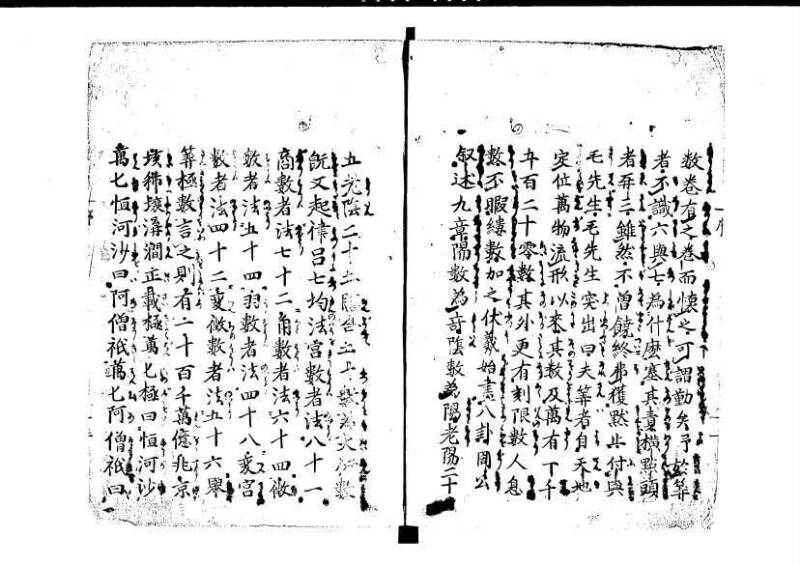
/数巻(すうくわん)/有(あり)/之(これ)/巻(まき)而/懐(ふところに)/之(これを)/可(べし)/謂(いふつつ)/勤矣(つとめたると)/予(よ)/於(をいては)/筭(さんに)
者/不(ず)/識(しら)/六(りくと)/與(とを)/七(しつ)/為(してか)/什(なん)/麼(と)/塞(ふさがん)/其(その)/責(せめを)/横點(わうてん)/頭(どうする)
/者(もの)/再三(さいさん)/雖(いへども)/然(しかりと)/不(ず)/曽(かつて)/饒(ゆるさ)/終(ついに)/弗(ず)穫/黙止(もくしすることを)/付與(ふよす)
/毛先生(まうせんじやうに)毛先生/突出(とつしゅつして)/曰(いわく)/夫(それ)/筭(さん)/者(は)/自(より)/天地(てんち)
/定(さためて)/位(くらひを)/萬物(ばんぶつ)/流(しいて)/形(かたちを)/以来(このかた)/其(その)/数(すう)/及(をよふ)/萬有(まんゆう)一/千(せん)
五百二十/零(れい)/數(すうに)/其(その)/外(ほか)/更(さらに)/有(あり)/刻限(こくけんの)/數(すう)人/息(そく)
/數(すう)/不(す)/暇(いとまあら)/縷(る)/數(すうするに)/加之(しかのみならす)/伏義(ふつき)/始(はしめて)/畫(くわくし)/八卦(はつくわを)/周公(しうこう)
/叙述(しよしつして)/九章(きうしやうを)/陽數(やうすうを)/為(し)/奇陰(きといん)數為/隅老(ぐうとらう)陽二十
【上巻序二丁表】
五/老陰(らういん)二十五/䐇合(ひんがうして)五/十(しう)/數(すうを)/為(す)/大衍(たいえんの)/數(すうと)
/既(すてに)/又(また)/起(たてて)/律呂(りつりよ)/七均(しつきんの)/法(はうを)/宮數(きうすう)/者(は)/法(のつとり)八一 ̄ニ
/商(じやう)/數(すう)/者(は)/法(のつとり)七十二 ̄ニ/角(かく)/數(すう)/者(は)/法(のつとり)六十四/徴(ち)
/數(すう)/者(は)/法(のつとり)五十四 ̄ニ/羽(う)/數(すう)/者(は)/法(のつとり)四十八 ̄ニ/変(へん)/宮(きうの)
/數(すう)/者(は)/法(のつとり)四十二 ̄ニ/変(へんな)/徴(ちの)/數(すう)/者(は)/法(のつとり)五十六/擧(◼︎)
/筭(さん)/極(きよく)/數(すうを)/言(いふ)/之(これを)/則(ともんは)/有(あ)一十百千/萬(まん)/億(をく)/兆(てふ)/京(けい)
/垓(かい)/杼(ちよ)/壌(しやう)/溝(かう)/澗(かん)/正(せい)/載(さい)/極(きょく)/萬(ばん)/匕(あいの)/極(〓くと)/曰(そ)/恒(かう)/河(が)/沙(しや)
/萬(はん)/匕(◼︎)/恒(かう)/河(が)/沙(しやを)/曰(い)/阿(あ)/僧(そう)/祇(き)/萬(はん)/匕(ひ)/阿(あ)/僧(そう)祇(き)曰(は)
現代語訳
【上巻序・一丁裏】
(続き)数巻(の算書)があり、それを懐に入れて(常に携えて)励んだと言うべきでしょう」と。私(光由)は算数においては、六と七を足して何になるかも知らないほどのものですので、その責めを(断ろうと)何度も首を横に振りましたが、それでも(相手は)ついに許してくれず、とうとう黙って断ることができず(序文を書くことを)引き受けてしまいました。そこで毛先生にお委ねしたところ、毛先生がすっと進み出て言うには、「そもそも算(数学)というものは、天地が位置を定め、万物が形を流し出して以来、その数は万有千五百二十に及び、その他さらに刻限の数、人の呼吸の数など、一つ一つ数え上げる暇もございません。しかのみならず、伏羲が初めて八卦を画き、周公が九章を叙述し、陽数を奇とし、陰数を偶とし、老陽(の数)は二十五、
【上巻序・二丁表】
老陰(の数)は二十五、これを合わせて五十を大衍の数とします。すでにまた律呂七均の法を立て、宮の数は八十一(を法とし)、商の数は七十二(を法とし)、角の数は六十四(を法とし)、徴の数は五十四(を法とし)、羽の数は四十八(を法とし)、変宮の数は四十二(を法とし)、変徴の数は五十六(を法と)します。算の極数を挙げて言えば、一・十・百・千・万・億・兆・京・垓・杼・壌・溝・澗・正・載・極があり、万の極を恒河沙といい、万の恒河沙を阿僧祇といい、万の阿僧祇を
英語訳
[Folio 1 Verso of Preface, Volume 1]
(Continued) ...there are several volumes of mathematical works, and one could say that carrying them in one's breast and studying diligently is admirable." As for me (Mitsuyoshi), I know so little of mathematics that I would not know what six and seven add up to, and so I shook my head repeatedly to decline the responsibility. Nevertheless, he would not forgive me in the least, and in the end I could not remain silently refusing, and so I accepted (the task of writing the preface). I then entrusted the matter to Mō Sensei, who stepped forward and said: "Mathematics, since the time when Heaven and Earth established their positions and the ten thousand things flowed forth in their forms, reaches the number of ten thousand, one thousand, five hundred and twenty things, and beyond that there are further numbers such as those of time-units and human breaths, leaving no leisure to enumerate them one by one. Moreover, Fu Xi first drew the Eight Trigrams, and the Duke of Zhou expounded the Nine Chapters; the yang numbers were taken as odd, the yin numbers as even; Old Yang numbers twenty-five,
[Folio 2 Recto of Preface, Volume 1]
Old Yin numbers twenty-five; combining these gives fifty, which is called the Great Expansion Number (Dayan). Furthermore, the law of the Seven Modes of Pitch Pipes (Lülü Qijun) was established: the note Gong takes the number eighty-one as its basis; Shang takes seventy-two; Jue takes sixty-four; Zhi takes fifty-four; Yu takes forty-eight; Biangong takes forty-two; and Bianzhi takes fifty-six. To enumerate the extreme numbers in mathematics: there are one, ten, hundred, thousand, ten-thousand (man), hundred-million (oku), trillion (chō), 京 (kei), 垓 (gai), 杼 (jo), 壌 (jō), 溝 (kō), 澗 (kan), 正 (sei), 載 (sai), and 極 (kyoku); ten-thousand times 極 is called Gōgasha (Ganges sand); ten-thousand times Gōgasha is called Asōgi; ten-thousand times Asōgi is called...