翻刻
【上巻廿九丁裏】
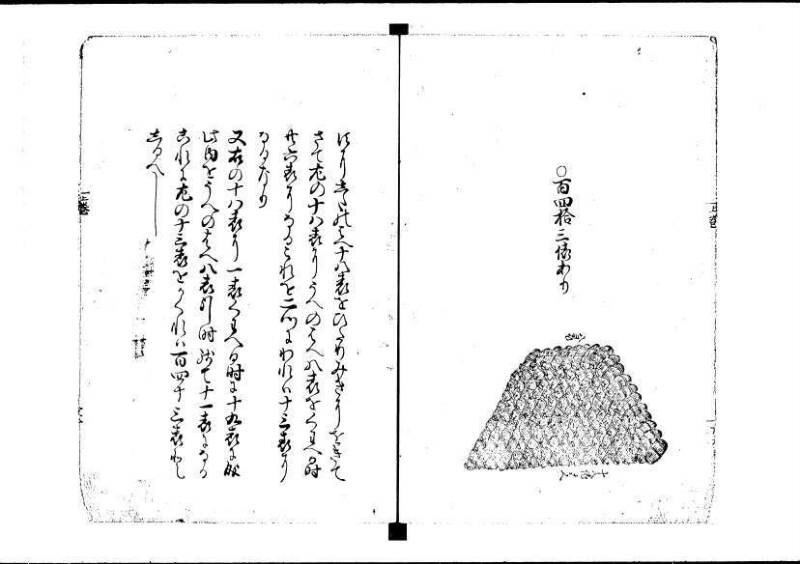
○百四拾三俵あり
【図始 台形に積み上げた俵】
【底辺の俵の数】十八俵はへ
【上底の俵の数】八俵
【上巻卅丁表】
法にしたのはへ十八表をひたりみきにをきて
さて左の十八表にうへのはへ八表をくわへる時
廿六表になるこれを二つにわれは十三表に
なるなり
又右の十八表に一表くわへる時に十九表に成
此内をうへのはへ八表引時残て十一表になる
これに左の十三表をかくれは百四千三表と
しるへし
現代語訳
【上巻二十九丁裏】
○百四十三俵あり
【図:台形に積み上げた俵の図】
【底辺の俵の数】十八俵並べ
【上底の俵の数】八俵
【上巻三十丁表】
法に、下の並べ十八俵を左右に置きて、
さて左の十八俵に上の並べ八俵を加える時、
二十六俵になる。これを二つに割れば十三俵に
なる也。
また右の十八俵に一俵を加える時に十九俵になる。
この内から上の並べ八俵を引く時、残って十一俵になる。
これに左の十三俵をかければ、百四十三俵と
知るべし。
英語訳
[Volume 1, Folio 29 verso]
○ There are 143 bales.
[Figure: A diagram of bales stacked in a trapezoidal arrangement]
[Number of bales in the bottom row:] 18 bales across
[Number of bales in the top row:] 8 bales
[Volume 1, Folio 30 recto]
The method: Place the 18 bales of the bottom row on both the left and right. Then, when the 8 bales of the top row are added to the 18 bales on the left, it becomes 26 bales. Dividing this by 2 gives 13 bales.
Next, when 1 bale is added to the 18 bales on the right, it becomes 19 bales. From this, subtract the 8 bales of the top row, leaving 11 bales.
Multiplying this by the 13 bales on the left gives 143 bales, as one should find.
</translation_ja>