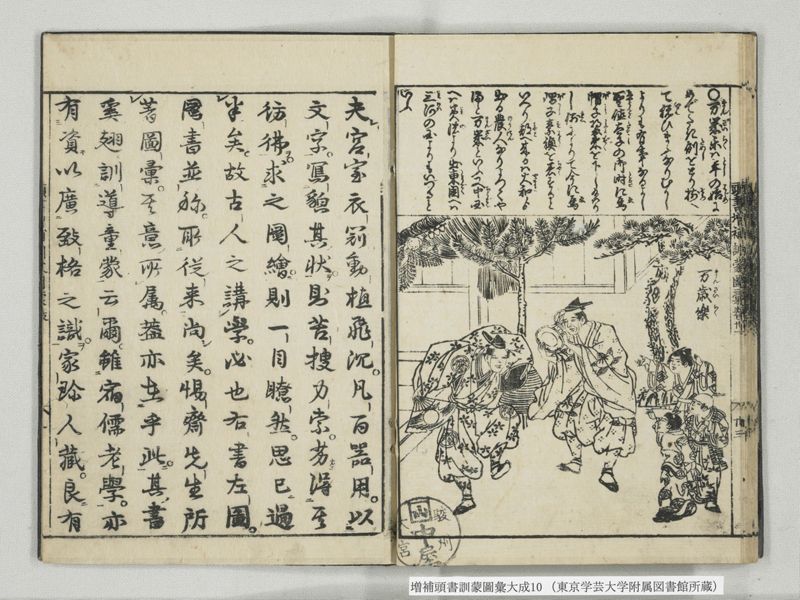
翻刻
【右丁 上段】
○万歳楽(まんざいらく)は年(とし)の始(はじめ)に
めでたき例(ためし)をとり揃(そろ)へ
て祝(いは)ひまふなりむかし
よりも有事なるよし
聖徳太子(しやうとくたいし)の御 時(とき)に烏(ゑ)
帽子(ぼし)装束(しやうぞく)を下し給はり
し例(れい)によりて今に烏(ゑ)
帽子(ぼし)素襖(すはう)を着(ちやく)すると
いへり都(みやこ)へ来るは大和(やまと)より
出る農人(のうにん)なりよつてや
まと万歳(まんざい)といふ又 中国(ちうごく)
へは美濃(みの)より出 東国(とうごく)へは
三河(みかは)の国よりもいづると
いふ
【同 下段挿絵】
万歳楽(まんざいらく)
【左丁】
夫 ̄レ宮-室衣-冠動-植飛-沈。凡-百器-用。以_二
文-字_一。写_二-貌其 ̄ノ状 ̄ヲ_一。則苦-捜力-索。劣 ̄カニ得_二其
彷-彿 ̄ヲ_一。求_二之図-絵 ̄ニ_一。則一-目瞭-然。思已 ̄ニ過
_レ半矣。故古-人之講_レ学。必也右-書左-図。
図-書並-称。取_二従-来_一尚 ̄シ矣。惕-齋先-生所
_レ著図-彙。其意 ̄ノ所_レ属。蓋亦在_二乎此 ̄ニ_一。其 ̄ノ書
奚翅。訓_二-導童-蒙_一云-爾。雖_二宿-儒老-学_一。亦
有_三資 ̄テ以広_二致-格之識 ̄ヲ_一。家-珍人-蔵。良 ̄ニ有
現代語訳
【右丁 上段】
○万歳楽は年の始めにめでたい例を取り揃えて祝い舞うものである。昔からある芸能とのことである。聖徳太子の御時代に烏帽子装束を下し賜った例により、今でも烏帽子と素襖を着用するという。都へ来るのは大和から出てくる農民である。よって大和万歳という。また中国地方へは美濃から出て、東国へは三河の国からも出るという。
【同 下段挿絵】
万歳楽
【左丁】
宮室・衣冠・動植・飛沈、およそ百器用について、文字をもってその状貌を写そうとすれば、苦労して探索しても、わずかにその彷彿を得るに過ぎない。これを図絵に求めれば、一目瞭然で、思いは既に半ばを過ぎる。故に古人の学を講ずるに、必ず右に書、左に図を配し、図書を並び称した。これを取ることは従来より尊ばれてきた。惕齋先生の著わした図彙は、その意の属するところ、蓋しまたここにある。その書は何ぞただ童蒙を訓導するのみならんや。宿儒老学といえども、また資するところがあって致格の識を広めることができる。家珍人蔵として、まことに...
英語訳
【Right Page Upper Section】
○Manzairaku (celebratory dance) involves gathering auspicious examples at the beginning of the year to perform celebratory dances. This is said to be an ancient art form. According to the precedent when Prince Shōtoku bestowed eboshi (court caps) and costumes, they still wear eboshi and suō (formal court dress) today. Those who come to the capital are farmers from Yamato province, hence called "Yamato Manzai." It is also said that those going to the Chūgoku region come from Mino, and those going to the eastern provinces also come from Mikawa province.
【Same Lower Section Illustration】
Manzairaku
【Left Page】
Regarding palace buildings, court dress, flora and fauna, flying and swimming creatures, and all manner of implements and utensils: if one attempts to describe their appearance through written characters alone, even with painstaking search and investigation, one can barely capture their semblance. But if one seeks them in pictorial illustration, they become clear at a glance, and understanding is already more than half achieved. Therefore, when ancient scholars pursued learning, they invariably placed writing on the right and illustrations on the left, with texts and pictures given equal importance. This practice has long been valued. The Zui (Illustrated Encyclopedia) authored by Master Tekisai has its purpose rooted precisely in this principle. How could such a book serve merely to instruct children? Even veteran scholars and learned elders can benefit from it to broaden their knowledge of investigation and understanding. As household treasures and personal collections, it truly has...