翻刻
聴(きく)_二暁角(けうかくを)_一
辺霜昨夜(へんさうさくや)墮(おつ)_二関(くはん)
榆(ゆ)_一吹(ふいて)_レ角(かくを)当城片(とうじやうへん)
月孤(げつこなり)無(なき)_レ限(かぎり)塞鴻(さいこう)
飛(とび)不(ず)_レ度(わたら)秋風吹(しうふうふいて)
入(いる)_二小単于(しやうぜんうに)_一 ̄ニ
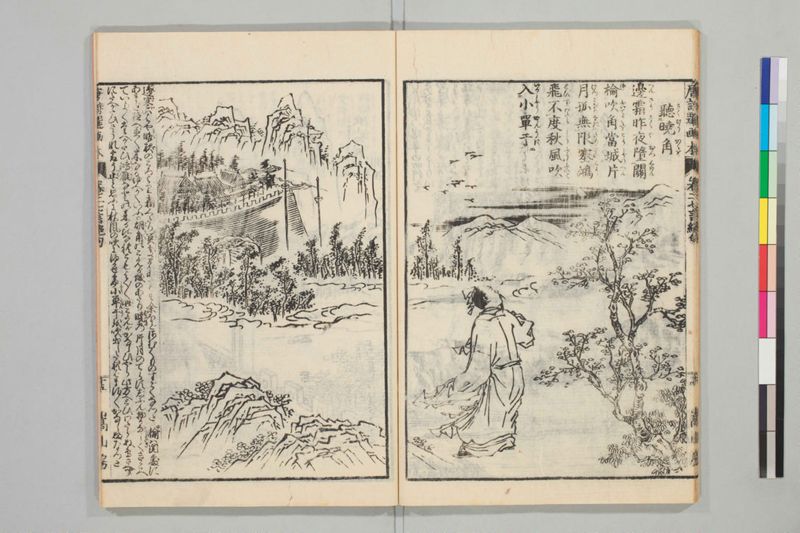
【挿絵】
《割書:辺塞(へんさい)ははや昨夜(さくや)のころより霜くだり関処(せきしよ)のあたりもよほどさむくものすごくなつた◦楡(ゆ)【左ルビ「にれのき」】は関処に|あまた植(う)へ置く木なるゆへかくいふ◦胡角(こかく)のこえが城のあたり暁(あかつき)の片月のてらすじふん物かなしくきこへ|ていよ〳〵たへがたひ鴻雁(こうがん)なとの来る比なれともよく〳〵此こえがかなしひやら此方へとびわたらぬ鳥さへ聞|にたへがたひさうなもう止(やむ)と思ふに秋風の吹にまかせて小単于(しやうたんう)を吹出したればます〳〵かなしふなつた》
現代語訳
暁の角笛を聞く
辺境の霜が昨夜、関所の楡の木に降りた。角笛を吹くと、城に片月が孤独に照らし、限りがない。塞外の雁は飛んでも渡らず、秋風が吹いて小単于に入る。
【挿絵】
《解説:辺境の砦では昨夜から霜が降り、関所のあたりもよほど寒く物寂しくなった。楡は関所に多く植えてある木なのでこのように言う。胡笛の音が城のあたりで、暁の片月の照らす中、物悲しく聞こえて、いよいよ耐え難い。雁などが来る頃であるが、この音が悲しいのか、こちらへ飛び渡らない鳥さえ聞くに耐え難そうだ。もう止むかと思うのに、秋風の吹くに任せて小単于を吹き出したので、ますます悲しくなった》
英語訳
Listening to the Dawn Horn
Border frost fell last night on the elms at the pass. The horn is blown, and a crescent moon shines lonely over the city without limit. The geese beyond the frontier fly but do not cross; autumn wind blows into the Lesser Chanyu's realm.
【Illustration】
《Commentary: At the border fortress, frost has been falling since last night, and the area around the pass has become quite cold and desolate. Elm trees are planted abundantly at passes, which is why they are mentioned thus. The sound of the barbarian horn around the city, in the light of the dawn's crescent moon, sounds melancholy and increasingly unbearable. Though it is the season when geese come, perhaps because this sound is so sad, even the birds that do not fly across to our side seem unable to bear listening to it. Just when one thinks it might stop, the autumn wind carries forth the sound of the Lesser Chanyu's horn, making it even more sorrowful》