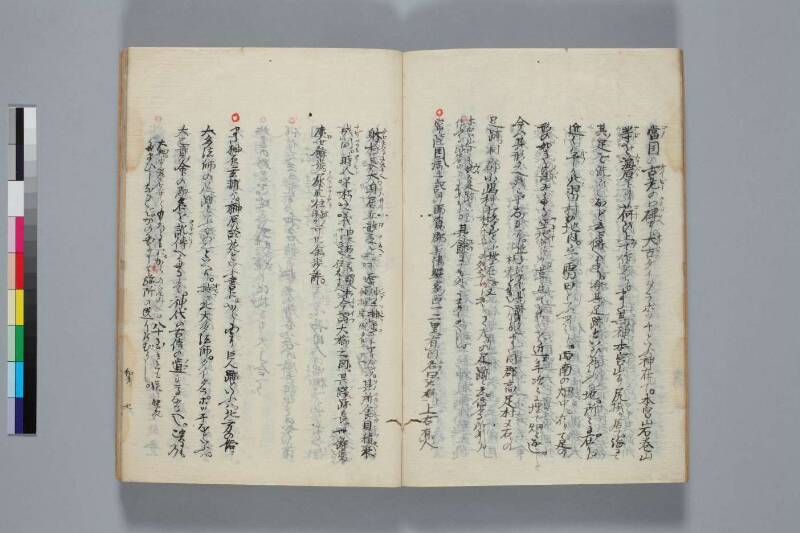
翻刻
【右丁】
【行頭の〇は朱書き】
当(コノ)【當】国の古老(オイビト)の口碑(クチヅタヘ)に。大古(オホムカシ)ダイダラボツチといふ神在りて。本宮山石巻山
等(ナド)を海原(ウナバラ)より荷(ニナ)ひ上 ̄ゲて作れり。また其神本宮山に尻掛 ̄ケ居て。海にて
其 ̄ノ足を洗ひしなどいう云 ̄ヒ伝【傳】へたり。今其 ̄ノ足跡といひ伝【傳】ふる地。所々に在(ア)り。
近くは予(オフ)【ママ】か此 ̄ノ羽田村の地内。字 ̄ノ西羽田といふ所より西南の畑 ̄ノ中 ̄ニ在 ̄リ て足の
形の如き窪(クボ)みたる空地(アキチ)ありて。草生てありしを。近 ̄キ年次々に埋(ウヅミ)て畑となし。
今は其形さへ残らずなれり。《割書:近き頃まで。其 ̄ノ跡ありし|と村老ともいへり。》また同郡高足村に右 ̄リ の
足跡。同郡小嶋村《割書:アタゴ山といふ地に在也。又|同村カホウヤト云処ニモアリト云リ》に左 ̄リ の足跡と云 ̄ヒ伝【傳】ふる所あり。
《割書:本宮山にも姥(ウバ)か足跡といひ|伝【傳】ふる跡岩の上にあり。》其 余(ホカ)【餘】にも処々にあるべし。
〇常陸国風土記に那賀郡平津駅【驛】家 ̄ノ西一二里 ̄ニ有 ̄リ_レ岡 名(ナ) ̄ヲ曰 ̄フ_二大櫛 ̄ト_一 上古有 ̄リ_レ 人
【左丁】
躰(ムクロ)《振り仮名:極長大|キハメテオホキ也》 。身居(ミハヰテ)_二【二点脱】丘壟(オカ)之上(ノウへ) ̄ニ_一手蜃【この二字の左に〇を付記】《割書:伸(ノベテ)_レ手 ̄ソ 捕(トレリ)_レ蜃 ̄ヲ ナトアリケンヲ。|伸捕字ノ脱タルヘシ。》其所食(ソノクラヒシ)貝(カヒ)積聚(ツモリテ)
成(ナレリ)_レ岡(ヲカト)。時人(ヨソヒト)不朽之義【この四字の左に〇を付記】《割書:由大朽之義謂大朽|ナド云文ノ脱タルナルベシ》今謂(イマイフ)_二大櫛之岡 ̄ト_一。其践 ̄シ跡長 ̄サ四十【表記は横一に縦線四本】余【餘】歩。
広【廣】 ̄サ廿余【餘】歩。尿穴住(イバリアナノアト)【「住」の字の左に○を付記】《割書:跡ノ|誤カ》可廿余歩許。
〇また榊原玄輔が。榊原談苑といふ書に。から国に巨人跡といふは。北方の俗 ̄ニ
大多法師の足跡といふもの也といへり。按(オモフ) ̄ニ此大多法師。ダイダラポッチなどいふは。
大已貴 ̄ノ命の御名を訛(ヨコナマリ)伝【傳】へたるにて。神代の古伝【傳】の遺(ノコ)れるなるへし。《割書:実にも|この》
《割書:大神。少彦名命ともろともに。からのえみしの八十国迄も造り堅め|たまひしなれば。かの国にも其跡所の遺り仕むかし。》
和考 七
現代語訳
【右丁】
当国の古老の口伝によると、大昔にダイダラボッチという神がいて、本宮山や石巻山などを海原から担ぎ上げて作ったという。また、その神が本宮山に腰をかけて座り、海でその足を洗ったなどと言い伝えられている。今、その足跡と言い伝えられる地が所々にある。
近くでは私のこの羽田村の地内で、字西羽田という所から西南の畑の中にあって、足の形のような窪んだ空地があり、草が生えていたが、近年次々に埋めて畑とし、今はその形さえ残らなくなった。《割書:近頃まで、その跡があったと村の老人たちも言っている。》また同郡高足村に右足跡、同郡小嶋村《割書:愛宕山という地にある。また同村カホウヤという処にもあると言う》に左足跡と言い伝える所がある。《割書:本宮山にも姥の足跡と言い伝える跡が岩の上にある。》その他にも所々にあるであろう。
○『常陸国風土記』に「那賀郡平津駅家の西一二里に岡があり、名を大櫛という。上古に人がいた
【左丁】
躯体は極めて長大であった。身は丘の上に居て、手を伸ばして蜃を捕った《割書:手を伸ばして蜃を捕ったなどとあったであろうが、伸捕の字が脱落したのであろう》。その食べた貝が積もって岡となった。時の人々は不朽の義《割書:大朽の義によって大朽などという文が脱落したのであろう》今は大櫛の岡という。その踏んだ跡の長さは四十余歩、広さは二十余歩。尿穴の跡《割書:跡の誤りか》およそ二十余歩ばかり」とある。
○また榊原玄輔の『榊原談苑』という書に、「韓国に巨人跡というのは、北方の俗にいう大多法師の足跡というものである」と言っている。思うに、この大多法師、ダイダラボッチなどというのは、大己貴命の御名が訛り伝わったもので、神代の古伝が遺されたものであろう。《割書:実際にもこの大神は、少彦名命とともに、唐の蝦夷の八十国までも造り固めたまったのだから、かの国にもその跡所が遺っているのだろう。》
和考 七
英語訳
【Right Page】
According to oral traditions of the elders of this province, in ancient times there was a deity called Daidarabotchi who carried mountains like Hongu-zan and Ishimaki-yama up from the sea and created them. It is also said that this deity sat on Hongu-zan and washed his feet in the sea. Today, places said to be his footprints exist in various locations.
Nearby, within the boundaries of my Hada village, in a place called Aza Nishi-Hada, there was a depression in the shape of a foot in a field to the southwest, where grass grew, but in recent years it has been gradually filled in and turned into farmland, so that now not even its shape remains. 《Interlinear note: Village elders say that the traces existed until recently.》 Also, in Takashi village in the same district there is what is said to be a right footprint, and in Kojima village in the same district 《Interlinear note: Located in a place called Atago-yama. It is also said there is one in a place called Kahōya in the same village》 there is a place said to be a left footprint. 《Interlinear note: On Hongu-zan too, there are traces on rocks said to be an old woman's footprints.》 There are probably others in various places as well.
○ The Hitachi-no-kuni Fudoki states: "One or two ri west of Hiratsu post station in Naka District, there is a hill called Ōgushi. In ancient times there was a person
【Left Page】
whose body was extremely large. His body rested on top of the hill, and he extended his hands to catch shellfish 《Interlinear note: There probably was text saying he extended his hands to catch shellfish, but the characters for "extended" and "caught" seem to have been omitted》. The shells he ate accumulated to form a hill. People of that time, [due to] the meaning of imperishability 《Interlinear note: Text such as 'due to the meaning of great decay called it great decay' seems to have been omitted》, now call it Ōgushi Hill. The traces of where he stepped are forty-some paces long and twenty-some paces wide. The urine hole traces 《Interlinear note: Perhaps an error for 'traces'》 are about twenty-some paces."
○ Also, in Sakakibara Gensuke's book called "Sakakibara Dan'en," it states: "What are called giant traces in Korea are what the northern folk call traces of Daitahōshi." I think that this Daitahōshi, or what is called Daidarabotchi, is a corrupted transmission of the divine name of Ōnamuchi-no-mikoto, representing remnants of ancient divine-age traditions. 《Interlinear note: Indeed, this great deity, together with Sukunahikona-no-mikoto, created and solidified even the eighty provinces of the Korean Emishi, so traces likely remain in that country as well.》
Wakō [Section] 7