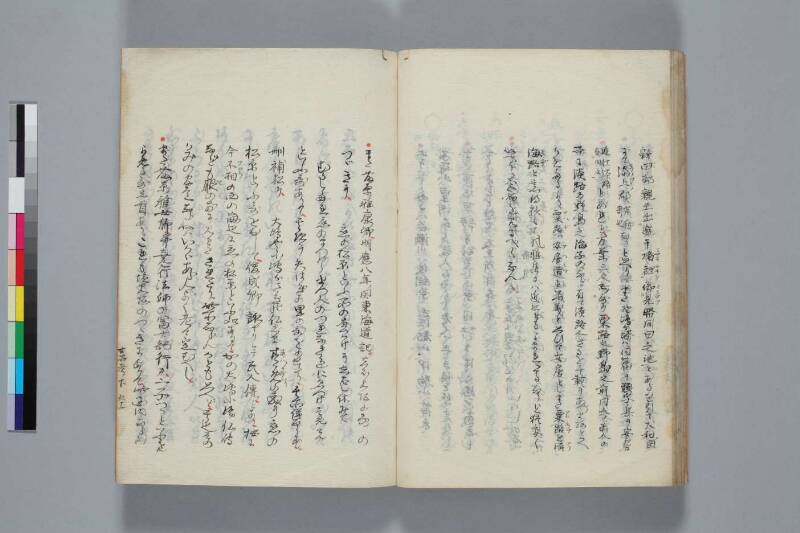
翻刻
新田部 ̄ノ親王出_二遊于/堵裡(ミヤコノウチヲ)_一御(ミ)_二_見(タマフ)勝間田之池_一とあるを引て、大和 ̄ノ国
にて添上(ソフノカミノ)郡《割書:薬師|寺ノ辺》なりといへり、また野嶋が崎は、同篇に類字集に安房
《割書:近江淡路|有_二同名_一》とあれど、万葉三、人丸 ̄ノ歌に、粟路之野島之前、同六ノ赤人の
歌に淡路の野島之海子の、など有て淡路也、さるを千載にあづま路とかへ
られたるより、粟路(アハヂ)は安房道(アハミチ)といふ義と思ひて安房とし、また粟路(アハミチ)を淡(アフ)
海路(ミヂ)と意得損して、風雅集には近江ともよまれたるなり、と猶委く
いへり、本篇を見るべくなん、
●また藤原 ̄ノ雅康 ̄ノ卿、明応八年 ̄ノ関東海道記、しほ見坂の歌の
つゞきに、 恋の松原といふ所の松かげにしばし休みて、
むかしたれ恋のまつばらまつ人のつれなき色に名づけそめけん
といふ歌ありて、其次に矢はぎの里の歌をのせたり、其所詳ならず、
刪補松に、 大嶋や小嶋がさきの仏じま/すゝめ(あはずイ)の森に恋の
松原といふ歌を出して、俊成卿 詠ナリトテ民人伝 ̄フ、とあり、按に
今/不相(フサウ)の西の海辺に恋の松原といふ処ありて、かの大嶋小嶋仏嶋
なども眼(マ)の前に見わたされたり、此所ならんかとも思へど、其辺その
かみの官道ならねばいかゞあらんよく考て定むへし、
●また藤原雅世卿、并堯行法師の富士紀行に、二子つかといふを
よめる歌三首あり、これも塩見坂のつゞきにありて、此国内ならん
【「●」「、」は朱字】
古歌考 下 六十一
現代語訳
新田部親王が都の内を出遊されて、勝間田の池をご覧になった」とあるのを引用して、大和国で添上郡(薬師寺の辺り)であると言っている。また野嶋が崎は、同篇に『類字集』では安房(近江・淡路に同名がある)とあるけれども、『万葉集』巻三の人麻呂の歌に「粟路之野島之前」、同巻六の赤人の歌に「淡路の野島之海子」などがあって淡路である。それを『千載集』で「あづま路」と改められたことから、「粟路(あわじ)」は「安房道(あわみち)」という意味だと思って安房とし、また「粟路(あわみち)」を「淡海路(あふみじ)」と勘違いして、『風雅集』では近江とも詠まれたのである、とさらに詳しく言っている。本篇を見るべきである。
●また藤原雅康卿の明応八年の『関東海道記』で、塩見坂の歌に続いて、「恋の松原という所の松陰にしばらく休んで、『昔誰が恋の松原で待つ人のつれない色に名付け始めたのだろう』」という歌があって、その次に矢作の里の歌を載せている。その場所は詳しく分からない。『刪補松』に、「大島や小島が崎の仏島 雀(合わずとも)の森に恋の松原」という歌を出して、「俊成卿の詠であるとして民人が伝える」とある。考えるに、今の不相(ふそう)の西の海辺に恋の松原という処があって、あの大島・小島・仏島なども目の前に見渡される。この所だろうかとも思うけれども、その辺りはその頃の官道ではないので、どうだろうか。よく考えて定めるべきである。
●また藤原雅世卿、並びに尭行法師の『富士紀行』に、「二子塚」というのを詠んだ歌三首がある。これも塩見坂の続きにあって、この国内であろう。
古歌考 下 六十一
英語訳
"Prince Niitabe went out from within the capital and viewed Katsuamada Pond," and citing this, states it was in Yamato Province, Soenokami District (around Yakushiji Temple area). Also regarding Noshima Cape, in the same volume it states in "Ruiji-shū" that it was in Awa Province (Ōmi and Awaji have places of the same name), but in Man'yōshū volume 3, Hitomaro's poem has "Awaji no Noshima no mae," and in volume 6, Akahito's poem has "Awaji no Noshima no amako," so it is Awaji. When this was changed to "Azuma-ji" in the Senzai-shū, people thought "Awaji" meant "Awa-michi" (Awa road) and designated it as Awa Province. Also, misunderstanding "Awa-michi" as "Afumi-ji" (Ōmi road), in the Fūga-shū it was also composed as Ōmi Province. He explains this in even greater detail. One should consult the main volume.
●Also, in Lord Fujiwara no Masayasu's "Kantō Kaidō-ki" from Meiō 8 (1499), following the poem about Shiomi-saka, there is: "Resting briefly in the shade of pines at a place called Koi no Matsubara (Pine Grove of Love), 'Who in ancient times first gave this name to Koi no Matsubara, after the cold demeanor of one who waits?'" This is followed by a poem about Yahagi village. The location is not detailed. In "San-po Matsu" it presents the poem "Ōshima ya Kojima ga saki no Hotoke-jima, suzume no mori ni Koi no Matsubara" and states "The common people传 this as a composition by Lord Shunzei." Considering this, there is now a place called Koi no Matsubara on the western seashore of Fusō, where those Ōshima, Kojima, and Hotoke-jima islands can be seen spread before one's eyes. One might think this could be the place, but since that area was not on the official road of that time, how could it be? This should be carefully considered and determined.
●Also, in the "Fuji Kikō" by Lord Fujiwara no Masayo and the monk Gyōkō, there are three poems composed about something called "Futago-zuka" (Twin Mounds). This also appears in continuation with Shiomi-saka and would be within this province.
Kokka-kō, Volume 2, Page 61