翻刻
【コマ18】
【右丁】
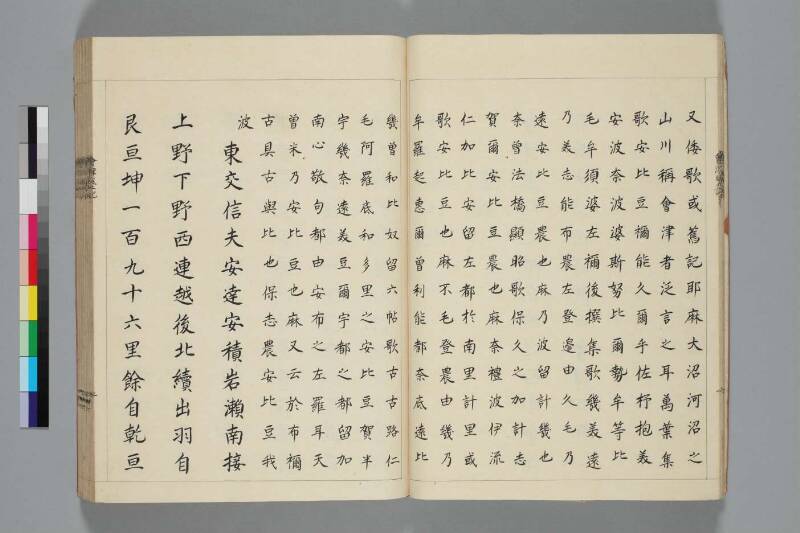
《割書:又倭歌或𦾔記耶麻大沼河沼之|山川稱㑹津者泛言之耳萬葉集|歌安比豆禰能久爾乎佐杼抱󠄁美|安波奈波婆斯努比爾勢牟等比|毛牟須婆左禰後撰集歌㡬美遠|乃美志能布農左登邉由久毛乃|遠安比豆農也麻乃波留計㡬也|奈曾法橋顯昭歌保久之加計志|賀爾安比豆農也麻奈禮󠄁波伊流|仁加比安留左都扵南里計里或|歌安比豆也麻不毛登農由㡬乃|牟羅起󠄁惠爾曾利能都奈底遠比》
【左丁】
《割書:㡬曽和比奴留六帖歌古古路仁|毛阿羅底和多里之安比豆賀半|宇㡬奈遠美豆爾宇都之都留加|南心敬句都由安布之左羅耳天|曽米乃安比豆也麻又云於布禰|古具古與比也保志農安比豆我》
《割書:波》東交信夫安達安積岩瀨南接
上野下野西連越後北續出羽自
艮亘坤一百九十六里餘自乾亘
現代語訳
【コマ18】
【右丁】
〔また、和歌あるいは記録において、耶麻・大沼・河沼の山川を「会津」と称するのは、広く総称して言うにすぎない。万葉集の歌に「あひづねのくにをさどほみ あはなはばしのびにせむと ひもむすばさね」(会津嶺の国を遠みに 逢はなはば 偲びにせむと 紐結ばさね)とある。後撰集の歌に「きみをのみしのぶのさとへゆくものを あひづのやまのはるけきやなぞ」(君をのみ忍ぶの里へ行くものを 会津の山の遥けきやなぞ)とある。法橋顯昭の歌に「ほくしかけしがにあひづのやまなれば いるにかひあるさとにありけり」(ほくしかけしがに 会津の山なれば 入るにかひある里にありけり)とある。ある歌に「あひづやまふもとのゆきのむらぎえに そりのつなでをひきそわひぬる」(会津山麓の雪の斑消えに 橇の綱手を引きそ侘びぬる)とある。〕
【左丁】
〔六帖の歌に「こころにもあらでわたりし あひづがはうきなをみづにうつしつるかな」(心にもあらで渡りし 会津川 浮き名を水に移しつるかな)とある。心敬の句に「つゆあふしらにてそめのあひづやま」(露逢ふ知らにて染めの会津山)とある。また云く「おふねこぐこよひやほしのあひづがは」(大船漕ぐ 今宵や星の 会津川)とある。〕
東は信夫・安達・安積・岩瀬に接し、南は上野・下野に接し、西は越後に連なり、北は出羽に続く。艮(うしとら)〔北東〕から坤(ひつじさる)〔南西〕にかけて一百九十六里余り、乾(いぬい)〔北西〕から…
英語訳
[Frame 18]
[Right folio]
[Furthermore, when waka poetry or other records refer to the mountains and rivers of Yama, Ōnuma, and Kawanuma as "Aizu," this is simply a broad, general usage of the name. The Man'yōshū contains the poem: "Aizu-ne no / kuni wo sa-dōmi / awanawaba / shinobi ni semu to / himo musuba sane" (The land of Aizu Ridge being so far away — if we cannot meet, let us at least tie our cords together as a token of longing). The Gosen'shū contains the poem: "Kimi wo nomi / Shinobu no sato e / yuku mono wo / Aizu no yama no / harukeki ya nazo" (I travel only toward the village of longing for you — why must Aizu's mountains lie so far away?). The poem of Hōkkyō Kenshō reads: "Hokushi kakeshi ga ni / Aizu no yama nareba / iru ni kai aru / sato ni arikeri" (Just as a star sets behind it — being Aizu's mountain, it is a village worth entering). Another poem reads: "Aizu-yama / fumoto no yuki no / muragieni / sori no tsunade wo / hiki so wabinuru" (As the snow at the foot of Aizu Mountain melts away in patches, how forlorn I am, pulling the towrope of the sled).]
[Left folio]
[The Rokujo contains the poem: "Kokoro ni mo / arade watarishi / Aizugawa / ukina wo mizu ni / utsushitsuru kana" (Having crossed the Aizu River with no intention — oh, how I have cast my floating reputation upon the waters). The verse by Shinkei reads: "Tsuyu au shira nite / some no Aizu-yama" (Unknowingly met by dew — Aizu Mountain dyed in color). And again: "Ōfune kogu / koyoi ya hoshi no / Aizugawa" (Rowing a great boat — tonight the stars reflect in the Aizu River).]
To the east it borders Shinobu, Adachi, Asaka, and Iwase; to the south it adjoins Kōzuke and Shimotsuke; to the west it connects with Echigo; to the north it continues into Dewa. From the northeast (ushitora) to the southwest (hitsujisaru) the distance is over one hundred and ninety-six ri; from the northwest (inui) to…