翻刻
【コマ9】
【右丁】
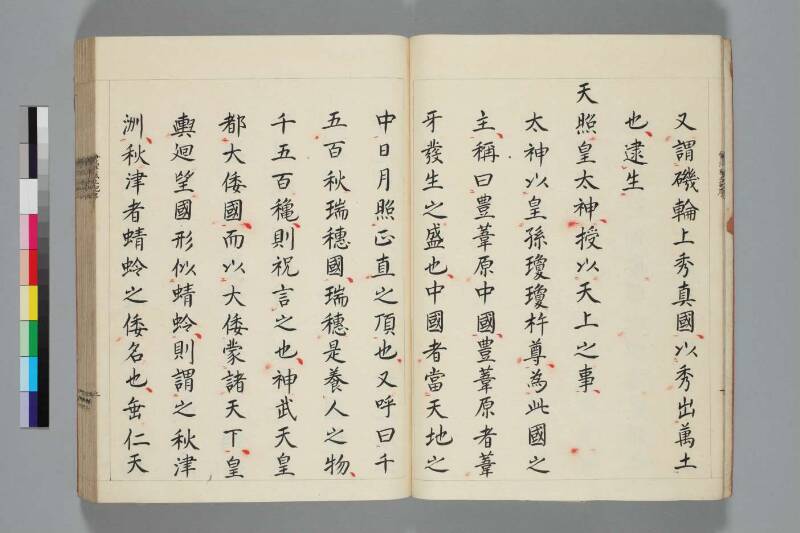
又謂_二磯輪上秀真國_一、以_三秀出_二萬土_一
也、逮_レ生_二
天照皇太神_一、授以《返り点:二》天上之事_一、
太神以_二皇孫瓊瓊杵尊_一、為_二此國之
主_一、稱曰_二豊葦原中國_一、豊葦原者葦
牙發生之盛也、中國者當《返り点:二》天地之
【左丁】
中_一日月照_二正直之頂_一也、又呼曰_二千
五百秋瑞穗國_一、瑞穗是養《返り点:レ》人之物、
千五百穐、則祝言_レ之也、神武天皇
都_二大倭國_一、而以_二大倭_一蒙_二諸天下_一、皇
輿𢌞望國形似_二蜻蛉_一、則謂_二之秋津
洲_一、秋津者蜻蛉之倭名也、𡸁仁天
現代語訳
【右丁】
また「磯輪上秀真国(しわかみほつまくに)」と謂うのは、万国の中で秀でているためである。天照皇太神がお生まれになるに及んで、天上のことを授けられた。太神は皇孫・瓊瓊杵尊をこの国の主とされ、「豊葦原中国(とよあしはらのなかつくに)」と称した。「豊葦原」とは葦の芽が盛んに生い茂ることであり、「中国」とは天地の中央にあって、日月が正しく直接に照らす頂きにあたるということである。
【左丁】
また「千五百秋瑞穂国(ちいおあきみずほのくに)」とも呼んだ。「瑞穂」とは人を養う物(稲穂)であり、「千五百秋」とはそれを祝い寿ぐ言葉である。神武天皇は大倭国(やまとのくに)に都を定め、「大倭」をもって天下全体を表した。天皇が輿に乗って国の形をご覧になると、蜻蛉(とんぼ)に似ていたので、「秋津洲(あきつしま)」と謂った。「秋津」とは蜻蛉の和名である。仁天(皇)…
英語訳
【Right folio】
It is also called "Shiwakami Hotsuma Kuni" (Land of Excellence Rising Above the Rocky Shores), because it surpasses all other lands. When Amaterasu Ōtaijin (the Great Deity of the Sun) was born, the affairs of heaven were entrusted to her. The Great Deity appointed the Imperial Grandchild Ninigi no Mikoto as the lord of this land, designating it "Toyoashihara no Nakatsukuni" (The Fertile Land of Reed Plains in the Middle). "Toyoashihara" refers to the vigorous sprouting and growth of reed shoots, while "Nakatsukuni" means that it lies at the center of heaven and earth, at the apex where the sun and moon shine directly and righteously.
【Left folio】
It is also called "Chiio Aki Mizuho no Kuni" (Land of Abundant Autumn Rice Ears for a Thousand Five Hundred Autumns). "Mizuho" (ripening rice ears) is that which nourishes people, and "Thousand Five Hundred Autumns" is an auspicious celebratory expression for it. Emperor Jinmu established his capital in Yamato Province, and "Yamato" came to represent the whole realm. When the Emperor viewed the shape of the land from his imperial palanquin, it resembled a dragonfly (tombo), and so it was called "Akitsushima" (Dragonfly Island). "Akitsu" is the Japanese (yamato) word for dragonfly. Emperor Jin[mu/nin]...