翻刻
【右丁】
【欄外上部】
百八十一
【上段】
歴(こよみ)の次第(したい)を二つ
の指(ゆび)に当(あて)。或は大二
ケ月 重(かさな)り。或は小
二ケ月重る時は。
何(いづれ)の月 躍(おどる)といふ
事を覚(おぼ)へ正月
大なれば中指(たけたかゆひ)よ
り算(かそへ)はじめ。
正月小なれば
食指(ひとさしゆび)より算(かぞ)へ
はじむべし。かく
のごとく一度 指(ゆひ)
【左丁・上段】
にあて覚(おぼ)ゆれば
毎月大小を忘(わす)るゝ
事なし。たとへば
延享二丑年の
大小は暦(こよみ)を見て
《振り仮名:図|づ》のごとく覚(おほ)ゆべ
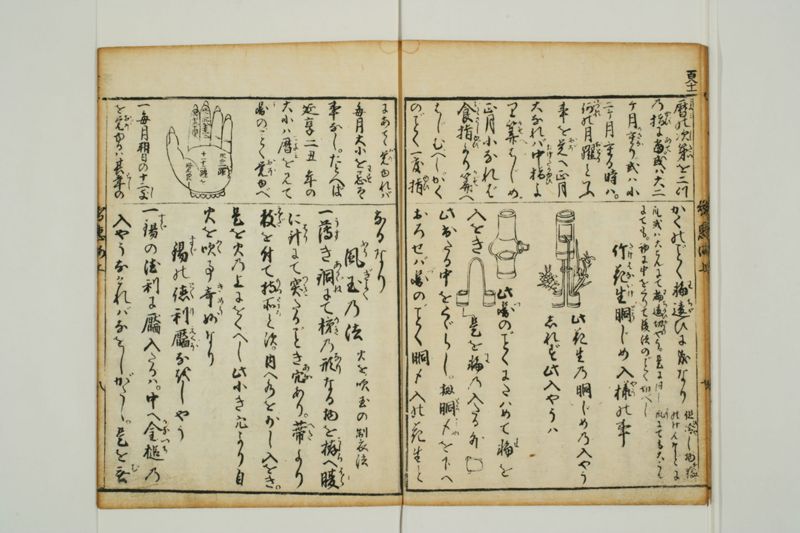
【図・上段】
正二三五八十一十二
四六七九十■
【図・下段】
正二三 躍(おとる)
十一十二躍と
覚ゆへし
一 毎月朔日の十二 支(し)
を覚(おぼ)ゆるは其 年(とし)の
【右丁・下段】
かくのごとく輪違(わちが)ひに成なり《割書:但 冷(ひや)し物 膾(なます)|のけんなどに》
《割書:瓜或は大こんにて輪違(わちかひ)切(きり)やう。是に同し瓜(うり)にても大こん|にても。初に中をくりて後法のごとく切べし》
竹花生(たけはないけ)胴(どう)じめ入 様(やう)の事
【図あり】此花生の胴じめの入やう
しれず此入やうは
【図あり】此 図(つ)のごとくにたはめて輪(わ)を
入をき【図あり】是を輪(わ)の入たる外【図あり】
此出たる中をくゞらし。扨 胴〆(とうしめ)を下へ
おろせば図(づ)のごとく胴〆入の花生と
なるなり
風玉(ふうぎよく)の法《割書:火を吹玉の製法| 》
一 薄(うす)き銅(あかゞね)にて柿(かき)の形(なり)なる物を拵(こしら)へ腹(はら)
に針(はり)にて突(つき)たるごとき穴(あな)あり。蔕(へた)より
枝(えだ)を付て持所(もつところ)と次。内へ水を少し入をき。
是を火の上にをくへし此小き穴より自
火を吹(ふく)事 奇妙(きめう)なり
錫(すゞ)の徳利(とくり)靨(えくぼ)なをしやう
一 錫(すゞ)の徳利に靨入たるは。中へ金槌(かなつち)の
入やうなければなをしがたし。是を無(む)
現代語訳
【右丁・上段】(ページ番号:百八十一)
暦の順序を二本の指に当てはめていき、大の月が二か月続く場合や、小の月が二か月続く場合は、どの月が「躍り(閏調整の飛び)」であるかを覚えておく。正月が大の月であれば中指(たけたかゆび)から数え始め、正月が小の月であれば人差し指から数え始めるとよい。このように一度指に当てて覚えれば、
【左丁・上段】
毎月の大小を忘れることはない。たとえば、延享二年乙丑(いつちゅう)年の大小は、暦を見て図のとおりに覚えるとよい。
【図・上段】
正・二・三・五・八・十一・十二(大の月)
四・六・七・九・十・■(小の月)
【図・下段】
正・二・三は躍(おどる=飛ぶ)
十一・十二も躍と
覚えるべし
一、毎月の朔日(ついたち)の十二支を覚えるには、その年の(暦の最初を確認し…)
---
【右丁・下段】
(前項の続き)このように輪違い(わちがい)になるのである。
*ただし、冷たい料理や膾(なます)のけんなどに、瓜または大根で輪違い切りをする場合も同じ方法である。瓜でも大根でも、最初に中をくり抜いてから、上記の方法のとおりに切るとよい。*
竹花生(たけはないけ)に胴締め(どうじめ)を入れる方法
【図あり】この花生の胴締めの入れ方は(一見)わかりにくい。その入れ方は次の通りである。
【図あり】この図のように(竹を)たわめて輪を入れておき、【図あり】その輪の入った外側を【図あり】、この(輪の)出ている中をくぐらせる。そうして胴締めを下へ降ろせば、図のように胴締め入りの花生が完成する。
風玉(ふうぎょく)の法 *(火を吹く玉の製法)*
一、薄い銅板で柿の形をしたものを作り、腹の部分に針で突いたような小さな穴を開ける。蔕(へた)の部分から枝を付けて持ち手とする。内部に水を少し入れておき、これを火の上に置くと、この小さな穴から自然と火に向かって(水蒸気が吹き出し)火を吹く様子が、誠に奇妙(不思議で面白い)である。
錫(すず)の徳利のへこみを直す方法
一、錫の徳利にへこみが入った場合、中に金槌を入れる手立てがなく、直しがたい。これを(道具なしで)直すには…(次ページへ続く)
英語訳
**[Right Page — Upper Section]** (Page number: 181)
*(Continuation from previous page — Method for Memorizing the Calendar)*
Assign the sequence of months in the calendar to two fingers in turn. When two "long" months (*dai*) fall consecutively, or when two "short" months (*shō*) fall consecutively, memorize which month is the "jumping" (*odoru*) one [i.e., where the pattern skips]. If the first month (正月, *Shōgatsu*) is a long month, begin counting from the middle finger (*taketaka-yubi*); if the first month is a short month, begin counting from the index finger. By assigning the months to your fingers in this way just once,
**[Left Page — Upper Section]**
you will never forget the long or short nature of each month. For example, for the second year of Enkyō (延享二年, the Year of the Ox, 1745), look at the calendar and memorize the long and short months as shown in the diagram below.
**[Diagram — Upper Row]**
Long months: 1st, 2nd, 3rd, 5th, 8th, 11th, 12th
Short months: 4th, 6th, 7th, 9th, 10th, ■ [one month obscured]
**[Diagram — Lower Row]**
The 1st, 2nd, and 3rd months are "jumping" (*odoru*);
The 11th and 12th months are also "jumping" —
these should be memorized as such.
- To memorize the twelve zodiac signs (*jūnishi*) for the first day (*tsuitachi*) of each month, check that year's (calendar at the beginning…)
---
**[Right Page — Lower Section]**
*(Continuation from the bamboo interlocking ring section)*
— and it will come out in an interlocking ring (*wachigai*) pattern as described.
*Note: The same method applies when making interlocking ring cuts from cucumber or daikon radish for cold dishes or as garnishes (*ken*) for *namasu*. Whether using cucumber or daikon, first hollow out the center, then cut according to the method described above.*
**Method for Inserting a Hoop (*dōjime*) into a Bamboo Flower Vase (*take-hamaike*)**
【Figure】 The way to insert the hoop (*dōjime*) into this flower vase may seem difficult to understand. The method is as follows:
【Figure】 Bend (the bamboo) as shown in this diagram and place the ring (hoop) inside. 【Figure】 Then pass the protruding part through the outside of where the ring sits, 【Figure】 looping it through the center that sticks out. Then slide the hoop downward, and — as shown in the diagram — it will become a flower vase with the hoop properly fitted inside.
**Method for Making a Wind-Ball (*Fūgyoku*): The Manufacture of a Fire-Blowing Ball**
- Using thin copper sheet, fashion an object in the shape of a persimmon, with tiny holes in its belly that look as though they were made with a needle. Attach a stem at the top to serve as a handle. Pour a small amount of water inside, then place it over a fire. The way the water [vapor] blows out of the tiny holes toward the fire is truly wondrous and remarkable.
**Method for Fixing a Dent in a Tin (*suzu*) Flask (*tokkuri*)**
- When a tin flask (*suzu no tokkuri*) becomes dented, it is difficult to repair because there is no way to insert a hammer inside. To fix it without [such tools]… *(continues on next page)*