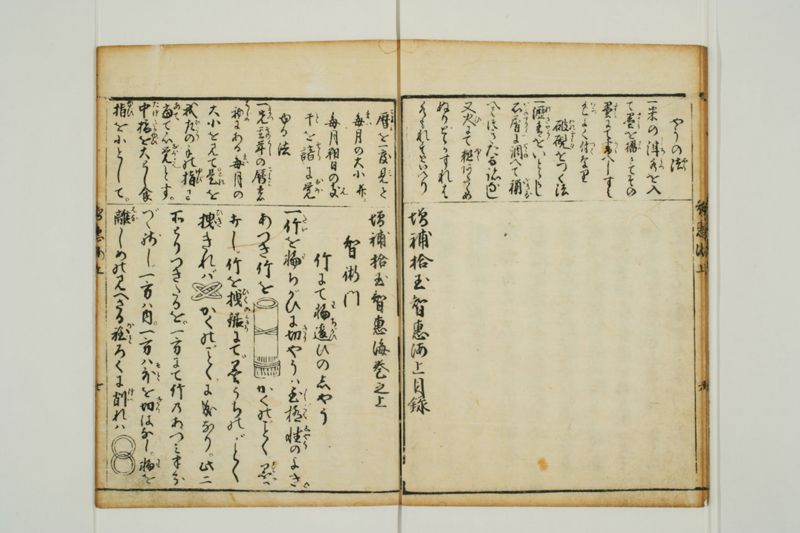
翻刻
【右丁・上段】
やうの法(ほう)
一 米の泔水(しろみつ)を入
て墨(すみ)を摺(すり)さてその
墨(すみ)にて書(かく)へしすみ
色(いろ)よく付(つく)なり
破硯(われすゝり)をつく法
一 瀝青(れきせう)をいとらかし
石屑(いしのすりくつ)に調(とゝの)へて補(をきな)
へはつきたる跡なし
又 火(ひ)にて粗(ほゝ)あたゝめ
ぬりとらかすれは
水もれすといへり
【左丁・上段】
暦(こよみ)を一 度見(み)て
毎(まい)月の大小幷 ̄ニ
毎月朔日の支(え)
干(と)を諳((そら)に覚(おほ)
ゆる法
一 先(まつ)其(その)年(とし)の暦(こよみ)の
初(はじめ)にある毎(まい)月の
大小を見て。是(これ)を
我 左(ひたり)の手の指(ゆび)に
当(あて)て心 覚(おぼえ)とす。
中指(たけたかゆび)を大とし食
指(ゆび)を小として。
【右丁・下段】
増補拾玉智恵海上目録
【左丁・下段】
増補拾玉智恵海巻之上
智術門
竹にて輪違(わちがひ)ひのしやう
一 竹(たけ)を輪(わ)ちがひに切(きり)やうは至極(しごく)性(しやう)のよき。
あつき竹を【図あり】かくのごとく墨(すみ)
打し。竹を拽(ひく)鋸(のこきり)にて。墨うちのごとく
拽(ひき)きれば【図あり】かくのごとくに成なり。此二
所とりつきたるを。一方にて竹のあつみ半分
づゝ残し。一方は内。一方は外(そと)を切(きり)はなし。輪(わ)を
離(はな)しめの見へさる程(ほと)ろくに削(けつ)れは【図あり】
現代語訳
【右丁・上段】
(紙が古くて書きにくい場合に墨色よく書く)方法
一、米のとぎ汁を(硯に)入れて墨を磨り、その墨で書くとよい。墨の色がよく付くものである。
割れた硯を接着・修繕する方法
一、瀝青(れきせい・ピッチ/アスファルト状の物質)を溶かし、石の粉末に調合して(割れた箇所に)補填すれば、継いだ跡が目立たない。また、火で(硯を)軽く温めてから塗り溶かせば、水が漏れないともいわれている。
---
【左丁・上段】
暦を一度見るだけで、毎月の大の月・小の月、ならびに毎月の朔日(ついたち)の干支を、そらで覚える方法
一、まずその年の暦の最初にある、毎月の大小を見て、これを自分の左手の指に当てはめて心覚えとする。中指(たけたかゆび)を「大」とし、人差し指を「小」として(覚える)。
---
【右丁・下段】
増補拾玉智恵海 上 目録
---
【左丁・下段】
増補拾玉智恵海 巻之上
智術門
竹を輪違い(わちがい)に切る方法
一、竹を輪違いに切る方法は、極めて質(たち)のよい、厚みのある竹を用いる。【図のとおり】このように墨で線を引き、竹を引き鋸(のこぎり)でその墨線の通りに引いて切れば、【図のとおり】このような形になる。この二か所がつながっている部分を、一方は竹の厚みの半分ずつ残し、一方は内側、もう一方は外側を切り離す。輪の継ぎ目が見えないほど丁寧に削れば、【図あり】(完成する)。
英語訳
**[Right Page — Upper Section]**
*(Continuation from the previous page: How to write with good ink color on paper that has aged and become difficult to write on)*
- Add rice-washing water (*shiromizu* / rice rinsing water) to the inkstone, grind the ink (*sumi*) with it, and then write using that ink. The ink color will adhere well.
**Method for Repairing a Cracked Inkstone**
- Melt *rekisei* (pitch/bitumen) and mix it with powdered stone, then fill in the cracked area. No trace of the repair will be visible. Furthermore, it is said that if you gently warm the inkstone over a flame before applying and spreading the mixture, it will not leak water.
---
**[Left Page — Upper Section]**
**A Method for Memorizing, After a Single Reading of the Calendar, the Long and Short Months of Each Month Throughout the Year, as well as the Cyclical Signs (*eto*) of the First Day (*tsuitachi*) of Each Month**
- First, look at the long and short months (*daishō*) listed at the beginning of that year's calendar, and assign them to the fingers of your left hand as a memory aid. Use the middle finger (*taketaka-yubi*) to represent a "long" month (*dai*), and the index finger to represent a "short" month (*shō*), and proceed accordingly.
---
**[Right Page — Lower Section]**
*Zoho Shūgyoku Chie no Umi* — Volume One: Table of Contents
---
**[Left Page — Lower Section]**
*Zoho Shūgyoku Chie no Umi* — Volume One
**Chapter on Ingenious Techniques (*Chijutsu-mon*)**
**Method for Cutting Bamboo in an Interlocking Ring (*wachigai*) Pattern**
- To cut bamboo in an interlocking ring pattern, use bamboo of the very finest quality that is thick-walled. Mark it with ink lines as shown 【figure】, then draw a pull-saw (*hiki-nokogiri*) along those ink lines to cut it, and it will come out as shown 【figure】. At the two connected joints, leave half the thickness of the bamboo wall on each side — cut one side from the inside and the other from the outside. If you shave it down carefully enough that the joint of the ring is invisible, 【figure】 (the interlocking rings are complete).