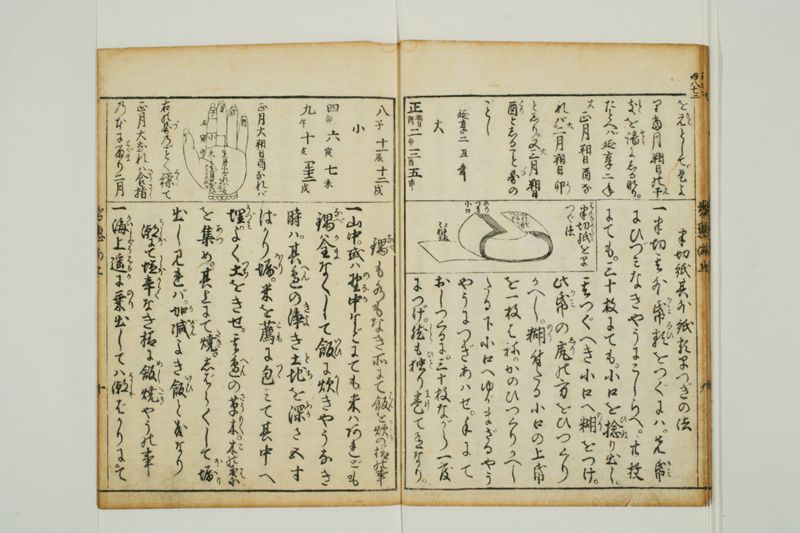
翻刻
【右丁】
【欄外上部】
百八十三
【上段】
を元(もと)として。是よ
り当月朔日の干(え)
支(と)を諳((そら)にしるなり。
たとへば延享二年
《割書:大| 》正月朔日酉な
れば。《割書:大| 》二月朔日 卯(う)
としり。又《割書:大| 》三月朔日
酉(とり)としること図(づ)の
ごとし
延享二丑年
大
正《割書:朔日|酉》二《割書: |卯》三《割書: |酉》五《割書: |申》
【左丁・上段】
八《割書: |子》十一《割書: |辰》十二《割書: |戌》
小
四《割書: |卯》六《割書: |寅》七《割書: |未》
九《割書: |午》十《割書: |亥》■十二《割書: |戌》
正月大朔日酉なれば
【図】
酉
戌
亥
子 小 大
丑 寅 卯
【小の説明】
先月小なれは爰
に止ル
【大の説明】
先月大なれは
こゝに止ル
右の図のごとく繰(くり)て
正月大なれは食指(ひとさし)
の本に留(とゞま)り二月
【右丁・下段】
半切紙其外紙類早つぎの法
一 半切其外 紙類(かみるひ)をつぐには。先 紙(かみ)
にひづみなきやうにこしらへ。廿枚
にても。三十枚にても。小口を捻(ひね)り出し。
其つぐへき小口へ糊(のり)をつけ。
此 紙(かみ)の尻(しり)の方をひつくり
かへし。糊(のり)付たる小口の上紙
を一枚はね。かのひつくりかへし
たる下小口へゆがまざるやう
やうにつぎあはせ。手にて
おしつくるに。三十枚ながら一度
につげ。然(しか)も独(ひと)り巻(まけ)て有なり。
【図】
半切紙(はんきりかみ)を早
つぐ法
こゝを
のり付
小口へ
つぐ
のり
つき
小口
上壱枚
はねる
【左丁・下段】
鍋(なべ)も水もなき所にて飯(はん)を炊(かしき)の様の事
一山中。或は野中(のなか)などにても。 米はあれども
鍋(なべ)釜(かま)なくして飯(いひ)に炊(かし)きやうなき
時は。其 辺(へん)の浄(きよ)き土地(とち)を深(ふか)さ五寸
ばかり堀(ほり)。米を薦(こも)に包(つゝ)みて其中へ
埋(うづみ)。よく土(つち)をきせ。其 辺(へん)の草木(さうもく)。木(こ)の葉(は)
を集(あつ)め。其上にて焼(たき)。しばらくして堀(ほり)
出しみれば。加減(かげん)よき飯(いひ)と成なり
潮(うしほ)にて塩(しほ)辛(からく)なき様に飯(めし)焼(たき)やうの事
一 海上(かいしやう)遥(はるか)に乗(のり)出しては潮(うしほ)ばかりにて
現代語訳
【右丁・上段】(ページ番号:百八十三)
(前ページより続き——毎月の朔日の十二支を覚える方法)
を元として、これをもとに当月の朔日の干支を暗記して知るのである。たとえば延享二年の場合、(大の月である)正月の朔日が酉であれば、(大の月である)二月の朔日は卯と知り、また(大の月である)三月の朔日は酉と知ることが、以下の図のとおりである。
延享二丑年
【大の月】
正(朔日・酉) 二(卯) 三(酉) 五(申)
【左丁・上段】
八(子) 十一(辰) 十二(戌)
【小の月】
四(卯) 六(寅) 七(未)
九(午) 十(亥) ■十二(戌)
正月が大の月で朔日が酉であれば……
【図】
酉
戌
亥
子 【小】 【大】
丑 寅 卯
【小の説明】先月が小の月であれば、ここで止まる
【大の説明】先月が大の月であれば、ここで止まる
右の図のように繰り(数えていき)、正月が大の月であれば人差し指の根元(の節)に留まり、二月は
---
【右丁・下段】
半切紙その他の紙類を素早く継ぐ方法
一、半切紙その他の紙類を継ぐには、まず紙に歪みがないように整えておく。二十枚でも三十枚でも、小口(端の部分)を捻り出し、継ぐべき小口に糊をつける。この紙の後ろの方をひっくり返し、糊をつけた小口の上の紙を一枚はね上げ、かのひっくり返した下の小口へ歪まないよう合わせて、手で押しつけると、三十枚ながら一度に継ぐことができ、しかも一人で巻いた状態のまま仕上がる。
【図の説明】
半切紙を素早く継ぐ方法
ここを糊付けして小口へ継ぐ
糊つき小口
上の一枚をはね上げる
【左丁・下段】
鍋も水もない場所で飯を炊く方法
一、山中あるいは野中などにおいて、米はあるけれども鍋も釜もなく、飯を炊く手段がない時は、その辺りの清潔な土地を深さ五寸ほど掘り、米を薦(こも)に包んでその中へ埋め、よく土をかぶせる。その辺りの草木・木の葉を集め、その上で焼く(火を焚く)。しばらくして掘り出してみれば、ちょうどよい加減の飯が出来上がっている。
潮水で塩辛くならないように飯を炊く方法
一、海上へ遥か沖まで乗り出した際には、潮水しかなく……
英語訳
**[Right Page — Upper Section]** (Page number: 183)
*(Continued from the previous page — Method for memorizing the twelve zodiac signs for the first day of each month)*
Using this as your base, you can memorize and know the cyclical sign (*eto*/*kanshi*) for the first day of the current month. For example, in the second year of Enkyō, if the first day (*tsuitachi*) of the first month — a "long" month — falls on *Tori* (the Rooster/tenth sign), then the first day of the second month — also a "long" month — will be *U* (the Hare/fourth sign), and the first day of the third month — likewise a "long" month — will be *Tori* (the Rooster), as shown in the diagram below.
**The Second Year of Enkyō (Ushi year)**
**Long months (*dai*):**
1st month (1st day: Rooster), 2nd (Hare), 3rd (Rooster), 5th (Monkey)
**[Left Page — Upper Section]**
8th (Rat), 11th (Dragon), 12th (Dog)
**Short months (*shō*):**
4th (Hare), 6th (Tiger), 7th (Sheep),
9th (Horse), 10th (Boar), ■12th (Dog)
*If the first month is a "long" month and its first day is Rooster:*
**[Diagram]**
Rooster → Dog → Boar → Rat
[Short] [Long]
Ox → Tiger → Hare
*[Note for "Short"]: If the preceding month was a short month, stop here.*
*[Note for "Long"]: If the preceding month was a long month, stop here.*
Counting as shown in the diagram on the right: if the first month is a long month, you stop at the base joint of the index finger, and the second month will be…
---
**[Right Page — Lower Section]**
**A Quick Method for Joining *Hankiri* Paper and Other Types of Paper**
- To join *hankiri* paper or other types of paper, first prepare the sheets so that there are no warps or distortions. Whether there are twenty or thirty sheets, twist out the edges (*koguchi*), apply paste (*nori*) to the edge that is to be joined, flip the back end of this paper over, lift up the top sheet at the pasted edge, and align it carefully against the lower edge of the flipped portion so that it does not become skewed. Press it down by hand, and in this way thirty sheets can be joined all at once; moreover, the finished result remains rolled up on its own.
**[Diagram caption]:**
A quick method for joining *hankiri* paper.
Apply paste here and join to the edge.
Pasted edge.
Lift the top sheet up.
**[Left Page — Lower Section]**
**A Method for Cooking Rice Where There Is Neither a Pot nor Water**
- When in the mountains or out in the fields, if you have rice but no pot or cauldron and no means of cooking it, dig a hole about five *sun* (approx. 15 cm) deep in a clean patch of nearby ground, wrap the rice in a rush mat (*komo*), and bury it in the hole, covering it well with soil. Gather grass, branches, and fallen leaves from the surrounding area and set them alight on top. After a while, dig it up and you will find that it has cooked into a nicely done serving of rice.
**A Method for Cooking Rice at Sea Without It Becoming Salty from the Seawater**
- When you have ventured far out to sea and have only seawater available…