翻刻
【右丁】
【欄外上部】
八十四
【上段】
朔日は卯(う)としる也。
又二月大なれば小指(こゆび)
のかしら卯(う)とし
て。食指(ひとさし)の二ノ節(ふし)
に留(とゞま)り。三月朔日
は酉(とり)としるなり。
此 法(はう)を能(よく)々 工夫(くふう)す
れば何千何百日
先(さき)も。何千何百日
後(のち)も。即座(そくざ)に考(かんがへ)
しるもの也
屏風(べうぶ)の縁恰好(へりかつかう)の寸法
一 屏風(へうふ)の長(たけ)に不(ふ)
相応(さうをう)なる縁幅(へりはゞ)
は見苦敷(みくるしき)物なり。
其 恰好(かつかう)を積(つも)り
たる細工(さいく)人の手段(しゆだん)
を見て定式(ぢやうしき)とす。
高 ̄サ五六尺ある
屏風(べうぶ)は縁(へり)の幅(はゞ)
壱寸七八分《割書:但小べり|とも也》
小 縁(べり)は弐分半ゟ
三分までにすべし。
高 ̄サ三四尺ある
【右丁・下段】
水なし潮(うしほ)にて飯(めし)焼(たけ)ば。しははゆくて一口
も食(しよく)しがたし。此時 鍋(なべ)にても釜(かま)にて
も。底(そこ)へ食椀(めしわん)をうつふけ入。其上へ米(こめ)
をいれ潮(うしほ)を汲(くみ)入てしかけ焼(たく)なり。飯(めし)と
成て後(のち)。器(うつはもの)へうつし見れば。塩(しほ)こと〳〵くうつ
ふけ入たる椀(わん)の中へかたまりとれ。飯(めし)少しも
しははゆからず。奇妙(きめう)なり
提灯(ちやうちん)なき所にて。何人まへにても早速(さつそく)
こしらへやうの事
一 旅(たび)などにて。闇(やみ)の夜に提灯(ちやうちん)なきとき
【左丁・下段】
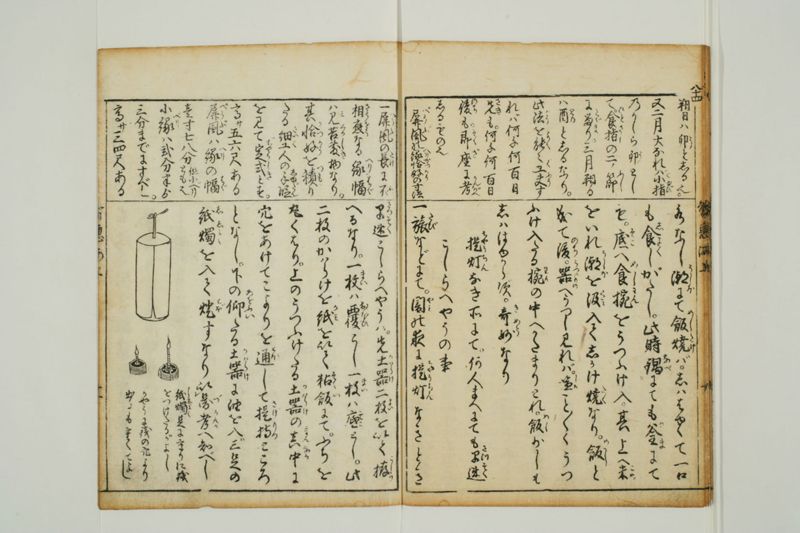
早速(さつそく)こしらへやうは。先 土器(かはらけ)二 枚(まい)を以て拵(こしら)
へるなり。一 枚(まい)は覆(おほひ)とし一 枚(まい)は底(そこ)とし。此
二枚のかはらけを紙(かみ)を以て粘飯(そくい)にて。ふちを
丸くはり。上のうつふけたる土器(かはらけ)の真中(まんなか)に
穴をあけてこよりを通(とほ)して提持(さげもつ)ところ
となし。下の仰(あをふい)たる土器(かはらけ)に油を入。三足の
紙燭(ししよく)を入て焼(とぼ)すなり以_レ図(づ)考(かんか)へ知べし
【図】
紙燭(ししよく)足に重りに銭
をつけたるがよし
かやうに銭の穴より
出すも重くてよし
現代語訳
【右丁・上段】(ページ番号:百八十四)
(前ページより続き——毎月の朔日の十二支を知る方法)
朔日は卯(う)と知るのである。また二月が大の月であれば、小指の頭を卯として、人差し指の第二節に留まり、三月の朔日は酉と知るのである。この方法をよくよく工夫すれば、何千何百日先も、何千何百日後も、即座に考えて知ることができるものである。
---
屏風の縁の寸法の目安
一、屏風の高さに不釣り合いな縁の幅では見苦しいものである。その適切な寸法を、(経験を積んだ)職人の手法を参考にして定式(基準)とする。高さ五、六尺ある屏風は、縁の幅は一寸七、八分(ただし小縁を含む)。小縁は二分半から三分までとするのがよい。高さ三、四尺ある
---
【右丁・下段】
(前ページより続き——潮水で塩辛くならないように飯を炊く方法)
水がなく潮水で飯を炊けば、たいへんしょっぱくてひと口も食べられない。このような時は、鍋でも釜でも、底に飯椀を伏せて入れ、その上へ米を入れ、潮水を汲み入れて火にかけて炊くのである。飯が炊き上がった後、器に移してみると、塩が残らず伏せて入れた椀の中に固まって取れており、飯は少しも塩辛くない。誠に不思議なことである。
---
提灯のない場所で、何人前にても即座に作る方法
一、旅などにて、暗い夜に提灯がない時、
【左丁・下段】
即座に作る方法は、まず素焼きの土器(かわらけ)二枚を使って作るのである。一枚は蓋とし、一枚は底とし、この二枚の土器を紙でそくい(糊)を使って縁を丸く貼り合わせる。上の伏せた土器の真ん中に穴をあけてこよりを通し、提げ持つ部分(取っ手)とする。下の仰向けにした土器に油を入れ、三本足の紙燭を立てて灯すのである。図を見て理解すること。
【図の説明】
紙燭の足に重しとして銭をつけるのがよい。
このように銭の穴からこよりを出すのも、重くなるのでよい。
英語訳
**[Right Page — Upper Section]** (Page number: 184)
*(Continued from the previous page — Method for determining the twelve zodiac sign for the first day of each month)*
…you will know that the first day (*tsuitachi*) is *U* (the Hare). Furthermore, if the second month is a "long" month, taking the tip of the little finger as *U* (the Hare), you stop at the second joint of the index finger, and you will know that the first day of the third month is *Tori* (the Rooster). If one thinks carefully about this method, one can instantly calculate the day — whether thousands of days in the future or thousands of days in the past.
---
**Standard Measurements for Folding Screen (*Byōbu*) Borders**
- A border width that is disproportionate to the height of a folding screen is an unsightly thing. The following standard is based on the methods of experienced craftsmen who have calculated the proper proportions. For a folding screen of five to six *shaku* in height, the border (*heri*) width should be one *sun* seven to eight *bu* (this includes the narrow inner border, *koberi*). The narrow inner border (*koberi*) should be between two and a half *bu* and three *bu*. For a screen of three to four *shaku* in height…
---
**[Right Page — Lower Section]**
*(Continued from the previous page — Method for cooking rice at sea without it becoming salty)*
…if you cook rice using only seawater with no fresh water available, it will be so salty that you cannot eat even a single mouthful. In such a case, place a rice bowl face-down at the bottom of a pot or cauldron, put the rice on top of it, ladle in the seawater, and then cook it over the fire. Once the rice is done and you transfer it to a serving vessel, you will find that all the salt has collected and solidified inside the upturned bowl at the bottom, and the rice itself is not salty at all. It is a truly remarkable thing.
---
**A Method for Quickly Making a Lantern for Any Number of People When No Lantern Is Available**
- When traveling and finding yourself on a dark night without a lantern,
**[Left Page — Lower Section]**
…the way to make one quickly is to use two unglazed earthenware dishes (*kawarake*). One serves as the cover and one as the base. These two dishes are joined together by pasting paper around their rims using *sokui* (rice-paste glue) to form a round seal. Pierce a hole in the center of the upper (inverted) dish, thread a twisted paper cord (*koyori*) through it, and this becomes the handle for carrying. Pour oil into the lower (upward-facing) dish, insert a three-legged paper candle (*shishoku*), and light it. Refer to the diagram to understand the construction.
**[Diagram caption]:**
It is best to attach coins as weights to the legs of the paper candle (*shishoku*).
Passing the cord through the hole of a coin in this manner also works well, as it adds weight.