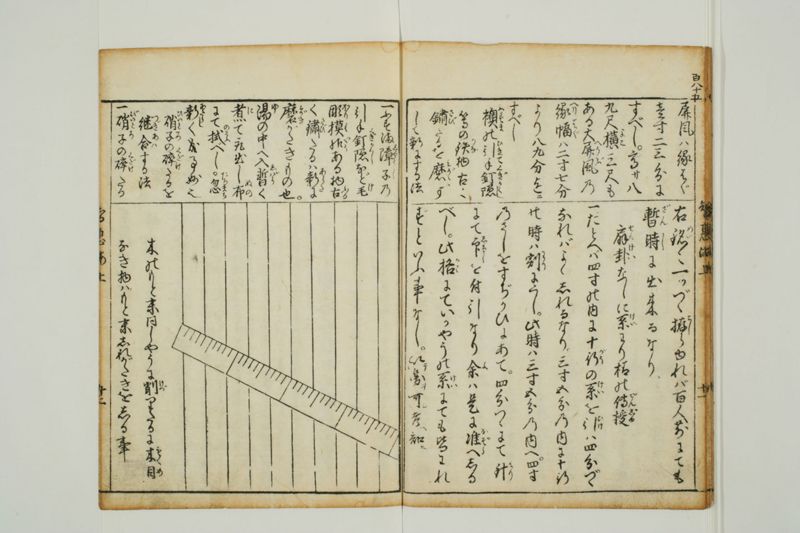
翻刻
【右丁】
【欄外上部】
百八十五
【上段】
屏風は縁はゞ
壱寸二三分に
すべし。高 ̄サ八
九尺 横(よこ)三尺も
ある大 屏風(へうぶ)の
縁幅(へりはゞ)は二寸七分
より八九分迄 ̄ニ
すべし
襖(ふすま)の引手(ひきて)釘隠(くぎかくし)
等の鉄(かな)物古く
鏽(さび)とるを磨(みがゝ)ず
して新にする法
【左丁・上段】
一 ふすま障子(しやうし)の
引手 釘隠(くぎかくし)など毛(け)
彫模様(ほりもやう)ある物 古(ふる)
く鏽(さび)たるは新(あらた)に
磨(みがき)がたきもの也。
湯(ゆ)の中へ入 暫(しばら)く
煮(に)て取出し布(ぬの)
にて拭(のこふ)べし。忽(たちまち)
新(あたらし)く成事妙也
硝子(ひいとろ)の砕(くだけ)たるを
継合(つぎあは)する法
一 硝子(びいどろ)の砕(くだけ)たる
【右丁・下段】
右 銘(めい)々一 ̄ツづゝ拵(こし)らゆれば百人前にても
暫時(ざんし)に出来るなり
扇卦(せんけい)なしに系(けい)わり様の伝授(でんじゆ)
一 たとへば四寸の内に十 行(がう)の系(けい)を引(ひけ)は四分づゝ
なればよくしれるなり。三寸五分の内に十行
の時は割(わり)にくし。此時は三寸五分の内へ。四寸
のさしをすぢかひにあて。四分つゝにて針(はり)
にて印(しるし)を付引なり余(よ)は是に准(なぞら)へしる
べし。此 格(かく)にていかやうの系(けい)にても皆われ
ずといふ事なし。以 ̄テ_レ図 ̄ヲ可 ̄シ_二考 ̄ヘ知 ̄ル_一
【左丁・下段】
木のもと末同しやうに削(けづ)りたるに木目(もくめ)
なき物はもと末しれがたきをしる事
現代語訳
【右丁・上段】(ページ番号:百八十五)
(前ページより続き——屏風の縁の寸法の目安)
屏風は縁の幅を一寸二、三分にするのがよい。高さ八、九尺、横三尺もある大きな屏風の縁の幅は、二寸七分から八、九分までとするのがよい。
---
襖の引手・釘隠しなどの金物が古くなって錆びたものを、磨かずに新しくする方法
【左丁・上段】
一、襖・障子の引手・釘隠しなど、毛彫り模様のあるものが古くなって錆びた場合は、新たに磨くことが難しいものである。(そのような時は、)熱湯の中に入れてしばらく煮て取り出し、布で拭くのがよい。たちまち新しくなることは誠に妙なることである。
---
ガラス(びいどろ)の割れたものを継ぎ合わせる方法
一、ガラス(びいどろ)の割れたもの
---
【右丁・下段】
(前ページより続き——提灯を即座に作る方法の補足)
以上のように一つずつ作れば、百人前でも短時間で出来上がるのである。
---
扇形の計算器(扇卦)なしに罫(けい)を割り付ける方法の伝授
一、例えば四寸の中に十行の罫線を引くとすれば、四分ずつにすればよいことは容易にわかる。しかし三寸五分の中に十行の罫線を引く時は割り切れないので難しい。この時は、三寸五分の幅の中に、四寸の物差しを斜めに当てて、四分ずつのところに針で印をつけて引くのである。その他のものもこれに倣って知るのがよい。この方法でどのような罫線の割り付けでも、すべて割り切ることができないものはない。図を見て理解すること。
---
【左丁・下段】
木の元と末が同じように削られていて木目のないものは、元(根もと)と末(梢)を見分けがたいのを知る方法
英語訳
**[Right Page — Upper Section]** (Page number: 185)
*(Continued from the previous page — Standard measurements for folding screen borders)*
…the border width of the folding screen should be one *sun* two to three *bu*. For a large folding screen measuring eight to nine *shaku* in height and three *shaku* in width, the border width should be between two *sun* seven *bu* and eight to nine *bu*.
---
**A Method for Renewing Old, Rusted Metal Fittings — Such as Finger-Pulls (*hikite*) and Nail Covers (*kugi kakushi*) on Sliding Doors — Without Polishing**
**[Left Page — Upper Section]**
- When the finger-pulls (*hikite*) and nail covers (*kugi kakushi*) of sliding doors (*fusuma*) and paper screens (*shōji*), particularly those with engraved hair-line designs (*kebori moyō*), have grown old and rusted, they are difficult to restore by polishing. In such cases, place them in hot water, boil them for a while, then take them out and wipe them with a cloth. That they instantly become like new is truly a remarkable thing.
---
**A Method for Joining Broken Pieces of Glass (*Biidoro*)**
- When a piece of glass (*biidoro*) is broken…
---
**[Right Page — Lower Section]**
*(Continued from the previous page — Supplementary note on the method of quickly making improvised lanterns)*
…if each one is made in this manner, even a hundred can be completed in a short time.
---
**A Method Taught for Dividing Rule Lines (*kei*) Without a Fan-Shaped Calculating Instrument (*senke*)**
- For example, if you are to draw ten lines (*gyō*) within four *sun*, it is easy to understand that each interval should be four *bu*. However, when drawing ten lines within three *sun* five *bu*, it is difficult because the measurement does not divide evenly. In this case, place a ruler of four *sun* diagonally across the space of three *sun* five *bu*, mark the points at every four *bu* with a needle, and draw the lines there. Other cases should be understood by analogy with this method. By this technique, there is no spacing of ruled lines that cannot be equally divided. Refer to the diagram to understand the method.
---
**[Left Page — Lower Section]**
**A Method for Distinguishing the Root End (*moto*) from the Tip End (*sue*) of a Piece of Wood That Has Been Planed to a Uniform Thickness with No Visible Grain**