翻刻
【右丁】
【欄外上部】
百八十六
【上段】
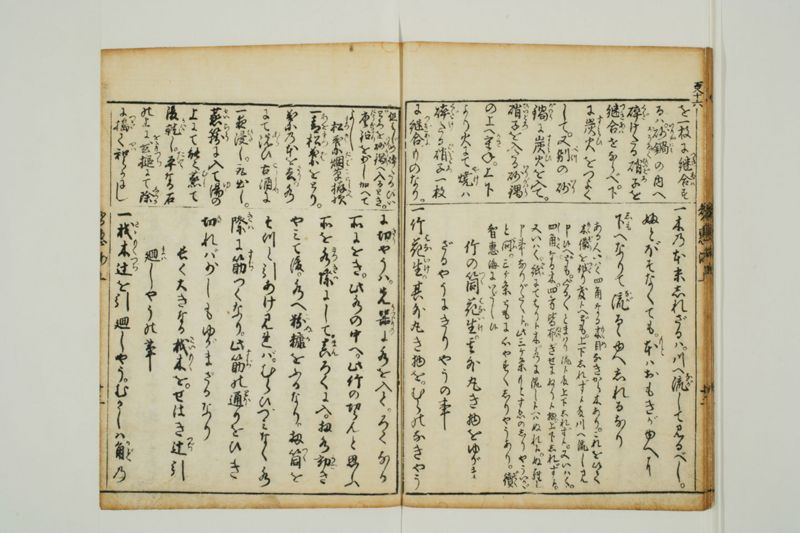
を一枚に継合(つきあは)す
るは。《振り仮名:砂鍋|いりがはら|ほうろく》の内へ
砕(くだ)けたる硝子(ひいどろ)を
継合(つきあは)せならべ。下
に炭火(すみひ)をつよく
して。又 別(べつ)の砂(いり)
鍋(がはら)に炭火(すみひ)を入て。
硝子(ひいとろ)を入たる砂鍋(いりがはら)
の上へ重(かさ)ね。上下
より火にて焼(やけ)は
砕(くだけ)たる硝子(ひいとろ)一枚
に継合(つぎあふ)ものなり。
【左丁・上段】
但はじめ砕たるびい
どろを砂鍋(いりかはら)へ入るとき。
重鉛(にうなまり)を少し加へて
よし
松葉煙草(まつばたばこ)拵(こしらへ)様
一 青松葉(あをまつば)をとり。
葉の本を去(さり)。水
にて洗(あら)ひ古酒(こしゆ)に
一夜 浸(ひた)し。取出し。
蒸籠(せいらう)に入て湯(ゆ)の
上にて能く蒸(むし)て
後 乾(かはか)し。平(たいら)なる石
の上に置(をき)。槌(つち)にて除(しづか)
に搗(つき)て和(やは)らかにし
【右丁・下段】
一木の本末しれざるは。川へ流(なが)して見るべし。
ふとぼそなくても。本(もと)はおもきがゆへに
下(しも)へなりて流(なが)るゝゆへしれるなり
ある人いはく四角なる木目(もくめ)なきから木あり。これを以て
木像(もくぞう)を作(つく)り度候へども。上下しれず候故川へ流し見
申候へども。ぐる〳〵とまはり流候故上下しれず候。又いはく。
四角(しかく)なる木。四方皆 布(ぬの)ぎせにぬり候物。上下しれず候。
又いはく。紙(かみ)にてはり候木。水に流し候へはぬれ候。ぬらし
申事なりがたく候。此三ケ条もとすゑのしりやういかゞ
と問(とふ)。三ケ条ともに心やすくしりやうあり。続(ぞく)
智恵海にいだし候
竹の筒花生(つゝはないけ)。其外丸き物をゆがま
ざるやうにきりやうの事
一竹 花生(はないけ)。其外丸き物を。むらのなきやう
【左丁・下段】
に切(きり)やうは。先 器(うつはもの)に水を入て。ろくなる
所にをき。此水の中へ。此竹の切らんと思ふ
所を水際(みつきは)にして。真(まん)ろくに入。扨水 動(うご)き
やみて後。水へ粉糠(こぬか)をふるなり。扨 筒(つゝ)を
そつと引あけ見れば。むらひづみなく水
際(きは)に筋(すぢ)つくなり。此 筋(すぢ)の通(とほ)りをひき
切(き)れば少しもゆがまざるなり
長く大きなる材木(たいもく)を。せはき辻(つぢ)引
廻(まは)しやうの事
一 材木(たいもく)辻(つぢ)を引廻しやう。むかしは角(かど)の
現代語訳
【右丁・上段】(ページ番号:百八十六)
(前ページより続き——ガラスの割れたものを継ぎ合わせる方法)
割れたものを一枚に継ぎ合わせるには、素焼きの土鍋(炒り瓦・焙烙)の中に割れたガラスを継ぎ合わせて並べ、下から炭火を強くおこし、さらに別の素焼き土鍋に炭火を入れて、ガラスを入れた土鍋の上に重ね、上下から火で焼くと、割れたガラスが一枚に継ぎ合わさるものである。
---
【左丁・上段】
ただし、はじめに割れたガラスを素焼き土鍋へ入れる時に、鉛(なまり)を少し加えるとよい。
---
松葉煙草の作り方
一、青い松の葉を採り、葉の根元を取り除いて、水で洗い、古酒(熟成した酒)に一晩浸して取り出す。蒸籠に入れて湯の上でよく蒸してから、乾かす。平らな石の上に置き、槌で静かに搗いて柔らかくし、
---
【右丁・下段】
(前ページより続き——木の元と末を見分ける方法)
一、木の元(根もと)と末(梢)が分からない時は、川へ流してみるとよい。太さが均一であっても、元(根もと)は重いために下流側に向いて流れるので、それで分かるのである。
---
ある人が言うには、「四角い形で木目のない唐木(からき)がある。これで木像を作りたいのだが、上下が分からないので川へ流して確かめようとしたが、くるくると回りながら流れるため上下が分からない。また、四角い木で、四方すべてに布着せ(布を張りつけること)を施した場合も、上下が分からない。さらに、紙を貼った木を水に流そうとしても、紙が濡れてしまうので、水に流すことが難しい。この三つの場合、元と末の見分け方はどうすればよいか」と問う。三つの条件いずれについても、容易に見分ける方法がある。続編『智恵海』に掲載する予定である。
---
竹の筒の花生け、その他丸いものを歪まないように切る方法
一、竹の花生け、その他丸いものを、むらなく
---
【左丁・下段】
(続き)均等に切るには、まず器に水を入れ、水平な場所に置く。この水の中に、竹の切ろうとする箇所を水際(水面)に合わせて、真っすぐ水平になるよう入れる。そうして水が静まった後、水の上に粉糠(こぬか)をふりかける。次に筒をそっと引き上げて見ると、歪みやひずみなく、水際に筋(線)がついているものである。この筋の通りに引き切れば、少しも歪まないのである。
---
長く大きな材木を、狭い辻(交差点・路地)で引き回す方法
一、材木を辻で引き回す方法として、昔は角(かど)の
英語訳
**[Right Page — Upper Section]** (Page number: 186)
*(Continued from the previous page — A Method for Joining Broken Pieces of Glass)*
To join broken pieces into a single sheet, arrange and place the broken pieces of glass (*biidoro*) together inside an unglazed earthenware vessel (*irigawara* / *hōroku*). Apply a strong charcoal fire from below, then place another earthenware vessel containing charcoal fire on top of the vessel holding the glass, so that it is fired from both above and below. The broken glass will thus fuse back together into a single piece.
---
**[Left Page — Upper Section]**
Note: when first placing the broken glass into the earthenware vessel, it is good to add a small amount of lead (*namamari*).
---
**A Method for Preparing Pine-Needle Tobacco (*matsubatobacco*)**
- Gather fresh green pine needles, remove the base of the needles, wash them in water, soak them overnight in aged sake (*koshū*), and then take them out. Place them in a steaming basket (*seirō*) and steam them well over boiling water, then dry them. Place them on a flat stone and pound them gently with a mallet until soft…
*(Continues on the next page)*
---
**[Right Page — Lower Section]**
*(Continued from the previous page — A Method for Distinguishing the Root End from the Tip End of a Piece of Wood)*
- When the root end (*moto*) and tip end (*sue*) of a piece of wood cannot be determined, one should float it in a river and observe it. Even if the wood is of uniform thickness throughout, the root end is heavier and will therefore sink lower and face downstream as it flows — and by this one can tell.
---
A certain person posed the following question: "There is a square piece of foreign wood (*karaki*) with no visible grain. I wish to carve a wooden image (*mokuzō*) from it, but since I cannot tell which end is the top and which is the bottom, I tried floating it in a river to find out. However, it merely spun around as it flowed, so I still could not determine the orientation. Furthermore, in the case of a square piece of wood with cloth affixed to all four sides, the top and bottom likewise cannot be determined. Additionally, if one attempts to float a piece of wood covered with paper in water, the paper gets wet, making it difficult to use the floating method. Regarding these three cases, what would be the way to distinguish the root end from the tip?" — For all three of these conditions, there are straightforward methods of determination. These will be presented in the sequel volume, *Chie no Umi*.
---
**A Method for Cutting Bamboo Flower Vases and Other Round Objects Evenly Without Distortion**
- To cut bamboo flower vases and other round objects without unevenness…
---
**[Left Page — Lower Section]**
*(Continued)*
…evenly, first fill a vessel with water and place it on a level surface. Lower the bamboo into the water so that the point where you wish to make the cut is exactly at the water's surface, holding it perfectly horizontal and straight. After the water has settled and become still, sprinkle powdered rice bran (*konuka*) onto the surface of the water. Then gently lift the tube of bamboo out and examine it — you will find that a perfectly even line has been marked all around the bamboo at the waterline, without any unevenness or distortion. If you cut along this line, the cut will not be the least bit uneven.
---
**A Method for Maneuvering Long, Large Timbers Around Narrow Intersections**
- The method for maneuvering timber around a narrow intersection (*tsuji*): in former times, at corners (*kado*)…
*(Continues on the next page)*