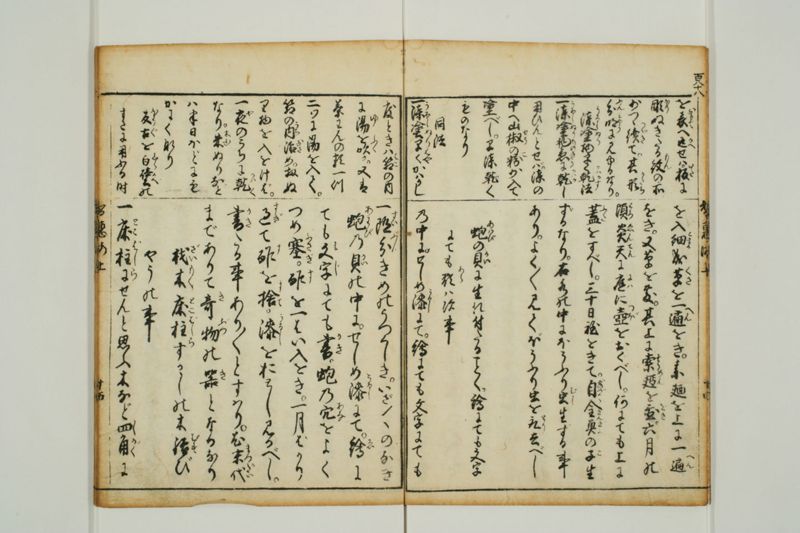
翻刻
【右丁】
【欄外上部】
百八十八
【上段】
を表(おもて)へ返(かへ)せは。板(いた)に
彫(ほり)ぬきたる紋(もん)の所
少つゝ続(つゞき)て。其 形(かたち)
分明(ふんみやう)に見ゆるなり。
漆塗(うるしぬり)物早く乾(かはかす)法
一 漆塗物(うるしぬりもの)急(きう)に乾(かはか)し
用ひんとせば。漆の
中へ山 椒(せう)の粉(こ)少入て
塗べし。早漆乾く
ものなり
同法
一 漆塗(うるしぬり)早(はや)くかはかし
【左丁・上段】
度ときは箱(はこ)の内
に湯(ゆ)を吹(ふく)か。又は
茶わんの類一つ
二つに湯を入て。
箱の内(うち)治(おさ)め。扨ぬ
り物を入をけば。
一 夜(や)のうちに乾(かはく)
なり。朱(しゆ)ぬりなと
は半日ほどにも
かわくなり
反古(ほうぐ)を白壁(しらかべ)の
すさに用ふる時
【右丁・下段】
を入 細(こまか)成 草(くさ)を一 遍(へん)をき。素麺を上に一 遍(へん)
をき。又草を敷。其上に索麺(そうめん)を置(をき)。六月の
頃(ころ)炎天(ゑんてん)に庭(には)に壺(つぼ)をおくべし。何にても上に
蓋(ふた)をすべし。三十日程をきて。自(おのづから)金魚(きんぎよ)の子(こ)生
ずるなり。右水の中にほうふり虫(むし)生ずる事
あり。よく〳〵見てぼうふり虫を取(とり)去べし
蚫(あはび)の貝(かい)に生れ付たることく。絵にても文字
にても顕(あら)はす事
の中に。せしめ漆(うるし)にて。絵にても文字にても
【左丁・下段】
一 随分(すいぶん)きめのうつくしき。いざ〳〵のなき
蚫(あわび)の貝(かい)の中に。せしめ漆(うるし)にて。絵(ゑ)に
ても文字(もじ)にても書(かき)。蚫の穴(あな)をよく
つめ塞(ふさぎ)。酢(す)を一はい入をき。一月ばかり
過(すぎ)て酢(す)を捨(すて)。漆(うるし)をおとし見るべし。
書(かき)たる事あり〳〵とすはり。尤 末代(まつだい)
までありて奇物(きぶつ)の器(き)となるなり
材木(ざいもく)床柱(とこばしら)すかしの木 結(むす)び
やうの事
一 床柱(とこばしら)にせんと思ふ木など四角(しかく)に
現代語訳
【右丁・上段】(ページ番号:百八十八)
(前ページより続き——刻み煙草に紋を付ける方法)
表へ返せば、板に彫り抜いた紋の箇所が少しずつ続いて、その形がはっきりと見えるものである。
---
漆塗り物を早く乾かす方法
一、漆塗り物を急いで乾かして使いたい場合は、漆の中へ山椒の粉を少し入れて塗るべし。早く漆が乾くものである。
---
同じ方法(別法)
一、漆塗りを早く乾かし
---
【左丁・上段】
たい時は、箱の内側に湯を吹きかけるか、あるいは茶碗の類を一つ二つ用意して湯を入れ、箱の中に収め、さて塗り物を入れておけば、一夜のうちに乾くものである。朱塗りなどは半日ほどでも乾くものである。
---
反古(ほうぐ)を白壁のすさに用いる時
(この項目は次段へ続く)
---
【右丁・下段】
(前ページより続き——金魚を孵化・育成する方法)
を入れ、細かい草を一重敷き、素麺をその上に一重置き、また草を敷き、その上に素麺を置く。六月頃の炎天下に庭に壺を置くべし。何によらず上に蓋をすべし。三十日ほど置けば、自然と金魚の子が生ずるものである。なお、この水の中にぼうふり虫(ボウフラ)が生ずることがある。よくよく見て、ぼうふり虫を取り除くべし。
---
鮑(あわび)の貝に、生まれつきのように絵でも文字でも表す方法
(その貝)の中に、せしめ漆にて絵でも文字でも
---
【左丁・下段】
一、十分に目の美しい、傷のない鮑の貝の中に、せしめ漆にて絵でも文字でも書き、鮑の穴をよく詰めて塞ぎ、酢を一杯入れておく。一ヶ月ばかり過ぎたら酢を捨て、漆を落として見るべし。書いたことがありありと定まって(浮かび上がって)おり、まことに末代までも残る奇物の器となるものである。
---
材木・床柱・透かしの木の結び方の事
一、床柱にしようと思う木などを四角に
(次ページへ続く)
英語訳
**[Right Page — Upper Section]** (Page number: 188)
*(Continued from the previous page — A Method for Imprinting Patterns on Cut Tobacco)*
…when turned over to face upward, the areas corresponding to the pattern carved out of the board will appear in continuous, fine detail, and the shape will be clearly visible.
---
**A Method for Quickly Drying Lacquerware**
- If one wishes to dry lacquerware quickly for immediate use, add a small amount of powdered Japanese pepper (*sansho*, *Zanthoxylum piperitum*) to the lacquer before applying it. The lacquer will dry rapidly.
---
**Another Method for the Same Purpose**
- When one wishes to dry lacquer quickly,
---
**[Left Page — Upper Section]**
…blow hot water vapor inside a box, or alternatively place one or two teacups filled with hot water inside the box, then put the lacquered item inside. It will dry within a single night. Items lacquered in vermilion (*shu-nuri*) will dry in as little as half a day.
---
**On Using Wastepaper (*hōgu*) as Fiber (*susa*) for White Plaster Walls**
*(This entry continues in the lower section)*
---
**[Right Page — Lower Section]**
*(Continued from the previous page — A Method for Breeding Goldfish)*
…add water [to the jar], lay down one layer of finely cut grass, place one layer of *sōmen* noodles on top, then lay another layer of grass, and again place *sōmen* on top. Around the sixth month [of the lunar calendar], during the height of summer, place the jar out in the garden under the blazing sun. Cover it with a lid of some kind. After approximately thirty days, goldfish fry will naturally appear. Note that *bōfuri* insects (mosquito larvae) may also appear in the water. Look carefully, and remove any *bōfuri* larvae you find.
---
**A Method for Causing Pictures or Characters to Appear on an Abalone Shell as if Born Naturally into It**
…inside [the shell], use *seshime* lacquer to paint pictures or write characters…
---
**[Left Page — Lower Section]**
- Inside an abalone shell of sufficiently fine grain and free of blemishes, paint pictures or write characters using *seshime* lacquer. Seal the holes of the abalone shell tightly, pour in a full measure of vinegar, and leave it for about one month. After that, discard the vinegar and wash away the lacquer and examine the shell. What has been written will appear vividly and distinctly [etched into the shell's surface], and it will truly become a remarkable and curious vessel (*kibutsu no ki*) that will endure for generations to come.
---
**On the Method of Binding Timber, Alcove Posts (*tokonobashira*), and Openwork Wood**
- For wood intended to be used as an alcove post (*tokonobashira*), [first work it into] a square…
*(Continues on the next page)*