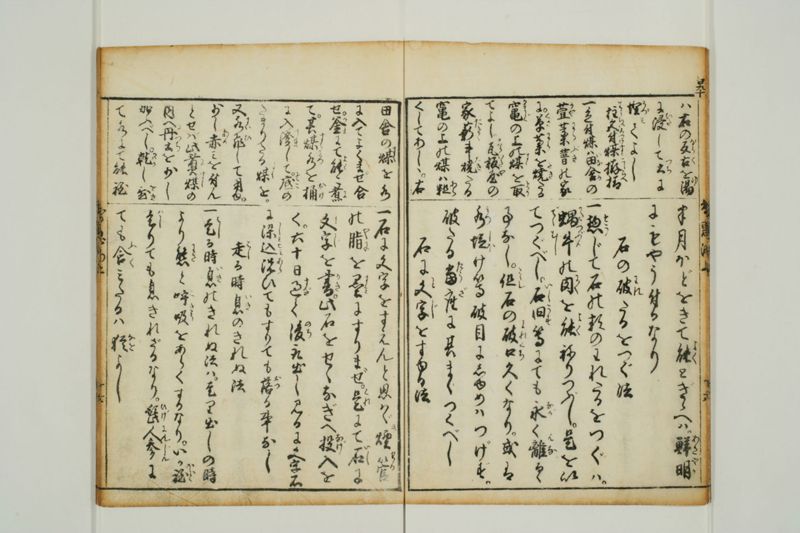
翻刻
【右丁】
【欄外上部】
百九十
【上段】
は右の反古(ほうく)を湯(ゆ)
に浸(ひた)して土(つち)に
埋(うづみ)てよし
柱(はしら)色付(いろつけ)煤(すゝ)拵(こしらへ)様
一色付煤は田舎(いなか)の
萱(かや)藁葺(わらぶき)の家
に。草藁(くさわら)を焼(たき)たる
竈(かまど)の上の煤(すゝ)を取(とり)
てよし。瓦(かはら)板屋(いたや)の
家 薪(たきゝ)斗 焼(たき)たる
竈の上の煤は粗(あら)
くしてあしゝ。右
【左丁・上段】
田舎の煤(すゝ)を水
に入てよくまぜ合
せ。釜(かま)にて能(よく)々煮(に)
て。其 煤水(すゝみつ)を桶(おけ)
に入。澄(すま)して。底(そこ)の
たまりたる煤(すゝ)を。
又 水(すい)飛(ひ)して用ゆ。
少し赤(あか)みを付ん
とせば此 煮煤(にすゝ)の
内へ丹土(につち)を少し
加ふべし。乾(かはか)し置(をき)
て水にて能程
【右丁・下段】
半月ほどをきて能(よく)とぎらへは。鮮明(あさやか)
にもやう付るなり
石の破(われ)たるをつぐ法
一 惣(そう)じて石の類のわれたるをつぐは。
蝸牛(かたつぶり)の肉(にく)を能(よく)ねりつぶし。是を以
てつぐべし。石臼(いしうす)等にても永(なが)く離(はな)るゝ
事なし。但(たゝし)石の破口(われくち)久くなり。或は
水(みつ)塩(しほ)け等破目にしゆめはつげず。
破たる当座(たうざ)に其まゝつくべし
石に文字(もじ)をすゆる法
【左丁・下段】
一石に文字をすえんと思はゞ。煙管(きせる)
の脂(やに)を墨(すみ)にすりまぜ。是(これ)にて石(いし)に
文字(もじ)を書(かき)。此石をせゝなぎへ投(なげ)入を
く。六十日 過(すぎ)て後(のち)取出し見るに文字石
に染込(しみこみ)洗(あら)ひてもすりても落(おつ)る事なし
走(はし)る時 息(いき)のきれぬ法
一 走(はし)る時 息(いき)のきれぬ法は。走り出しの時
より態(わさ)と呼吸(こきう)をあらくするなり。いか程(ほど)
走(はし)りても息きれざるなり。髭人参(ひげにんじん)に
ても含(ふく)みたるは猶(なを)よし
現代語訳
【右丁・上段】(欄外:百九十)
(前ページより続き——墨を早く落として白くする方法)
…冬は、右の反古を湯に浸してから土に埋めてもよい。
---
柱の色付け用の煤(すす)の拵え方
一、色付け用の煤は、田舎の萱(かや)・藁葺(わらぶき)の家で、草や藁を焚いた竈(かまど)の上に溜まった煤を取るのがよい。瓦屋根・板屋根の家で薪だけを焚いた竈の上の煤は粗くて質が悪い。右に述べた
---
【左丁・上段】
田舎の煤を水に入れてよく混ぜ合わせ、釜でよくよく煮て、その煤水を桶に入れ、澄ませて、底に溜まった煤を、さらに水飛(すいひ)して用いる。少し赤みを付けたい場合は、この煮た煤の中へ丹土(につち)を少し加えるとよい。乾かしておいて、水で適度に
(次段へ続く)
---
【右丁・下段】
(前ページより続き——小刀・庖丁に紋または焼き刃を付ける事)
半月ほど置いてよく研ぎならせば、鮮やかに模様が付くものである。
---
石の割れたものを継ぐ方法
一、総じて石の類の割れたものを継ぐには、蝸牛(かたつむり)の肉をよく練り潰し、これをもって継ぐべし。石臼などでも長く離れることはない。ただし、石の割れ口が久しくなったもの、あるいは水気・塩気などが割れ目に染みているものは継げない。割れたその場で直ちに継ぐべし。
---
石に文字を据える方法
---
【左丁・下段】
一、石に文字を据えようと思うならば、煙管(きせる)の脂(やに)を墨に擦り混ぜ、これにて石に文字を書き、この石を瀬(せせなぎ・川の流れ)へ投げ入れておく。六十日過ぎて後に取り出して見ると、文字が石に染み込み、洗っても擦っても落ちることはない。
---
走る時に息の切れない方法
一、走る時に息の切れない方法は、走り出しの時から、わざと呼吸を荒くすることである。どれほど走っても息が切れないものである。髭人参(ひげにんじん)でも口に含んでいれば、なおよい。
英語訳
**[Right Page — Upper Section]** (Marginal number: 190)
*(Continued from the previous page — A Method for Quickly Removing Ink to Make Paper White Again)*
…In winter, it is also acceptable to soak the said wastepaper in hot water before burying it in the ground.
---
**On Preparing Soot for Coloring Pillars and Columns**
- For soot to be used as a coloring agent, the best type is that collected from above the hearth (*kamado*) of rural farmhouses with thatched roofs of *kaya* (miscanthus) or straw, where grass and straw are burned as fuel. The soot from the hearths of tile-roofed or board-roofed houses, where only firewood is burned, is coarse and of poor quality. Take the rural soot described above…
---
**[Left Page — Upper Section]**
…mix it well with water, and boil it thoroughly in a pot. Pour the sooty water into a barrel, allow it to settle, and collect the soot that accumulates at the bottom. Refine it further by the water-levigation method (*suihi*) before use. If one wishes to add a slight reddish tint, add a small amount of red ochre (*nitsuchi*) to the boiled soot. Allow it to dry, then dissolve it in an appropriate amount of water…
*(Continues in the lower section)*
---
**[Right Page — Lower Section]**
*(Continued from the previous page — On Applying Patterns or a Temper Line to a Small Knife or Kitchen Knife)*
…leave it for about half a month, then polish it well, and the pattern will appear vividly and clearly.
---
**On Mending Broken Stone**
- As a general rule, to mend broken stones of any kind: thoroughly knead and crush the flesh of a snail (*katatsumuri*), and use this to join the broken pieces. Even stone mortars repaired in this way will not come apart for a long time. However, if the broken surfaces have been left for a long period, or if moisture or salt has seeped into the crack, the mending will not hold. One should join the pieces immediately at the moment of breakage.
---
**On Inscribing Characters into Stone**
---
**[Left Page — Lower Section]**
- If one wishes to inscribe characters into stone: mix the resinous tar (*yani*) from a tobacco pipe (*kiseru*) into ink, use this mixture to write the desired characters on the stone, then cast the stone into a river current (*sesenagi*). After more than sixty days, retrieve it and examine it — the characters will have permeated deeply into the stone and will not come off no matter how much one washes or scrubs it.
---
**On a Method to Prevent Losing One's Breath While Running**
- The method to prevent losing one's breath while running is as follows: from the very moment one begins to run, breathe deliberately and roughly [i.e., consciously take deep, forceful breaths]. No matter how far one runs, one's breath will not give out. If one also holds a piece of *hige ninjin* (a type of herb) in the mouth, the effect is even better.