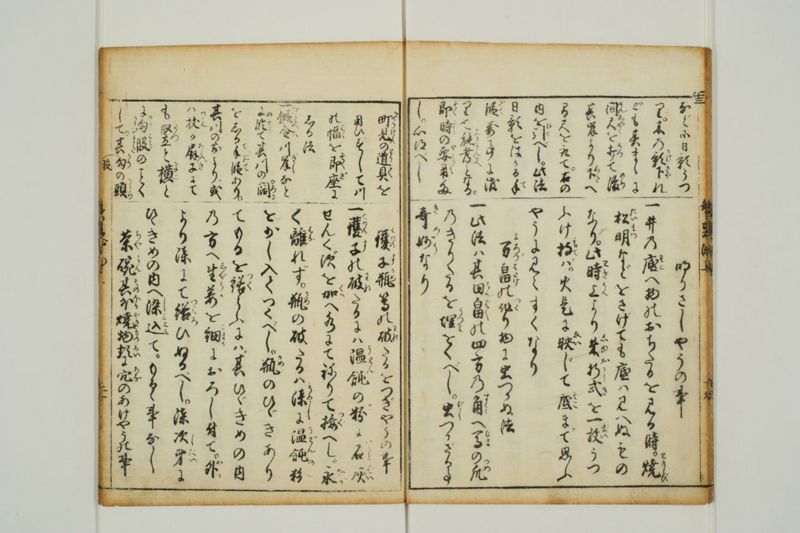
翻刻
【右丁】
【欄外上部】
▢十三
【上段】
などに日影うつ
り。木の影(かけ)下(さが)れ
ども其まゝに
間尺(けんしやく)を打(うつ)て後(のち)
其岸より下(した)へ
間尺を取て。右の
内を引(ひく)べし。此法
日影をはかる手(て)
段(だて)万事に渡
りて能(よき)考(かんがへ)となる。
即時(そくじ)の要用(やう〳〵)多
し。心得べし
【左丁・上段】
町見(ちやうけん)の道具(とうく)を
用ひずして川
の幅(はゝ)を即座(そくざ)に
しる法
一 仮令(たとへは)川 岸(ぎし)なと
に臨(のそみ)て其川の闊(ひろさ)
をしる手段(てだて)あり。
其川の前より。或
は杖(つえ)か扇(あふぎ)にて
も竪(たつ)と横(よこ)と
に《振り仮名:勾股|かうこう|かゝ■また》のことく
して。其 勾(かう)の頭(かしら)
股
【右丁・下段】
明りさしやうの事
一井の底(そこ)へ物のおちたるを見る時。焼(ともしび)
松明(たいまつ)などをさげても底は見へぬもの
なり。此 時(とき)上(うへ)より朱折式(しゆおしき)を一 枚(まい)うつ
ふけ持(もて)ば。火是に映(ゑい)じて底(そこ)まで思ふ
やうに見てすくなり
万(よろづ)畠(はたけ)の作(つく)り物に虫つかぬ法
一此法は其《振り仮名:田畠|てんば■》の四方の角(すみ)へ馬(むま)の爪(つめ)
のきりたるを埋(うつみ)をくべし。虫(むし)つかざる事
奇妙(きめう)なり
【左丁・下段】
鑊子(くはんす)瓶(かめ)等の破(われ)たるをつぎやうの事
一 鑊子(くはんす)の破(われ)たるには温飩(うとん)の粉(こ)に石灰(いしばい)
せんくずを加(くは)へ水にてねりて接(つぐ)へし。永(なが)
く離(はな)れず。瓶(かめ)の破たるは漆(うるし)に温飩粉(うどんのこ)
を少し入てつくべし。瓶(かめ)のひゞきあり
てもるを繕(つく)らふには。其ひゞきめの内
の方へ生姜(しやうが)を細(こまか)におろし付て。外(ほか)
より漆にて繕(つくろ)ひぬるべし。漆 次第(したい)に
ひゝきめの内へ染込(しみこみ)て。もるゝ事なし
茶碗(ちやわん)其外(そのほか)焼物類(やきものるい)に穴(あな)あけやうの事
現代語訳
【右丁・上段】(前ページより続き——立木の高さを日影で知る方法)
——などに日影が映って、木の影が(崖の下へ)垂れ下がっていても、そのまま間尺(けんじゃく)を当てて測り、その後、崖の上から下への間尺を取って、右(上記)の内(数値)を引くべし。この方法は、日影を測る手段として万事にわたって良い考えのもとになる。とっさの時に役立つことが多い。心得ておくべきである。
---
【左丁・上段】
測量道具を使わずに、川の幅を即座に知る方法
一、たとえば川岸などに臨んで、その川の幅を知る手段がある。その川の手前から、あるいは杖か扇などを使って、縦と横に「勾股(かぎ・また=直角三角形の二辺)」のようにして、その勾(こう)の頭(先端)と股(また)——
(次段・次ページへ続く)
---
【右丁・下段】(前ページより続き——井戸へ物が落ちたときにそれを取り出す方法)
井戸の底を明るく照らす方法
一、井戸の底へ物が落ちたときに見ようとして、灯火や松明などを下げても底は見えないものである。このとき、上から朱折式(朱塗りの折敷=漆塗りの角盆)を一枚、伏せた状態で持つと、火がこれに映って底まで思うように見ることができて便利である。
---
あらゆる畠の作物に虫が付かない方法
一、この方法は、その田畠の四方の角に、馬の爪(蹄)の切ったものを埋めておくべし。虫が付かないことが奇妙(不思議なほど効果的)である。
---
【左丁・下段】
鍋・瓶などの割れたものを継ぐ(修繕する)方法
一、鍋(鑊子)の割れたものには、うどんの粉に石灰とせんくず(繊維くず)を加えて水で練り、接ぎ合わせるべし。永く離れることはない。瓶の割れたものは、漆にうどんの粉を少し入れて付けるべし。瓶にひびが入って水が漏れるのを繕うには、そのひびの内側に生姜を細かくおろして塗り付け、外側から漆で繕い塗るべし。漆がしだいにひびの内側へ染み込んで、漏れることがなくなる。
---
茶碗そのほか焼き物類に穴を開ける方法
(次ページへ続く)
英語訳
**[Right Page — Upper Section]** *(Continued from the previous page — On Determining Height Using Shadow Measurement)*
—and so forth: even when the shadow falls onto a cliff face and the tree's shadow descends below the edge, measure it as-is with the *kenjaku* (measuring rod/rope), and afterward take the measurement from the top of the cliff down to its base, then subtract the value noted above (the overlapping portion). This method of measuring by shadow serves as a useful approach applicable to all manner of situations. It has many uses in urgent moments. One should bear it well in mind.
---
**[Left Page — Upper Section]**
**A Method for Instantly Determining the Width of a River Without Surveying Instruments**
- For example, when standing on a riverbank and wishing to know the width of that river, the following technique is available. From the near side of the river, using a walking stick or a fan held vertically and horizontally in the manner of the *kōkō* (the two legs of a right triangle — the shorter leg and the longer leg), align the tip of the *kō* (shorter leg) and the *ko* (longer leg)—
*(Continues in the lower section / next page)*
---
**[Right Page — Lower Section]** *(Continued from the previous page — On Retrieving Objects Fallen into a Well)*
**On the Matter of Illuminating the Bottom of a Well**
- When an object has fallen to the bottom of a well and you wish to see it, lowering a lamp or torch will not allow you to see the bottom clearly. In such a case, hold a single *shu-oshiki* (a lacquered square tray) face-down from above, and the firelight will reflect off it, allowing you to see all the way to the bottom just as you wish — most convenient.
---
**A Method to Prevent Insects from Afflicting All Crops in the Field**
- For this method: bury clippings of horse hooves at the four corners of the field or paddy. That insects will not attack the crops is a wondrous thing.
---
**[Left Page — Lower Section]**
**On the Method of Mending Cracked or Broken Pots, Jars, and Similar Vessels**
- For a cracked iron pot (*kwansu*): mix wheat flour (*udon* flour) with lime and fiber scraps (*sen-kuzu*), knead with water, and use this to join the broken pieces together. They will not come apart for a long time. For a cracked ceramic jar: mix a little wheat flour into lacquer and apply it to bond the pieces. For a jar that has a crack and is leaking: grate fresh ginger finely and apply it to the inside of the crack, then apply lacquer to the outside to seal it over. The lacquer will gradually seep into the crack from the inside, and the vessel will no longer leak.
---
**On the Method of Making Holes in Teacups and Other Ceramic Ware**
*(Continues on the next page)*