翻刻
【右丁】
【欄外上部】
▢九十四
【上段】
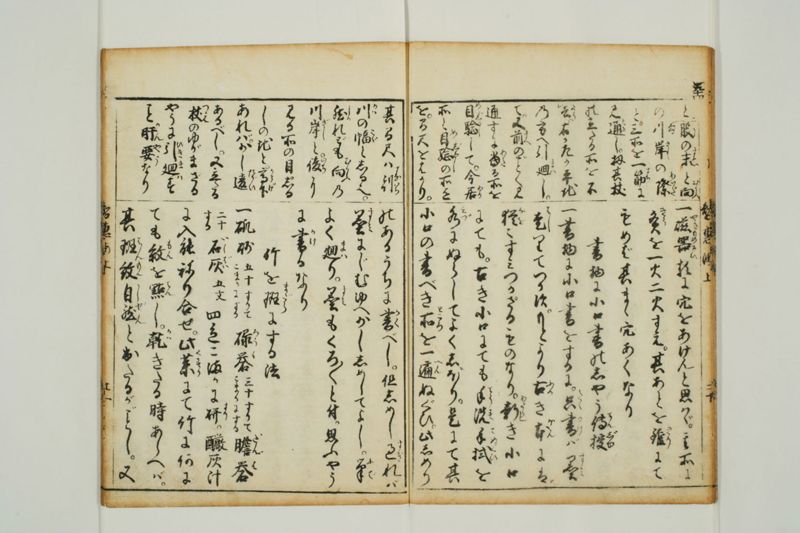
と ̄ニ股の末(すゑ)と向(むかふ)
勾
の川 岸(きし)の際(あいだ)
と。三所を一 筋(すち)に
見 通(とを)し。扨其杖
の立たる所を不
_レ去(さら)。右か左か平地
の方へ引 廻(まは)し。
て。又 前(まへ)のごとく見
通すに当(あた)る所を
目騐(めじるし)して。今 居(ゐる)
所と目騐(めじるし)の所迄
を。間尺をはかり。
【左丁・上段】
其間尺は則(すなはち)
川(かわ)の幅(はゞ)としる也。
然(しか)れども向(むかふ)の
川 岸(きし)と。後(のち)に
見る所の目じる
しの地と。高下(かうげ)
あれば。少し違(たがひ)
あるべし。又立たる
杖(つえ)のゆがまざる
やうに引廻(ひきまは)す
こと。肝要(かんやう)なり
【右丁・下段】
一 磁器類(やきものるひ)に穴をあけんと思はゞ。其所に
灸(きう)を一火二火すえ。其あとを錐(きり)にて
もめば其まゝ穴あくなり
書物に小口書のしやう伝授(てんじゆ)
一書物に小口書をするに。只(たゝ)書(かけ)ば墨(すみ)
走(はし)りてつかす。もとより古(ふる)き本(ほん)には。
猶(なを)々すみつかざるものなり。新(あたらし)き小口
にても。古き小口にても手洗(てうす)手拭(てぬくひ)を
水(みづ)にぬらしてよくしぼり。是にて其
小口の書べき所(ところ)を一 遍(へん)ぬぐひ。此しめり
【左丁・下段】
のあるうちに書(かく)べし。但しめし過(すぎ)れば
墨(すみ)にじむゆへ少ししめしてよし。筆(ふで)
よく廻(まは)り。墨(すみ)もくろ〳〵と付。思ふやう
に書(かけ)るなり
竹を斑(まだら)にする法
一■【「石」に「爪」】砂《割書:五十すりて|こまかにする》碌礜(ろくは)《割書:三十すりて|こまかにする》胆礜(だんは)
《割書:二十|する》石灰(いしばい)《割書:五文| 》四色こまかに研(すり)。釅灰汁
に入能ねり合せ。此 薬(くすり)にて竹に何に
ても紋(もん)を点(てん)し。乾(かは)きたる時あらへば。
其 斑紋(はんもん)自然(しぜん)と出たるがごとし。又
現代語訳
【右丁・上段】(前ページより続き——測量道具を使わずに川の幅を即座に知る方法)
——と、二股(勾と股)の末端と、向こう岸との間を、三点を一直線に見通す。そして、その杖を立てた場所を動かさずに、右か左か、平地の方へ(杖ごと)引き回して、また前のように見通したときに当たる場所を目印として、今いる場所から目印の場所までを間尺で測る。
【左丁・上段】
その間尺が、すなわち川の幅である、と知るべし。ただし、向こう岸と、後で見通した目印の地点との間に高低差があれば、少し誤差が生じるであろう。また、立てた杖が傾かないようにして引き回すことが、肝要である。
---
【右丁・下段】(前ページより続き——茶碗その他焼き物類に穴を開ける方法)
一、焼き物類に穴を開けたいと思えば、その箇所に灸(きゅう)を一火・二火据えて、そのあとを錐で揉めば、そのまま穴が開くものである。
---
書物に小口書きをする方法の伝授
一、書物に小口書きをするには、ただそのまま書けば墨が走って(滲んで)うまく付かない。もとより古い本には、なおさら墨が付かないものである。新しい小口であっても、古い小口であっても、手洗いの手拭いを水に濡らしてよく絞り、これでその小口の書くべき箇所を一遍拭い、この湿り
【左丁・下段】
のあるうちに書くべし。ただし、湿らせ過ぎれば墨が滲むゆえ、少し湿らせる程度でよい。筆がよく走り、墨も黒々と付き、思うように書けるものである。
---
竹を斑(まだら)模様にする方法
一、礜砂(ごさ)(五十、すり細かくする)・碌礜(ろくは)(三十、すり細かくする)・胆礜(だんは)(二十、する)・石灰(いしばい)(五文〔分〕)——この四色を細かに研って、濃い灰汁に入れてよく練り合わせる。この薬(くすり)で竹に何であれ紋(もよう)を点じ(塗り付け)、乾いたときに洗えば、その斑紋が自然に出たかのようになる。また——
(次ページへ続く)
英語訳
**[Right Page — Upper Section]** *(Continued from the previous page — On Determining River Width Without Surveying Instruments)*
—and then, align three points in a single line of sight: the tip of the two-pronged configuration (the ends of the *kō* and *ko*, i.e., the two legs of the right-angle frame), and the far bank of the river. Without moving the spot where the stick is planted, swing it around to the right or left toward flat ground, and again sight through as before; mark the point where the line of sight falls. Then measure the distance from your current position to the marked point with a *kenjaku* (measuring rod/rope).
**[Left Page — Upper Section]**
That measurement is to be understood as the width of the river. However, if there is a difference in elevation between the far bank and the newly marked point on the ground, there will be some slight error. It is also of vital importance that the planted stick be kept perfectly straight when it is swung around.
---
**[Right Page — Lower Section]** *(Continued from the previous page — On Making Holes in Teacups and Other Ceramic Ware)*
- If you wish to make a hole in ceramic ware, apply moxibustion (*kyū*) to the desired spot once or twice, and then bore into the burned area with an awl (*kiri*), and the hole will open just as desired.
---
**Instructions on the Method of Writing on the Fore-Edge of Books**
- When writing on the fore-edge (*koguchi*) of a book, if you simply write as you would normally, the ink will run and not adhere well. With old books in particular, the ink will adhere even less readily. Whether the fore-edge is new or old, dampen a hand towel with water, wring it out well, and wipe the area of the fore-edge where you intend to write, just once. While this slight dampness
**[Left Page — Lower Section]**
remains, proceed to write. However, if the edge is made too wet, the ink will bleed, so only a slight dampening is needed. The brush will move smoothly, the ink will adhere with a deep, rich black, and you will be able to write just as you wish.
---
**A Method for Creating Mottled Patterns on Bamboo**
- Finely grind the following four ingredients: *gosa* (礜砂, orpiment-type mineral — grind fifty *me* until fine); *rokuha* (碌礜, a mineral compound — grind thirty *me* until fine); *danha* (胆礜, a mineral substance — grind twenty *me*); and lime (*ishibai* — five *fun*). Mix these into concentrated lye (*aku*) and knead them together well. Using this preparation, apply any pattern or design (*mon*) you wish to the bamboo, and when it has dried, wash it off — the mottled pattern will appear as though it had occurred naturally. Furthermore—
*(Continues on the next page)*