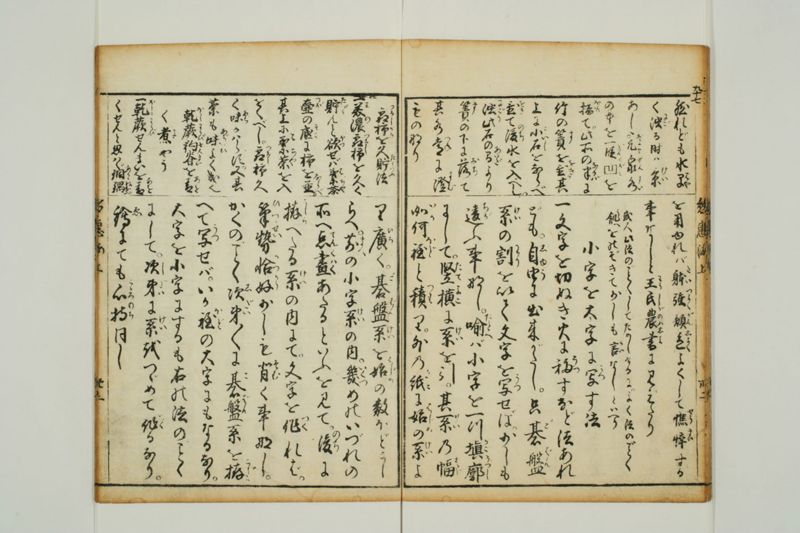
翻刻
【右丁】
【欄外上部】
九十七
【上段】
然れども水 早(はや)
く濁(にご)る時は景(けい)
あしゝ。凡(およそ)泉水(せんすい)
の中を一 段(だん)凹(くぼみ)を
掘(ほり)て。此所の半(なかば)に
竹の簀(す)を置(をき)。其
上に小石(こいし)をならべ
置(をき)て後(のち)水を入べし。
濁(にごり)此石の間(あいだ)より
簀(す)の下に落(おち)て
其水 常(つね)に澄(すむ)
ものなり
【左丁・上段】
霜柿(つるしがき)を久 貯(たくはふ)法
一 美濃(みの)霜(つるし)柿を久く
貯(たばゝ)んと欲(ほつ)せば葉茶(はちや)
壺(つぼ)の底(そこ)に柿を並(ならべ)。
其上に葉茶(はちや)を入
をくべし。霜(つるし)柿久
く味(あぢ)かはらず。又其
茶も味(あぢはひ)よく成也
乾蕨(ほしわらび)狗脊(せんまい)を青(あお)
く煮(に)やう
一 乾蕨(ほしわらび)ぜんまいを青(あを)
くせんと思はば銅鍋(あかゝねなべ)
【右丁・下段】
を用ゆれば体(たい)強(つよく)顔色(がんしよく)よくして憔悴(せうすい)する
事なしと王氏(わうしが)農書(のふしよ)に見えたり
或人此法のごとくしてためしけるに。よく法のごとく
飢(うへ)をのぞきて少しも害(かい)なしといへり
小字を太字に写(うつ)す法
一文字を切ぬき火に移(うつ)すなど法あれ
ども。自由(じゆう)に出来がたし。只 碁盤(ごばん)
系(けい)の割(わり)を以て文字を写(うつ)せば。少しも
違(ちが)ふ事なし。喩(たとへ)ば小字を一つ。塡廓(かごうつし)
にして。竪(たて)横(よこ)に系(けい)を引。其 系(けい)の幅(はゞ)
如何程(いかほど)と積(つも)り。外の紙(かみ)に始(はじめ)の系(けい)よ
【左丁・下段】
り広(ひろ)く。碁盤系(ごばんけい)を始(はじめ)の数ほどこし
らへ。前(まへ)の小字 系(けい)の内。幾(いくつ)めのいづれの
所へ点画(てんくはく)あたるといふを見て。後(のち)に
拵(こしら)へたる系(けい)の内にて。文字を作(つく)れば。
筆勢(ひつせい)恰好(かつかう)少しも背(そむ)く事なし。
かくのごとく次第(しだい)〳〵に碁盤(こばん)系を拵(こじら)
へて写(うつ)せば。いか程(ほど)の大字にもなるなり。
大字を小字にするも右の法のことく
にして。次第(しだい)に系(けい)をつゞめて作(つく)るなり。
絵(ゑ)にても心持(こゝろもち)同し
現代語訳
【右丁・上段】(前ページ「泉水を替えずに溜まり水を清くする方法」の続き)
(欄外)九十七(百九十七)
しかし水が早く濁るようであれば、景観がよくない。そもそも泉水(庭池)の中に一段低いくぼみを掘り、そのくぼみの半ばに竹のすのこを置き、その上に小石を並べ置いてから水を入れるとよい。濁りはこの石の間からすのこの下に落ちて、水が常に澄んでいるものである。
---
【左丁・上段】
干し柿を長く貯蔵する方法
一、美濃(みの)の干し柿(つるし柿)を長く貯蔵しようと思うならば、葉茶壺の底に柿を並べ、その上に葉茶(茶葉)を入れておくとよい。干し柿は長く置いても味が変わらない。またその茶葉も味がよくなる。
---
干し蕨・ぜんまいを青く煮る方法
一、干し蕨・ぜんまいを青く仕上げようと思うならば、銅鍋(あかがね鍋)を
(次段へ続く)
---
【右丁・下段】(前ページ「飢えを除く方法」の続き)
(これ)を用いれば体が強壮になり、顔色もよく、やつれることがないと、王氏の農書に見える。
ある人がこの方法のとおりに試してみたところ、よく法のとおりに飢えを除き、少しも害がなかったと言っている。
---
小さい文字を大きい文字に写す方法
一、文字を切り抜いて火で移すなどの方法もあるが、思い通りにはなかなかうまくいかない。ただ碁盤の升目(方眼)の割り付けをもって文字を写せば、少しも狂いが生じない。たとえば小さい文字一字を輪郭をなぞって写し取り、縦横に方眼の線を引き、その線の幅がどれほどかを測る。別の紙に最初の方眼よりも
---
【左丁・下段】
広く、碁盤の方眼を最初と同じ数だけ作り、前の小さい文字の方眼の中で、何番目のどの箇所に点画があるかを見て、後から作った大きい方眼の中で文字を書けば、筆の勢いや形が少しも違うことがない。このように次第に碁盤の方眼を作って写せば、どれほど大きい文字にもすることができる。大きい文字を小さい文字にするのも、右の方法と同じように、順々に方眼を縮めて作るのである。絵においても考え方は同じである。
英語訳
**[Right Page — Upper Section]** *(Continued from previous page — "A Method for Keeping Pond Water Perpetually Clear Without Changing It")*
*(Margin note: [One hundred and] ninety-seven)*
However, if the water becomes cloudy quickly, the appearance of the garden will suffer. In general, one should dig a sunken depression one level deeper within the garden pond, place a bamboo screen (*su*) at the midpoint of this depression, lay small stones arranged on top of it, and then allow the water in. The sediment will fall through the gaps between the stones and down beneath the bamboo screen, and the water will thus remain clear at all times.
---
**[Left Page — Upper Section]**
**A Method for Storing Dried Persimmons (*Tsurushigaki*) for a Long Time**
- If one wishes to store Mino dried persimmons (*tsurushigaki*) for a long time, one should arrange the persimmons on the bottom of a leaf-tea jar (*hacha tsubo*) and place loose-leaf tea (*hacha*) on top of them. The dried persimmons will retain their flavor for a long time without changing. Furthermore, the tea itself will become better in flavor.
---
**A Method for Boiling Dried Bracken (*Warabi*) and Royal Fern (*Zenmai*) to Keep Them Green**
- If one wishes to keep dried bracken and royal fern green when boiling them, one should use a copper pot (*akaganabe*)—
*(Continues in lower section)*
---
**[Right Page — Lower Section]** *(Continued from previous page — "A Method for Eliminating Hunger")*
—using this will strengthen the body, improve one's complexion, and prevent physical decline, as can be seen in the *Nōsho* (Agricultural Treatise) of Master Wang.
A certain person tried this method as described, and reported that it removed hunger precisely as prescribed, without the slightest harm.
---
**A Method for Copying Small Characters as Large Characters**
- There are methods such as cutting out characters and transferring them using fire, but these are difficult to execute freely with good results. Simply by using a grid division like that of a *goban* (Go board) to copy a character, not the slightest deviation will occur. For example, trace the outline of one small character, draw horizontal and vertical grid lines through it, and measure the width of each cell. On a separate sheet of paper, construct a grid with the same number of cells as the first, but with each cell made larger—
---
**[Left Page — Lower Section]**
—and, looking at where each stroke and dot falls within which numbered cell of the small-character grid, recreate the character within the corresponding cell of the larger grid. The force of the brushwork and the overall shape will not deviate in the slightest. By repeatedly constructing such grids in this manner and copying, one can produce characters of any size whatsoever. To reduce large characters to small ones, follow the same method as above, gradually making the grid cells smaller. The same principle applies equally to pictures.