翻刻
【右丁】
【欄外上部】
百九十八
【図あり】
【上段】
にて煮(にる)べし。色(いろ)
甚(はなはだ)青(あを)くして見
事なり
餅(もち)を水に漬(つけ)置
て久く貯ふ法
一 寒(かん)の水一斗に塩(しほ)
八合入 釜(かま)にて煎(せん)
じ。さまして餅(もち)の
【左丁・上段】
乾(かはき)たるを上につき
たる粉(こ)を水にて
洗(あら)ひ落(おと)し。能(よく)かは
かして後。右の寒(かん)
の水に漬(つけ)をくべし。
但 壺(つぼ)に入てよし。
かくのごとくすれば。
水を替(かゆ)事なく。
久く貯て味(あぢ)損(そん)
ぜず
巻物(まきもの)小口 截(きり)様(やう)
の秘伝
【右丁・下段】
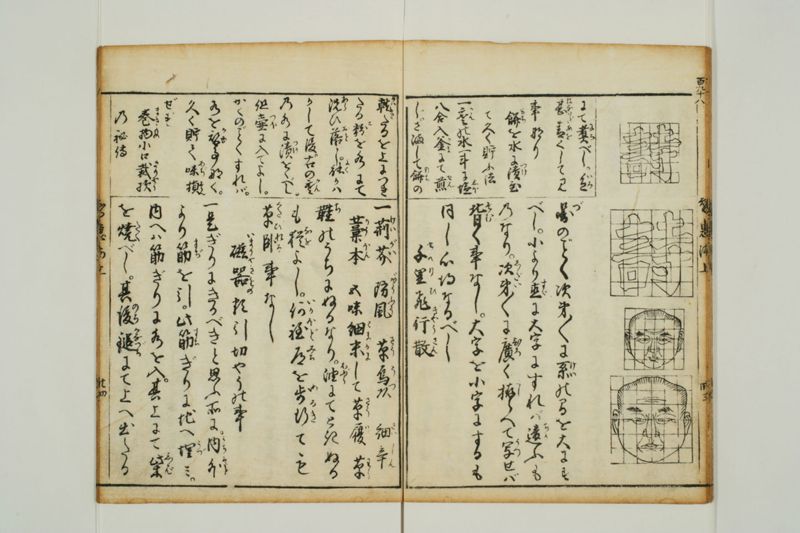
図(づ)のごとく次第〳〵に系(けい)の間を大にす
べし。小より直(すぐ)に大字にすれば違(ちか)ふも
のなり。次第(しだい)〳〵に広(ひろ)く拵(こし)らへて写(うつ)せば
背(そむ)く事なし。大字を小字にするも
同し心得なるべし
千里飛行散(せんりひきやうさん)
【左丁・下段】
一 荊芥(けいがい) 防風(ぼうふう) 草烏頭(さううつ) 細辛(さいしん)
藁本(かうぼん) 五味 細末(くまかに)して草履(さうり) 草(わら)
鞋(ち)のうちにぬるなり。油(あぶら)にてときぬる
も猶(なを)よし。何程(いかほど)道(みち)を歩行(あるき)ても
草臥(くたびれる)事なし
磁器(いまりやきもの)類引切やうの事
一是ぎりにきるべきと思ふ所に。内外(うちそと)
より筋(すぢ)を引。此 筋(すち)ぎりに地へ埋(うづ)み。
内へは筋ぎりに水を入。其上にて柴(しば)
を焼(たく)べし。其 後(のち)鎚(かなづち)にて上へ出たる
現代語訳
【右丁・上段】(前ページ「干し蕨・ぜんまいを青く煮る方法」の続き)
(欄外)百九十八
(図あり)
(銅鍋)で煮るとよい。色が非常に青々として見事である。
---
餅を水に漬けて長く貯蔵する方法
一、寒の水一斗に塩八合を入れ、釜で煎じて冷ます。餅の
---
【左丁・上段】
乾いたものを、表面についた粉を水で洗い落とし、よく乾かしてから、右の寒の水に漬けておくとよい。ただし壺に入れるとよい。このようにすれば、水を替えることなく、長く貯えても味が損なわれない。
---
巻物の小口の切り方の秘伝
---
【右丁・下段】(前ページ「小さい文字を大きい文字に写す方法」の続き)
図のように次第に方眼の間隔を大きくするとよい。小さい文字から直接大きい文字に写すと狂いが生じるものである。少しずつ順に広くして写せば、違いが生じることがない。大きい文字を小さい文字にする場合も、同じ心得でおこなうべきである。
---
千里飛行散(せんりひきょうさん)
---
【左丁・下段】
一、荊芥(けいがい)・防風(ぼうふう)・草烏頭(そううず)・細辛(さいしん)・藁本(こうぼん)・五味子(ごみし)を細かく粉末にして、草履や草鞋の内側に塗るのである。油で溶いて塗るのはさらによい。どれほど道を歩いても疲れることがない。
---
磁器(伊万里焼き物)類の切り方について
一、ここで切るべきと思う箇所に、内外から線を引く。この線のとおりに地面に埋め、内側には線のとおりに水を入れ、その上で柴を焚くとよい。その後、金槌で地上に出ている部分を
(次ページへ続く)
英語訳
**[Right Page — Upper Section]** *(Continued from previous page — "A Method for Boiling Dried Bracken and Royal Fern to Keep Them Green")*
*(Margin note: One hundred and ninety-eight)*
*(Illustration present)*
—one should boil them in [a copper pot]. The color will be remarkably vivid green and truly impressive.
---
**A Method for Preserving Mochi (Rice Cakes) for a Long Time by Soaking in Water**
- Take one *to* of midwinter (*kan*) water, add eight *gō* of salt, and simmer it in a pot (*kama*). Let it cool. Take dried mochi—
---
**[Left Page — Upper Section]**
—wash off the powdery coating on the surface with water, dry them thoroughly, and then soak them in the aforementioned midwinter salt water. It is best to store them in a ceramic jar (*tsubo*). If one does this, the water need not be changed, and the mochi can be kept for a long time without any loss of flavor.
---
**A Secret Technique for Cutting the End (*Koguchi*) of a Scroll**
*(Continues in lower section)*
---
**[Right Page — Lower Section]** *(Continued from previous page — "A Method for Copying Small Characters as Large Characters")*
As shown in the diagram, one should gradually increase the spacing between the grid lines. If one attempts to copy directly from a small character to a very large one in a single step, discrepancies will arise. By gradually enlarging the grid step by step and copying at each stage, no deviation will occur. When reducing large characters to small ones, the same principle should be observed.
---
**Senri Hikyō-san (千里飛行散: "Thousand-League Flying Powder")**
---
**[Left Page — Lower Section]**
- Grind the following into a fine powder: *keigai* (Schizonepeta), *bōfū* (Saposhnikovia root), *sō-uzu* (aconite herb, *Aconitum*), *saishин* (Asarum root), *kōbon* (Ligusticum root), and *gomishi* (Schisandra). Apply this powder to the inside of straw sandals (*zōri*) or straw shoes (*waraji*). Mixing it with oil before applying is even better. No matter how far one walks, one will not grow weary.
---
**On the Method of Cutting Porcelain Ware (Imari Ceramics)**
- At the point where one wishes to make the cut, draw a line on both the inside and outside [of the piece]. Bury the piece in the ground up to the line, fill the inside with water up to the line, and then burn brushwood (*shiba*) on top. After that, strike the part protruding above the ground with a metal hammer—
*(Continues on next page)*