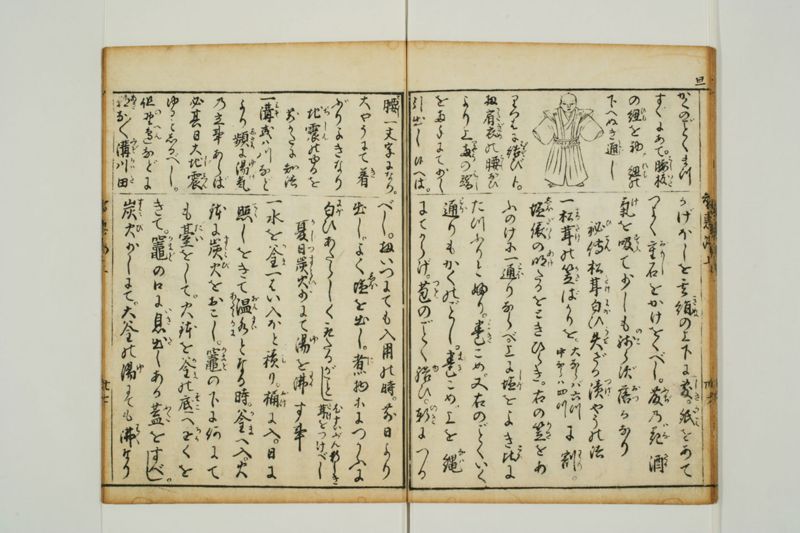
翻刻
【右丁】
【欄外上部】
日一
【上段】
かくのごとくまつ
すぐにあて。腰板(こしいた)
の紐(ひも)を初 ̄メ紐(ひも)の
下へぬき通(とほ)し
【図】
りつはに結(むす)び候。
扨 肩衣(かたぎぬ)の腰(こし)おび
より上 両(りやう)の端(はし)
を両手にて少し
引出し候へば。
【左丁・上段】
腰(こし)一文字になり。
大やうにて着(き)
ぶりよきなり
地震(ぢしん)のゆるを
前かたに知法
一 溝(みぞ)或は川など
より頻(しきり)に湯気(ゆげ)
の立事あらば
必其日大 地震(じしん)
ゆるとしるべし。
但 野辺(のへん)などに
朝(あさ)な〳〵溝(みぞ)川(かは)田(た)
【右丁・下段】
かげほしを其 絹(きぬ)の上下に敷(しき)。紙(かみ)をあて
つよく重石(おもし)をかけをくべし。藤(ふぢ)の花(はな)酒(さか)
気(け)を吸(すふ)て少しも残(のこ)らず落(おつ)るなり
秘伝(ひてん)松 茸(たけ)匂(にほ)ひ失(うせ)ざる漬(つけ)やうの法
一 松茸(まつたけ)の笠(かさ)ばかりを。《割書:大ならば六つ|中ならは四つ》に割(わり)。
塩俵(しほだはら)の明(あけ)たるをときひらき。右の笠(かさ)をあ
ふのけに一 通(とほ)りならべ。上に塩(しほ)をよき比(ころ)に
たつふりとふり。巻(まき)こめ。又右のごとくいく
通(とほ)りもかくのごとし。巻(まき)こめ。上を縄(なは)
にてからげ。苞(つと)のごとく結(ゆ)ひ。軒(のき)につる
【左丁・下段】
べし。扨いつにても入用の時。前日より
出し。よく塩(しほ)を出し。煮(に)物等につかふに
匂(にほ)ひあたらしく取たるがことし《割書:尤すいぶん新しき|茸(たけ)をつけべし》
夏日(かじつ)炭火(すみひ)少にて湯(ゆ)を沸(わか)す事
一水を釜(かま)一はい入ほと《振り仮名:積|▢も》り。桶(おけ)に入。日に
照(てら)しをきて《振り仮名:温水|おんすい|あたゝかに》となる時。釜(かま)へ入。火
鉢に炭火(すみび)をおこし。竈(かまど)の下に何にて
も台(だい)をして。火鉢を釜(かま)の底(そこ)へ近(ちか)くを
きて。竈(かまど)の口に息(いき)出(だ)しある蓋(ふた)をすべし。
炭火(すみび)少しにて。大釜の湯(ゆ)にても沸(わく)なり
現代語訳
【右丁・上段】(前ページ「袴をきれいに着る方法」の続き)
(欄外)二百一
このようにまっすぐに当て、腰板の紐を最初の紐の下へ抜き通し、
【図】
しっかりと結ぶ。さて、肩衣の腰帯より上の両端を両手で少し引き出せば、
---
【左丁・上段】
腰が一文字になり、全体として着ぶりがよくなる。
---
地震の揺れを事前に知る方法
一、溝あるいは川などから頻りに湯気が立つことがあれば、必ずその日に大地震が揺れると知るべし。ただし、野辺などに朝ごとに溝・川・田から(湯気が立つのは)
---
【右丁・下段】(前ページ「衣服に酒がしみた時の落とし方」の続き)
陰干しをして、その絹の上下に(藤の花を)敷き、紙を当てて強く重石をかけておくとよい。藤の花が酒気を吸って、少しも残らず落ちるのである。
---
秘伝 松茸の匂いが失われない漬け方の法
一、松茸の傘だけを、〔大きければ六つ、中ならば四つ〕に割る。塩俵の明けたものをとき開き、この傘を仰向けに一通り並べ、上に塩をよい加減にたっぷりとふり、巻き込め。またこのように何通りも同様にする。巻き込めて、上を縄でからげ、苞のように結い、軒につるす
---
【左丁・下段】
とよい。さて、いつでも入用の時は、前日から出して、よく塩を抜いて、煮物等に使えば、匂いが新しく取ったものと同じようである。〔なお、十分に新しい茸を漬けるべし。〕
---
夏の日に炭火が少なくて湯を沸かす方法
一、水を釜一杯ほど桶に入れ、日に照らしておいて温水(あたたか)になった時に、釜へ入れる。火鉢に炭火を起こし、竈の下に何でも台をして、火鉢を釜の底へ近くを置いて、竈の口に息が出る(通気孔のある)蓋をするとよい。炭火が少しでも、大釜の湯であっても沸くものである。
英語訳
**[Right Page — Upper Section]** *(Continued from previous page — "A Method for Wearing Hakama Neatly and Properly")*
*(Margin note: Two hundred and one)*
—apply it straight in this manner, pass the cord of the hip board (*koshiita*) through beneath the first cord—
**[Diagram]**
—and tie it firmly. Now, if one pulls out the two ends of the shoulder garment (*kataginu*) above the hip sash slightly with both hands,
---
**[Left Page — Upper Section]**
—the hip line will become straight (like the character 一 *ichi*), and overall, the appearance of wearing it will be fine and proper.
---
**A Method for Knowing in Advance When an Earthquake Will Strike**
- If steam rises frequently and persistently from ditches or rivers, one should know that a great earthquake will certainly strike that day. However, in fields and meadows, ditches, rivers, and rice paddies every morning (steam rises naturally)—
*(Continues below)*
---
**[Right Page — Lower Section]** *(Continued from previous page — "A Method for Removing Sake Stains from Clothing Without Washing")*
—dry it in the shade, laying the wisteria blossoms above and below the silk, place paper over it, and press down firmly with a heavy weight. The wisteria blossoms will absorb the sake smell, and it will be completely removed without leaving a trace.
---
**A Secret Method for Preserving Matsutake Mushrooms Without Losing Their Fragrance**
- Take only the caps of matsutake mushrooms and split them into [six pieces if large, four pieces if medium]. Open up an empty salt bale (*shiodawara*) and unfurl it. Lay the caps face-upward in a single layer, sprinkle salt generously over them in good measure, and roll them up inside. Repeat this process as many layers as desired in the same manner. Roll them up, bind the top with rope, tie it up into a bundle like a *tsuto* (a straw-wrapped parcel), and hang it from the eaves.
---
**[Left Page — Lower Section]**
When needed at any time, take it down the day before use, draw out the salt thoroughly, and use the mushrooms in simmered dishes and the like — the fragrance will be just as if they had been freshly gathered. [It is best to use sufficiently fresh mushrooms for pickling.]
---
**A Method for Boiling Water with a Small Amount of Charcoal in Summer**
- Fill a bucket with approximately one full釜 (*kama*) worth of water, and leave it out in the sunlight. When it becomes warm (*onsui*), transfer it to the cooking pot (*kama*). Light a charcoal fire in a brazier (*hibachi*), place some kind of stand beneath the cooking hearth (*kamado*), position the brazier close to the bottom of the pot, and cover the mouth of the hearth with a lid that allows some air to pass through. Even with only a small amount of charcoal, even a large pot of water will come to a boil.