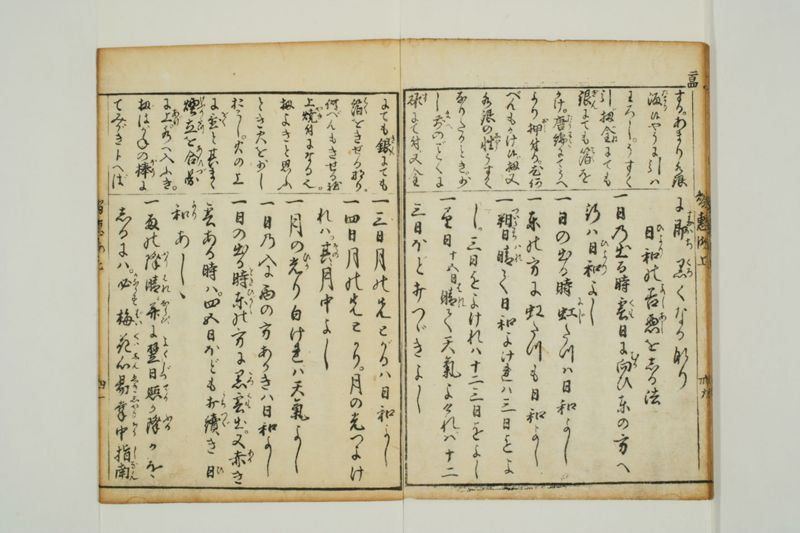
翻刻
【右丁】
【欄外上部】
一百四
【上段】
する。あまり水銀
溜(たまり)候やうに引は
わろし。うすく
引。扨 金(かね)にても
銀(ぎん)にても箔(はく)を
かけ。唐綿(たうわた)にてうへ
より押(おし)付る。尤何
べんもかけ候。扨又
水銀の性(しやう)うすく
なりたるとき。少
し前(まへ)のごとくに
酢(す)にて付。又金
【左丁・上段】
にても銀(きん)にても
箔(はく)をきせるなり。
何べんもきせる程
上 焼(やき)付になる也。
扨よきと思ふ
とき火を少し
おこし。火の上
に置(をく)と其まゝ
煙(けふり)立(たつ)を合図(あひづ)
に上(あげ)。水へ入ふき。
扨はがねの棒(ぼう)に
てみがき候へば
【右丁・下段】
に即(すなはち)黒(くろ)くなるなり
日和(ひより)の善悪(よしあし)をしる法
一日の出る時 雲(くも)日に向(むか)ひ東の方へ
行は日和(ひより)よし
一日の出る時 虹(にじ)たつは日和よし
一東の方に虹たつも日和よし
一 朔日(ついたち)晴(はれ)て日和よけれは三日迄よ
し。三日迄よけれは十二三日迄よし
一望日《割書:十五日| 》晴(はれ)て天気よければ十二
三日ほど打つゞきよし
【左丁・下段】
一三日月の先とがるは日和よし
一四日月の先とかり。月の光つよけ
れは。其(その)月中よし
一月の光(ひか)り白けれは天気よし
一日の入に西の方あかきは日和よし
一日の出る時(とき)東(ひがし)の方に黒雲(くろくも)出。又 赤(あか)き
雲ある時は。四五日ほども打続(うちつゞ)き日(ひ)
和(より)あしゝ
一雨の降(ふり)晴(はれ)。幷(ならび)に翌日(よくじつ)照(てる)か降(ふる)かを
しるには。必(かならす)梅花心易掌中指南(ばいくはしんゑきしやうちうしなん)
現代語訳
【右丁・上段】
(欄外上部:一百四/二百四)
(前ページ「日本焼付けの仕方」の続き)
(水銀を)擦り付ける。あまり水銀が溜まるほど厚く引くのはよくない。薄く引くこと。そして、金でも銀でも箔をかけ、唐綿(とうわた)で上から押し付ける。何度も繰り返しかけるとよい。さらに、水銀の効き(性質)が薄くなってきたときは、少し前と同じように酢で付けて、また金
---
【左丁・上段】
(続き)
でも銀でも箔をきせる(被せる)のである。何度も被せるほど、上等な焼付けになる。さて、十分だと思うときに、少し火を起こし、火の上に置くと、そのまま煙が立つのを合図に(器を火から)上げ、水に入れて拭く。そして鋼(はがね)の棒で磨けば、
---
【右丁・下段】
(続き)
すぐに黒くなるものである。
---
日和(天気)の良し悪しを知る法
一、日の出る時、雲が日に向かって東の方へ流れていくときは、天気がよい。
一、日の出る時、虹が立つのは天気がよい(しるし)。
一、東の方に虹が立つのも天気がよい(しるし)。
一、朔日(一日)が晴れて天気がよければ三日まで(天気が)よい。三日まで(天気が)よければ、十二・三日まで(天気が)よい。
一、望日(十五日)が晴れて天気がよければ、十二・三日ほど晴天が続く。
---
【左丁・下段】
(続き)
一、三日月の先が尖っているのは天気がよい(しるし)。
一、四日月の先が尖り、月の光が強ければ、その月中(つきじゅう)天気がよい。
一、月の光が白ければ天気がよい。
一、日の入り時に西の方が赤いのは天気がよい(しるし)。
一、日の出る時、東の方に黒雲が出て、また赤い雲がある時は、四・五日ほど打ち続けて天気が悪い。
一、雨の降り晴れ、並びに翌日晴れるか降るかを知るには、必ず『梅花心易掌中指南(ばいかしんえきしょうちゅうしなん)』
(次ページへ続く)
英語訳
**[Right Page — Upper Section]**
*(Page number in margin: 204)*
*(Continued from previous page — "The Method of Japanese Burnishing")*
—rub it in. Applying it so thickly that mercury pools up is not good. Apply it thinly. Then apply gold or silver leaf, and press it down from above with *tōwata* (Chinese cotton wool). Repeat this process many times. Furthermore, when the potency (properties) of the mercury has grown weak, apply it again with vinegar as before, and once again apply gold
---
**[Left Page — Upper Section]**
*(Continued)*
—or silver leaf. The more times the leaf is applied, the finer the resulting burnished finish will be. When you judge it to be sufficient, kindle a small fire, place the piece over the flame, and as soon as smoke begins to rise — that is the signal — remove it from the heat, plunge it into water, and wipe it dry. Then, when polished with a steel rod,
---
**[Right Page — Lower Section]**
*(Continued)*
—it will immediately turn black.
---
**A Method for Knowing Whether the Weather Will Be Good or Bad**
- When the sun rises, if the clouds move facing toward the sun and travel eastward, the weather will be fine.
- If a rainbow appears at sunrise, the weather will be fine.
- If a rainbow appears in the eastern sky, the weather will also be fine.
- If the first day of the month (*tsuitachi*) is clear and the weather is fine, it will remain fine for up to three days. If it stays fine for three days, it will remain fine for up to twelve or thirteen days.
- If the full moon day (the fifteenth) is clear and the weather is good, fine weather will continue for about twelve or thirteen days.
---
**[Left Page — Lower Section]**
*(Continued)*
- If the tip of the crescent moon (three-day moon) is sharp and pointed, the weather will be fine.
- If the tip of the fourth-day moon is sharp and the moonlight is strong, the weather will be fine throughout that month.
- If the moonlight appears white, the weather will be fine.
- If the western sky is red at sunset, the weather will be fine.
- If black clouds appear in the east at sunrise, or if there are red clouds, the weather will be bad for about four or five days consecutively.
- To know whether rain will clear up, as well as whether the next day will be sunny or rainy, one must consult the *Baikashin'eki Shōchū Shinan* (*Guide to the Heart of Divination by Plum Blossom, in Pocket Form*)—
*(Continued on next page)*