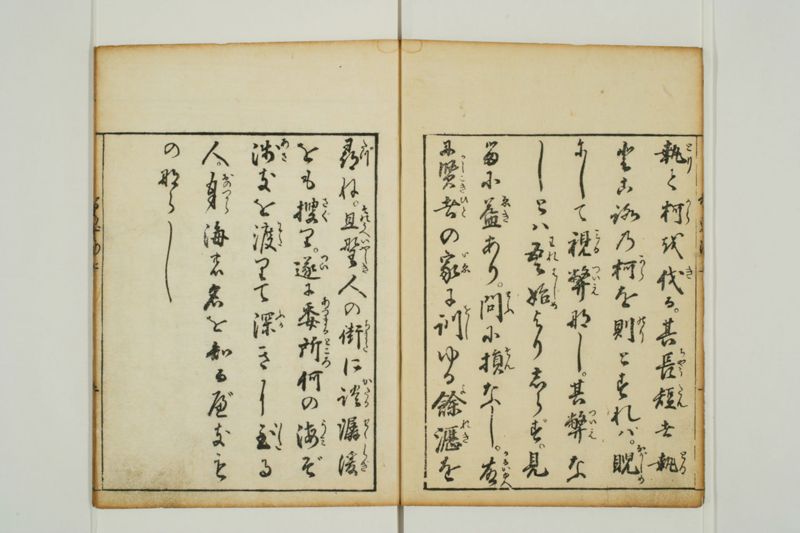
翻刻
【右丁】
執(とり)て柯(から)を伐(き)る。其 長短(ちやうたん)は執(とる)
ところの柯(から)を則(のり)とすれば。睨(ながしめ)
にして視(みる)弊(ついえ)なし。其 弊(ついえ)な
しとは吾(われ)始(はじめ)よりしらず。見
るに益(ゑき)あり。問(とふ)に損(そん)なし。故(かるいゆへ)
に賢者(かしこきひと)の家(いゑ)に訓(をし)ゆる余瀝(よれき)を
【左丁】
尋(たづ)ね。且(そのうへ)野(いやしき)人の街(ちまた)に談(かたる)潺湲(せゝらぎ)
をも捜(さぐ)り。遂(つい)に委(あつまる)所(ところ)何の海(うみ)ぞ
浅(あさ)きを渡(わた)りて深(ふか)きに至(いた)る
人。身(おのつから)海の名を知るべきも
のならし
現代語訳
【右丁】
柯(え)を手に執って柯を切る。その長さの基準は、手に持っている柯そのものを規範とすればよいのだから、横目でちらりと見るだけで(規範は)失われることがない。その「失われることがない」とは、私がはじめから知っていたというわけではない。見ることに益があり、問うことに損はない。それゆえ、賢者の家で教え伝えられてきた余瀝(教えのしたたり)を
【左丁】
訪ね求め、さらには身分の低い人々が巷で語るせせらぎのような話をも探り集め、ついに集まりゆく所はいかなる海であるか——浅きを渡りて深きに至る人は、おのずからその海の名を知ることができるであろう。
英語訳
**[Right Page]**
One grasps the handle (*kara*) in order to cut the branch (*kara*). Since the handle one holds in one's hand serves as the very measure of length, a mere sideways glance is enough — the standard is never lost. That it is "never lost" does not mean that I knew it from the very beginning. There is benefit in observing, and no loss in asking. For this reason, I sought out the lingering drops (*yoreki*) of teaching passed down in the households of the wise,
**[Left Page]**
and also gathered up the murmuring streams (*sesesragi*) of conversation spoken by humble folk in the streets. At last, into what sea do all these gathered waters flow? Those who cross from the shallows and reach the depths shall naturally come to know the name of that sea.