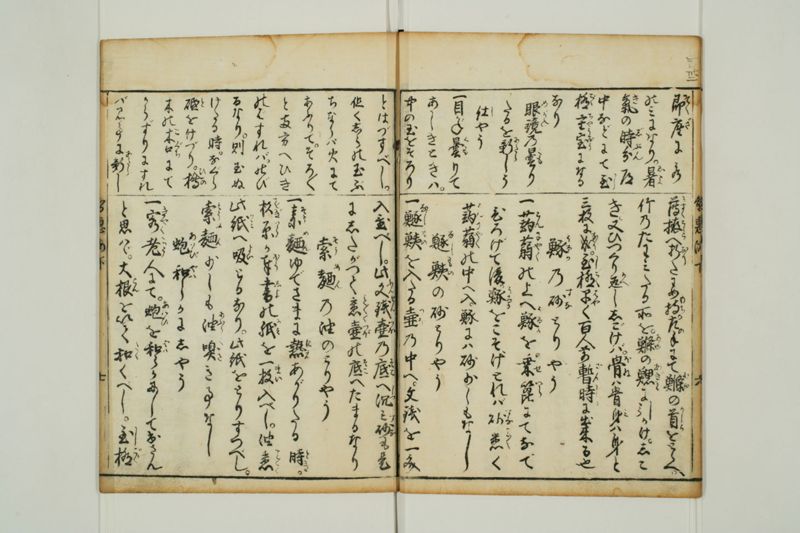
翻刻
【右丁】
【欄外上部】二百卅二
【上段】
即座(そくざ)に水
のみになり。暑(しよ)
気(き)の時分(じぶん)道
中などにて至(し)
極(ごく)重宝(ちやうほう)になる
なり
眼鏡(めがね)の曇(くも)り
たるを新(あたら)しう
仕(し)やう
一目がね曇(くも)りて
あしきときは。
中の玉をそろり
【左丁・上段】
とはづすべし。
但くしらの玉ぶ
ちならば火にて
あふりて。そろ〳〵
と両方へひき
のばすれば。のび
るなり。則玉ぬ
けたる時。なぐら
砥(と)をけづり。檜(ひの)
木の木口(こぐち)にて
からずりにすれ
ば見事に新(あたら)し
【右丁・下段】
薄(うすく)拵(こしら)へ折(おり)たわめ持(もち)。左の手にて鰷(あゆ)の首(かしら)をとらへ。
竹のたわみたる所を。鰷(あゆ)の鰓(あぎと)に引かけ。しこ
き。又ひつくり返(かへ)ししごけば。骨(ほね)は骨 身(み)は身と
三枚に成(なり)。至極(しごく)早(はや)く百人前 暫時(ざんじ)に出来る也
鱁(うるか)の砂(すな)とりやう
一 蒟蒻(こんにやく)の上へ鱁(うるか)を乗(のせ)箆(へら)にてなで
ひろげて後。鱁(うるか)をこそげとれば砂(すな)悉(こと〳〵)く
蒟蒻(こんにやく)の中へ入。鱁には砂少しもなし
鱁鮧(なしもの)の砂とりやう
一 鱁鮧(なしもの)を入たる壺(つほ)の中へ。文銭を一文
入置べし。此 文銭(ふんせん)壺(つほ)の底(そこ)へ沈(しつ)み砂(すな)も是
にしたがつて悉(こと〳〵く)壺(つぼ)の底(そこ)へたまるなり
索麺(そうめん)の油のとりやう
一 素麺(そうめん)ゆでさまに熱(にえ)あがりたる時(とき)。
杦原(すぎはら)か奉書(ほうしよ)の紙(かみ)を一 枚(まい)入べし。油 悉(こと〳〵く)
此 紙(かみ)へ吸(すい)とるなり。此紙をとりすつべし。
索麺(そうめん)少しも油(あふら)嗅(くさ)き事なし
蚫(あはび)和(やは)らかにしやう
一 客(きやく)老(らう)人にて。蚫(あはひ)を和(やは)らかにして出さん
と思はゞ。大 根(こん)を以て扣(たゝ)くべし。至極(しごく)
現代語訳
【右丁・上段】
(前ページからの続き)
すぐに水飲み(の器)になる。暑い時期に道中などで至極重宝なものである。
眼鏡の曇りを新しくする方法
一 眼鏡が曇って具合が悪いときは、中のレンズをそっと外すべし。ただし、鯨のレンズ枠であれば、火であぶって、ゆっくりと両方へ引き伸ばせば、伸びるものである。レンズを外したら、名倉砥(なぐらと)を削り、檜の木口(木の切り口の端面)で空研ぎにすれば、見事に新し(く……)
【左丁・上段】
(……く仕上がる。)
(前ページ下段の続き)
薄く拵えて折りたわめ持ち、左の手で鮎の頭をとらえ、竹のたわんだ所を、鮎の鰓(えら)に引っ掛けてしごき、またひっくり返ししごけば、骨は骨、身は身と三枚になり、至極早く百人前が暫時(しばらく)のうちに出来上がる。
うるかの砂の取り方
一 蒟蒻の上へうるかを乗せ、箆(へら)でなで広げた後、うるかをこそげ取れば、砂はことごとく蒟蒻の中へ入り、うるかには砂が少しもなくなる。
なしものの砂の取り方
一 なしもの(塩辛の一種)を入れた壺の中へ、文銭を一文入れておくべし。この文銭が壺の底へ沈み、砂もこれに従ってことごとく壺の底へたまるようになる。
素麺の油の取り方
一 素麺が茹で上がって熱い時に、杉原紙か奉書紙を一枚入れるべし。油がことごとくこの紙へ吸い取られる。この紙を取り捨てるべし。素麺には少しも油臭い事がなくなる。
鮑を柔らかくする方法
一 客が老人で、鮑を柔らかくして出そうと思うならば、大根で叩くべし。至極(やわらかくなる……)
英語訳
【Right Page, Upper Section】
(Continued from previous page)
...it instantly becomes a drinking vessel. During hot seasons, it is an extremely convenient item to have when traveling.
Method for Restoring Cloudy Eyeglass Lenses to Like-New Condition
- When eyeglass lenses have become cloudy and are in poor condition, carefully remove the lenses from their frames. However, if the frames are made of whalebone, heat them over a flame and slowly stretch both sides outward — they will extend. Once the lenses are removed, shave some nagura whetstone powder and dry-polish [the lenses] using the end-grain of a Japanese cypress (hinoki) block, and they will be restored to a splendidly like-new condition...
【Left Page, Upper Section】
(...like-new condition.)
(Continued from the lower section of the previous page)
...make [the bamboo implement] thin, bend it, and hold it. With your left hand, grasp the head of the ayu (sweetfish), hook the bent part of the bamboo onto the gills of the ayu, and strip it; then flip it over and strip again — and the bones separate from the flesh into three clean fillets. In this way, one hundred servings can be prepared in an extremely short time.
Method for Removing Sand from Uruka (Sweetfish Roe Paste)
- Place the uruka on top of a piece of konnyaku (konjac), spread it out smoothly with a spatula, and then scrape the uruka off. All the sand will have been absorbed into the konnyaku, leaving the uruka completely free of grit.
Method for Removing Sand from Nashimono (Salted Fish Entrails)
- Place one mon coin (bunsен) into the jar containing the nashimono. The coin will sink to the bottom of the jar, and all the sand will follow it and settle at the bottom of the jar.
Method for Removing Oil from Sōmen Noodles
- When the sōmen has just been boiled and is still hot, insert one sheet of sugihara paper or hōsho paper. The paper will absorb all of the oil. Remove and discard this paper. The sōmen will have no oily smell whatsoever.
Method for Tenderizing Abalone
- If your guest is elderly and you wish to serve abalone in a tender form, beat it with daikon radish. It will become extremely [tender...]